Packaging guide
Poly Mailer vs Bubble Mailer: Which to Use in 2026 (Decision Table)
Poly mailer vs bubble mailer compared by product type, weight, fragility and cost, with a decision table for bulk ecommerce buyers.
Updated Oct 21, 2026
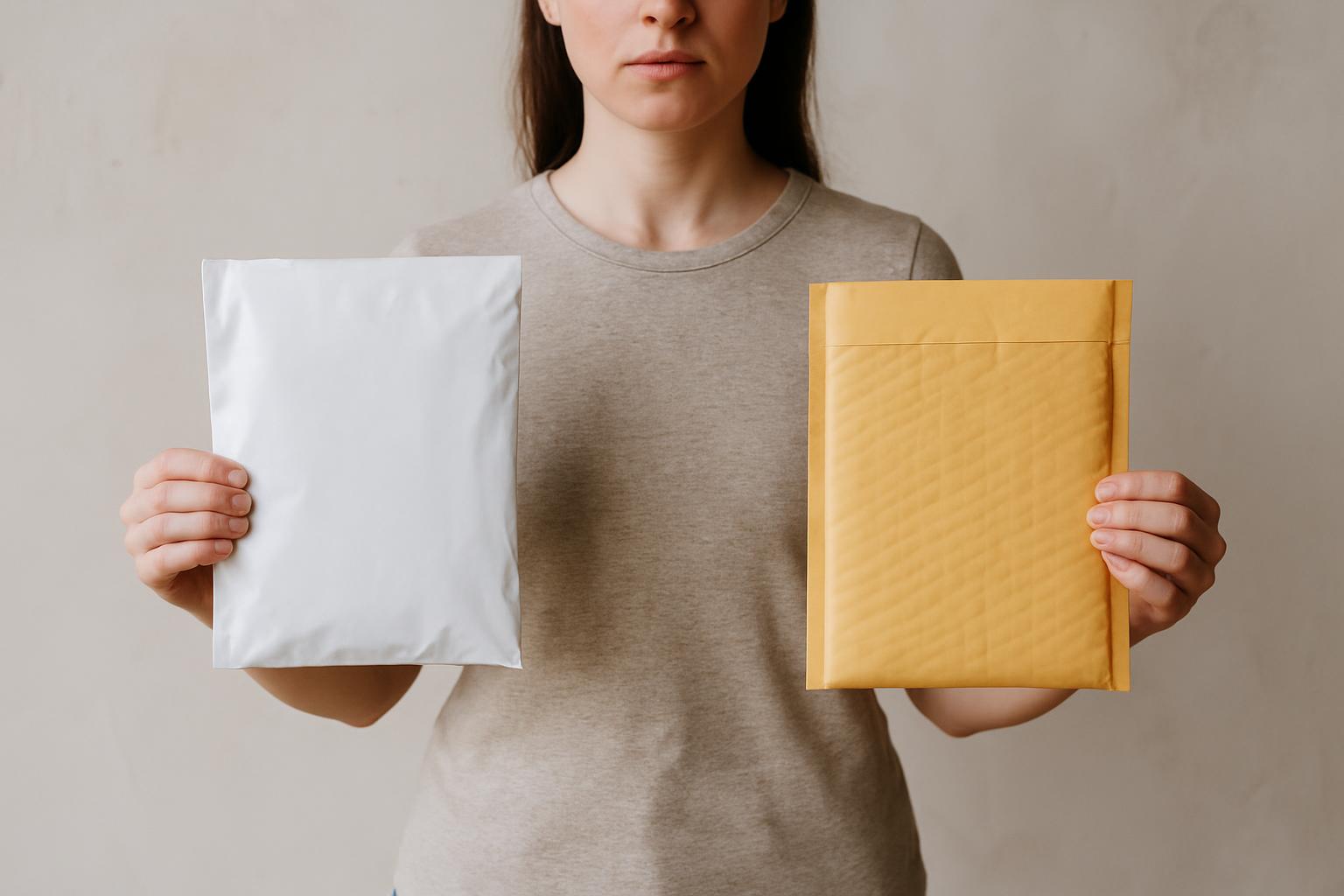
The poly mailer vs bubble mailer decision comes down to one question: does the item need cushioning, or only protection from dirt, water and tearing? Choose a poly mailer for soft goods and you ship at the lowest cost per parcel. Choose a bubble mailer for small items that scratch or knock easily and you add a layer of padding without the bulk of a box. Choose wrongly and you pay twice, either in damage claims or in padding you never needed. This guide gives you a decision table by product type, weight, fragility and cost, plus the checks that matter when you buy by the thousand. It is written for ecommerce brands and retailers worldwide, so measurements are shown in metric and imperial, and local differences are flagged.
In this article
- Key takeaways
- Poly mailer vs bubble mailer: the core difference
- Decision table: which mailer for which product
- Best mailer for shipping clothes and soft goods
- Mailers for fragile items: when padding is enough
- Choosing by weight and size
- Padded vs poly mailers: the real cost comparison
- Sustainability, materials and local rules
- Buying poly and bubble mailers in bulk without guessing
- Conclusion
Key takeaways
- Use poly mailers for clothing, textiles and other soft, non-fragile goods where the main risks are moisture, dirt and tearing.
- Use bubble mailers for small, light, breakable or scratch-prone items such as accessories, cosmetics, cables and paperback books.
- Neither mailer resists crushing. Glass, ceramics, screens and anything heavy or rigid belong in a corrugated box.
- The cheaper mailer is not always the cheaper shipment: judge cost per delivered order, including damage and returns.
- Decide the specification before you order, because bulk orders carry minimums and there is little room for trial and error.
Poly mailer vs bubble mailer: the core difference
Both are flexible, self-seal envelopes that ship light parcels without a box. The difference is what sits between the product and the carrier network.
What a poly mailer does well
A poly mailer is a single or co-extruded plastic film bag with a peel-and-seal strip. It is thin, light, waterproof and tear-resistant, and it collapses to almost nothing in storage. Because it adds almost no weight or volume, it is usually the cheapest way to send a parcel. What it does not do is cushion. Anything hard, sharp or breakable inside is only protected by the film.
What a bubble mailer adds
A bubble mailer has an outer shell, often poly or kraft paper, lined with a layer of air-cell cushioning. That lining absorbs small knocks, scuffs and vibration. It costs more per unit and takes more space on the shelf, but it lets you ship delicate small items without building a box and filling the void. For a deeper look at sizes and quality checks, see our guide to buying bubble mailers in bulk.
Where other mailer types fit
Kraft paper mailers suit brands that want a paper look and are often lined with bubble or paper padding. Recycled and compostable mailers replace virgin film for sellers with sustainability goals. They work like poly mailers in use, so the same decision logic applies. Our comparison of poly mailers vs compostable mailers covers those trade-offs.
Decision table: which mailer for which product
Use this table as a starting point. Weights are typical ranges, not hard limits, and carriers set their own rules.
| Product type | Typical weight | Fragility | Best choice | Why |
|---|---|---|---|---|
| T-shirts, hoodies, knitwear | 150-800 g (5-28 oz) | None | Standard poly mailer | Lowest cost and smallest parcel; only moisture protection needed |
| Folded jeans, jackets | 500 g-1.5 kg (1-3.3 lb) | Low | Thicker poly mailer | Zips and rivets can puncture thin film |
| Socks, scarves, underwear | Under 200 g (7 oz) | None | Small poly mailer | Light and flat; padding adds cost without benefit |
| Jewellery, small accessories | Under 100 g (3.5 oz) | Medium | Bubble mailer, or a mailer box for gifting | Protects from scratches and light impact |
| Cosmetics in plastic tubes or jars | 100-300 g (3.5-10.5 oz) | Low to medium | Bubble mailer | Cushions pressure points and caps |
| Cables, phone accessories | 50-300 g (2-10.5 oz) | Medium | Bubble mailer | Protects connectors and packaging corners |
| Paperback books, media | 200 g-1 kg (7 oz-2.2 lb) | Medium (corners) | Bubble mailer | Corner and edge protection |
| Hardbacks, multiple books, heavy items | Over 1 kg (2.2 lb) | Medium to high | Corrugated box | Mailers sag and burst at the seams under load |
| Glass, ceramics, candles, screens | Any | High | Corrugated box with protective fill | Padding does not stop crushing |
How to read the table
Start with fragility, because it overrides everything else. If the item can break from a crush or a drop onto a corner, go to a box. If it can only scratch or dent, a bubble mailer is usually enough. If it is soft and durable, a poly mailer is the efficient choice. Weight and cost then decide the finer details, such as film thickness.
Three quick rules of thumb
- Soft and light: poly mailer.
- Small, hard and light: bubble mailer.
- Heavy, rigid, glass or high value: box.
Best mailer for shipping clothes and soft goods
For most apparel sellers the answer to "best mailer for shipping clothes" is a well-specified poly mailer. Bubble padding on a sweater is cost you cannot see the benefit of.
Why poly wins for apparel
Clothing does not break. The real threats are rain, puddles, grease on a loading dock and tearing from handling. A sealed poly mailer handles all three. It is also light, so it keeps postage down, and its flat shape fits more units on a pallet or shelf. Many carriers price by volume as well as weight, so a slim parcel can be cheaper to send than a box holding the same garment.
Thickness, opacity and seams
Film thickness is quoted in microns or mils (1 mil is about 25 microns). Thin film is fine for T-shirts, but heavier or structured garments, or anything with metal fittings, need thicker film and strong side seams. Opaque or co-extruded film, often with a dark inner layer, hides the contents and discourages tampering. When you compare quotes, check thickness, seam strength and adhesive quality, not just size. Our guide to what drives bulk poly mailer cost per unit explains how those specifications change pricing.
Returns and reuse
If returns are common in your category, a mailer with a second adhesive strip lets the customer reuse it. That can cut both your packaging spend and your complaints. Our guide on designing packaging for returns covers this in more detail.
Mailers for fragile items: when padding is enough
Searches for mailers for fragile items often assume a bubble mailer makes anything safe. It does not. It makes some things safer, within limits.
What bubble padding protects against
The air-cell lining absorbs light impact, surface abrasion and vibration. That suits items with some inherent toughness: cosmetics in sturdy packaging, accessories in retail boxes, cables, small tools, paperbacks and similar goods. The padding spreads a small point load, but it compresses fully under a large one.
When to move to a box
Move to a corrugated box when the item is glass, ceramic, a candle, a screen, or anything with an exposed corner that could shatter. Also use a box when the product weighs enough to stress the mailer seams, or when parcels will be stacked in sacks and conveyors, where crush forces are real. Inside the box, protective fill such as honeycomb paper wrap gives cushioning and keeps the item from shifting. Compare options in our guide to void fill compared: paper, air pillows, bubble and foam.
Books, electronics and mixed orders
Paperbacks usually travel well in a bubble mailer, but hardbacks and multi-book orders are riskier because corners take the impact. See bubble mailers vs boxes for shipping books. Electronics with screens or batteries need more than a mailer; read our packaging for electronics guide. For mixed orders, pack to the most fragile item, not the average.
Choosing by weight and size
Weight and dimensions affect both protection and shipping price, so they deserve their own check.
Weight guidance
There is no universal weight limit, because film thickness, seam quality and carrier handling vary. As a practical guide, light poly mailers suit parcels up to around 1 kg (2.2 lb) if the contents are soft. Heavier film can take more, but a mailer that bulges or has sharp-cornered contents is a failure risk. Bubble mailers are usually best for items under about 500 g (1.1 lb) because the padding is designed for small goods. When in doubt, drop-test a packed mailer from about 1 m (3 ft) onto a hard floor.
Sizing the mailer to the product
Pick a mailer that fits the folded or boxed item with about 2-3 cm (1 inch) of spare length for the seal and a snug fit. Oversized mailers let items slide, which causes seam stress and, in bubble mailers, uneven padding. Undersized ones strain the adhesive strip and split in transit. Measure the packed product at its thickest point, not its flat dimensions.
Dimensional weight and carrier rules
Many international carriers charge on the greater of actual and dimensional weight, and the formulas, size bands and letter-versus-parcel thresholds differ by country and service. A thin poly mailer often keeps a parcel in a cheaper band, while a thick bubble mailer may tip it into a larger one. Check the current rules for the carriers and destinations you actually use.
Padded vs poly mailers: the real cost comparison
Unit price is the obvious difference, but it is only one input.
Unit price versus cost per delivered order
Poly mailers typically cost less per unit than bubble mailers of a similar size, and they take up less warehouse space. Bubble mailers cost more because of the extra material, but they replace the labour and materials of building a protected parcel in a box. Compare these costs per delivered order:
- Packaging unit cost (mailer plus any extra protection).
- Packing time per parcel.
- Postage, which depends on weight, size band and destination.
- Storage space per thousand units.
The cost of damage and returns
A mailer that is 10 percent cheaper but causes one extra damaged parcel per hundred shipped can cost more overall once you add the replacement item, the shipping and the lost customer. The reverse also applies: paying for padding on a sweatshirt is pure overhead. If damage is a concern, review what to do when a shipment arrives damaged to see how to trace the cause.
Sustainability, materials and local rules
Material choice matters more to many buyers than it did a few years ago, and the rules vary around the world.
Recycled and compostable options
Recycled-content poly mailers keep the same performance as standard film while reducing virgin plastic use. Compostable mailers are made from plant-based or biodegradable polymers and may require industrial composting conditions, which are not available everywhere. Kraft paper mailers use a recyclable outer layer, though padding linings can complicate recycling. Always check which certification a claim refers to and whether the local infrastructure can process it. For clothing-specific guidance see best compostable mailers for clothing.
Regulations differ by country
Rules on plastic film, recycled content, labelling and extended producer responsibility differ between countries and sometimes between regions inside one country. Some markets require recyclability markings or producer registration. Others restrict certain single-use plastics. Check the rules in each market you sell to before you commit to a material, and use our overview of packaging rules a small business needs to know as a starting point.
Buying poly and bubble mailers in bulk without guessing
Bulk buying lowers the cost per unit, but it also means choosing the specification carefully before you order.
Test with what you already have
Pack Merchants does not offer samples, so settle your requirements from specifications and from your own testing. Drop-test your current packaging with real products, note where failures occur, and write down the size, film thickness, seal type and padding you need. Then order the specification that fits, rather than a compromise. If you are changing supplier, our guide on switching packaging suppliers without disrupting shipping helps you plan the changeover.
Plan quantities around the minimums
Orders are placed by the product, with a $500 minimum and 1,000 units per product. That suits regular sellers, but it means choosing sizes with care. Use your sales history to pick the two or three sizes that cover most of your orders, instead of ordering many sizes in small quantities. Our guide to how much packaging you should actually buy shows how to estimate demand.
Payment and freight
Payment is by bank transfer, USDT or BTC. Freight is always quoted separately, so include it when you compare suppliers and when you calculate cost per delivered order. We supply poly mailers, recycled and compostable mailers, bubble mailers, kraft paper mailers, corrugated shipping boxes, ecommerce mailer boxes and protective packaging such as honeycomb paper wrap, so one order can cover both the mailer and the box side of your range.
Conclusion
The right choice in the poly mailer vs bubble mailer question depends on the product. Soft, durable goods suit poly mailers. Small, light items that scratch or dent suit bubble mailers. Heavy, rigid or breakable items belong in boxes. Check weight, size and carrier rules, compare cost per delivered order rather than unit price alone, and confirm material rules in your markets. Settle the specification before ordering, so each bulk order matches the products you ship.
Frequently asked questions
What is the main difference between a poly mailer and a bubble mailer?
A poly mailer is a thin, waterproof plastic bag with no cushioning, while a bubble mailer has an air-cell padded lining. Poly mailers suit soft goods like clothing. Bubble mailers suit small items that need protection from light knocks and scratches.
Are bubble mailers worth the extra cost?
They are worth it when the item can scratch, dent or crack from small impacts, such as accessories, cosmetics or paperbacks. For clothing and other soft items the padding adds cost without improving protection. Compare the cost per delivered order, including damage and returns.
What is the best mailer for shipping clothes?
A poly mailer with suitable film thickness and strong seams is usually best. It keeps garments dry, adds almost no weight and keeps parcels slim. Use thicker film for heavy items or garments with zips and metal fittings.
Can I ship fragile items in a bubble mailer?
Only items that are mildly fragile, such as items in sturdy retail packaging. Bubble mailers do not resist crushing, so glass, ceramics, candles and screens should go in a corrugated box with protective fill.
How much weight can a poly mailer hold?
It depends on film thickness, seam quality and the shape of the contents. As a practical guide, soft items up to about 1 kg (2.2 lb) suit most poly mailers, and heavier films can carry more. Always drop-test a packed mailer before ordering in bulk.
Are padded mailers cheaper to ship than boxes?
Often yes, because they are lighter and slimmer, which can place the parcel in a cheaper size or weight band. Pricing rules differ by carrier and country, so check the current rates for the services you use.
Are recycled or compostable mailers as strong as standard poly mailers?
Many perform similarly for light goods, but strength varies by material and thickness. Compostable options may also need industrial composting to break down, which is not available everywhere. Check certifications and local waste infrastructure.
Does Pack Merchants provide samples of mailers?
No, we do not offer samples. Orders carry a $500 minimum and 1,000 units per product, so it helps to confirm your size, thickness and padding requirements through your own testing before ordering.
Still not sure?
Tell us what you ship and roughly how much of it, and we will recommend a specification and price it.