Packaging guide
Bulk Poly Mailers Price 2026: What Drives Cost Per Unit
Bulk poly mailers price explained: how size, thickness and quantity set cost per unit, how volume tiers work, and how to compare quotes.
Updated Oct 18, 2026
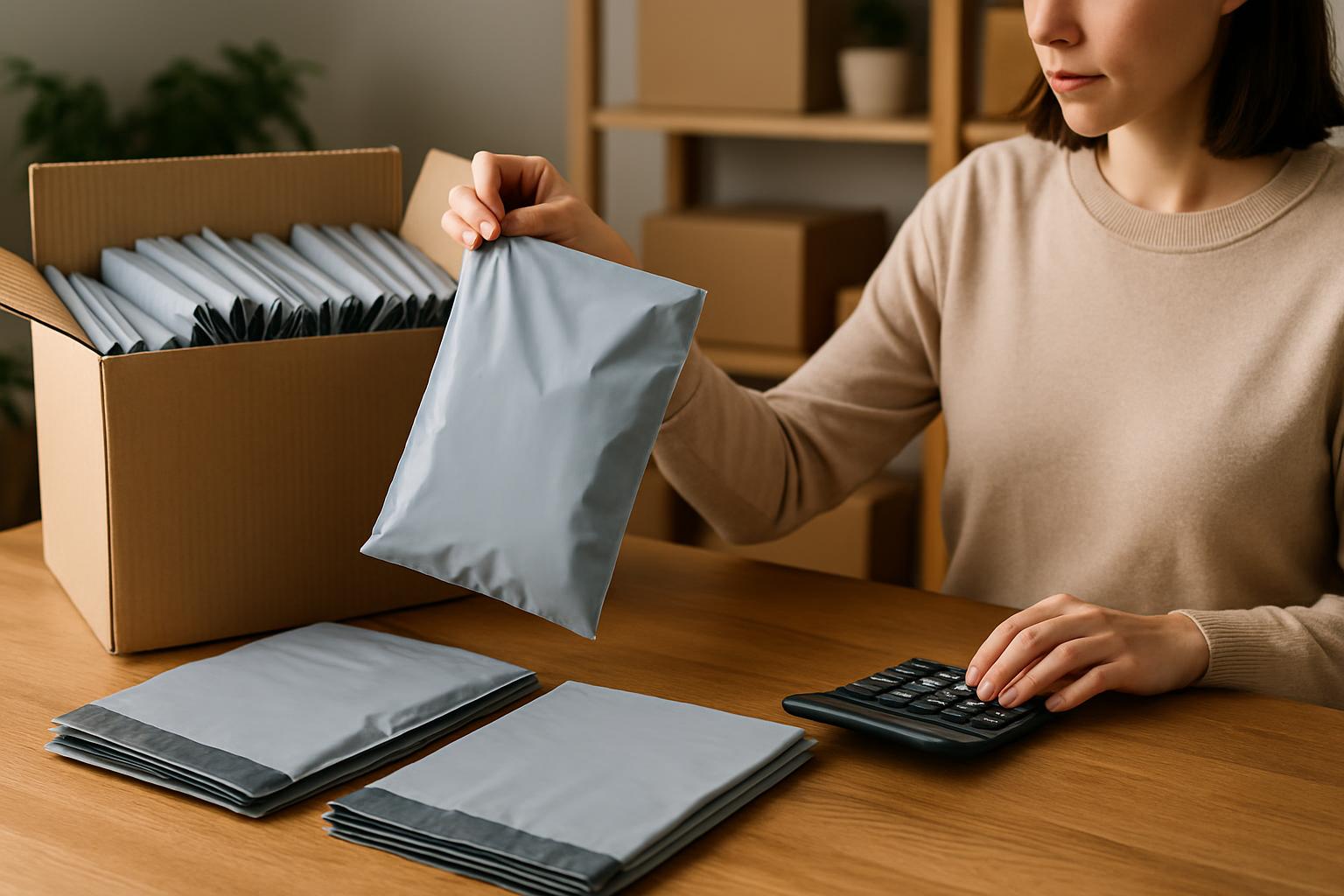
Bulk poly mailers price is not a single number. It is the result of three things you control: the size of the mailer, the thickness of the film, and the quantity you order. Get those three right and you can cut your cost per parcel without increasing damage or returns. Get them wrong and you either overpay for strength you do not need or lose money on torn bags and reships. This guide explains how each factor changes the price, how volume tiers work, and how to compare quotes properly, so you can plan a wholesale order with confidence wherever your business ships from.
In this article
- Key takeaways
- What bulk poly mailers price really means
- How mailer size drives cost
- Thickness, mil and micron: paying for the right strength
- How volume tiers work in wholesale mailer pricing
- Other factors that change the price
- Landed cost: the number that actually matters
- How to compare cheap poly mailers in bulk without being misled
- Conclusion
Key takeaways
- Size is the biggest lever: a mailer with double the surface area uses roughly double the film, so move to the smallest size that fits your product comfortably.
- Thickness is measured in mil or micron (1 mil = 25.4 microns). Each step up adds resin cost, so match the film to the product's weight and sharp edges.
- Unit cost normally falls as quantity rises because setup, packing and handling costs are spread over more units.
- Always compare on landed cost per mailer, which means unit price plus freight, not the headline price per 1,000 alone.
- At Pack Merchants, minimums apply per product ($500 and 1,000 units), and freight is always quoted separately.
What bulk poly mailers price really means
When people search for how much poly mailers cost, they usually want a quick figure. The honest answer is that a poly mailer is a plastic film product, and its price follows the amount of film, the quality of that film, and how many are made in one run. That is why two mailers that look similar can have very different prices.
Price per unit versus poly mailer price per 1000
Wholesale suppliers often quote per 1,000 units because the numbers per single mailer are very small and easy to misread. To convert, divide the price per 1,000 by 1,000. To compare across suppliers, always convert to cost per mailer so you are looking at the same unit. If one quote is per 500, another per 1,000 and a third per carton, convert them all before judging.
Why there is no single honest number
Film prices move with raw material costs, which differ by region and change over time, so any price printed in an article goes out of date quickly. Currency, local taxes, import duties and distance to your warehouse also change what you pay. Rather than quote a figure that may not apply to you, this guide shows you what moves the price so you can read any quote critically. For current published volume pricing on our poly mailers, check the product page or request a quote.
How mailer size drives cost
Size is usually the strongest driver of price, and the one buyers most often get wrong. A mailer is two layers of film plus a seal flap, so cost scales with its area, not just its length.
Film area grows faster than you expect
Compare the flat face area of four common sizes against a 10 x 13 inch (25 x 33 cm) mailer. The ratios below are approximate, since flaps and seams add a little, but they show the trend clearly.
| Mailer size (inches) | Approx. size (cm) | Face area (sq in) | Film vs 10 x 13 |
|---|---|---|---|
| 6 x 9 | 15 x 23 | 54 | About 0.4x |
| 10 x 13 | 25 x 33 | 130 | 1.0x |
| 12 x 15.5 | 30 x 39 | 186 | About 1.4x |
| 14.5 x 19 | 37 x 48 | 275.5 | About 2.1x |
In other words, stepping from a 10 x 13 to a 14.5 x 19 mailer means roughly twice the plastic. Material is not the only cost, but it is the largest part, so expect the unit price to rise in the same direction.
Choosing the smallest size that fits
Measure your products folded or packed, then add a small allowance for the seal and for ease of packing. Oversized mailers cost more to buy, take up more warehouse space, and can raise shipping charges in countries where carriers price by dimensional weight. Many sellers find that one or two sizes cover most of their catalogue. Consolidating to fewer sizes also helps you reach larger quantities per product, which improves your tier pricing.
Thickness, mil and micron: paying for the right strength
Thickness is the second major cost driver. Thicker film means more resin per mailer, so a higher price, but it also means more resistance to punctures and tears.
What the numbers mean
Film thickness is quoted in mil (one thousandth of an inch) in North America and in microns in most other regions. One mil equals 25.4 microns. Some suppliers use gauge, where 100 gauge equals 1 mil, but definitions can vary, so check the unit on every quote.
| Thickness (mil) | Approx. microns | Film vs 2 mil | Typical suitability |
|---|---|---|---|
| 2.0 | 51 | 1.0x | Light, soft goods with no sharp edges |
| 2.5 | 63.5 | 1.25x | General apparel and soft accessories |
| 3.0 | 76 | 1.5x | Heavier items, folded goods, rougher handling |
The suitability column is a general guide, not a guarantee. Product weight, shape and your carrier network all matter.
When thicker film pays off
Choose a heavier film when items have corners, zips, buckles or hard packaging that can push through the plastic, or when parcels travel long distances through many handling points. One reshipped order usually costs more than the saving from thinner film across hundreds of mailers.
When thicker film is wasted money
Folded T-shirts, soft knitwear and lightweight textiles often ship well in a mid-range film. Paying for the thickest option on every item adds cost with no benefit. If a product needs cushioning rather than strength, a comparison of poly and compostable mailers or a padded format such as a bubble mailer may be a better fit than simply adding more film.
How volume tiers work in wholesale mailer pricing
Wholesale mailer pricing is built on tiers: the more you buy of one product in one order, the lower the price per unit. This is how almost all bulk packaging is sold, and understanding it helps you decide how much to order.
Why unit cost falls as quantity rises
Several costs are fixed per production run or per order, not per mailer. Machine setup, film changeovers, quality checks, order handling, documentation and packing labour are all spread across more units as the quantity grows. Buying film and other inputs in larger volumes can also improve a manufacturer's cost. The saving is passed on through tier pricing, though the exact structure differs from supplier to supplier.
Reading a tier table
A tier table lists quantity bands and the price per 1,000 (or per unit) at each band. Look for three things: the starting quantity, the size of each step, and how much the price actually drops between steps. Sometimes a small increase in quantity reaches a lower tier and costs less per mailer than the previous quantity. Work out the total order cost at each tier, not just the unit price, before deciding.
Matching tiers to your real usage
A lower unit price only helps if you use the stock in a reasonable time. Poly mailers store well in dry conditions, but ordering far more than you need ties up cash and warehouse space. Estimate monthly usage, then decide how many months of supply you want on hand. Our guide on how much packaging you should actually buy walks through that calculation.
At Pack Merchants, poly mailers are sold in bulk only, with published volume pricing. A $500 minimum and a 1,000-unit minimum apply to each product, so an order must meet both. If you are unsure what that means for your plans, read what a $500 minimum order actually means.
Other factors that change the price
Size, thickness and quantity explain most of the price, but several other details can move it too. Ask about each one so nothing surprises you on the final quote.
Printing and custom artwork
A plain mailer is the cheapest form. Adding a printed logo or full design introduces plates or artwork setup, extra colours and inspection steps. Custom packaging is quoted per order, because the cost depends on size, number of colours, coverage and quantity. Custom work generally suits larger, repeat volumes where the setup is spread across many units.
Material type and recycled content
Standard virgin polyethylene film, recycled-content film and compostable film are made from different inputs and priced differently. Recycled and compostable mailers can serve brands with sustainability goals, but the rules about what can be recycled or composted differ widely between countries and even between municipalities. Check local requirements before making environmental claims on your packaging.
Features and packing
Self-seal strips, tamper-evident adhesive, tear strips for returns, opacity (co-extruded layers that hide contents) and perforations can all affect the price. So can how the mailers are packed: units per carton, carton size and whether the cartons suit your pallet configuration. Opaque film is often worth it for privacy, since it prevents theft and keeps contents discreet.
Landed cost: the number that actually matters
A cheap unit price can disappear once shipping and handling are added. Landed cost is the full cost of getting the mailers to your door, divided by the number of mailers. This is the only fair way to compare suppliers.
Adding freight to the unit price
Use this simple formula: landed cost per mailer = (product total + freight + any duties or taxes) / number of mailers. At Pack Merchants, freight is always quoted separately per order, since it depends on volume, weight, destination and shipping method. Poly mailers are light and compress well, which tends to keep freight per unit low compared with rigid packaging, but check the quote rather than assume. If you are shipping on pallets, how to cut pallet freight costs has practical ways to lower the per-unit freight share.
Minimum order rules and payment
Before you plan, confirm the supplier's minimums and payment terms. Our orders require $500 and 1,000 units per product, and payment is by bank transfer, USDT or BTC. We do not offer samples, so decide your size and thickness from the dimensions and specifications, and measure your own packed products against the mailer's stated internal size. If you are importing, remember that duties, VAT or GST, and customs handling vary by country and may apply on top of the quote.
How to compare cheap poly mailers in bulk without being misled
The lowest headline price is rarely the lowest real cost. A careful comparison protects you from thin film, mismatched sizes and hidden extras.
A like-for-like checklist
Ask each supplier for the same information, then line up the answers side by side.
- Exact internal dimensions, including whether the flap is included in the stated length.
- Film thickness in mil or microns, and whether it is a minimum or an average.
- Material type: virgin, recycled-content or compostable.
- Opacity and colour, plus any printing or custom work.
- Quantity per carton and total quantity in the quote.
- Price per 1,000 and the tier thresholds above and below your quantity.
- Freight, duties and payment terms, so you can calculate landed cost.
Red flags in quotes
Be careful when a quote gives no thickness, mixes units without explanation, or lists a size that looks too small for the stated dimensions. A very low price on a poly mailer may reflect thinner film, so the savings can vanish if mailers split in transit. If a shipment does reach customers damaged, this guide on what to do can help you handle the claim, but prevention through the right spec is always cheaper.
It also helps to think beyond the mailer itself. Pack Merchants supplies poly mailers alongside recycled and compostable mailers, bubble mailers, kraft paper mailers, corrugated shipping boxes, ecommerce mailer boxes, honeycomb paper wrap, packing tape, labels, stretch film and trash bags, so you can consolidate orders and keep each product above its minimum.
Conclusion
Bulk poly mailers price comes down to size, thickness and quantity. Size sets how much film you buy, thickness sets how much strength you pay for, and quantity sets how far fixed costs are spread. Volume tiers lower the unit price as orders grow, but only landed cost, including freight, tells you the true figure. Measure your products, choose the smallest size and the right thickness, calculate landed cost per mailer, and compare quotes like for like.
Frequently asked questions
How much do poly mailers cost in bulk?
It depends on size, film thickness, material type and quantity, and prices change with raw material costs and your location. Instead of relying on a generic figure, request a quote for your exact specification and convert it to a cost per mailer. Remember to add freight and any import taxes for the landed cost.
What is a typical poly mailer price per 1000?
There is no universal price per 1,000 because a small thin mailer and a large thick one can differ by a wide margin. Larger sizes use more film, and thicker film uses more resin. Compare prices per 1,000 only between mailers with the same size, thickness and material.
Does a thicker poly mailer always cost more?
Yes, in general, because more resin is used per mailer. The extra cost is justified for heavier items, items with sharp edges or long, rough shipping routes. For light, soft goods, a thinner film is usually enough and saves money.
How do volume tiers work for poly mailers?
Volume tiers lower the price per unit as the order quantity increases, because setup, handling and packing costs are spread across more units. Check the quantity bands and compare the total order cost at each tier. Only order a larger quantity if you will use it within a reasonable time.
What is the minimum order for bulk poly mailers at Pack Merchants?
Pack Merchants requires a $500 minimum and 1,000 units per product. Both apply to each product line. We sell in bulk only and quote freight separately for each order.
Does Pack Merchants offer samples of poly mailers?
No, we do not offer samples. To choose the right mailer, measure your packed product, compare it to the stated internal dimensions, and pick a thickness based on the product's weight and shape.
How do I convert mil to microns for poly mailers?
Multiply the mil value by 25.4 to get microns. For example, 2.5 mil is about 63.5 microns and 3 mil is about 76 microns. Always confirm which unit a supplier is using, since gauge definitions can vary.
What payment methods are accepted for bulk orders?
Pack Merchants accepts payment by bank transfer, USDT or BTC. Freight and any custom packaging are quoted separately per order. Import duties and taxes depend on your country and are not included in product pricing.
Still not sure?
Tell us what you ship and roughly how much of it, and we will recommend a specification and price it.