Packaging guide
Best Compostable Mailers for Clothing 2026: Materials, Strength and Certifications
Best compostable mailers for clothing: compare materials, strength, shelf life and certifications before you buy in bulk for apparel.
Updated Oct 20, 2026
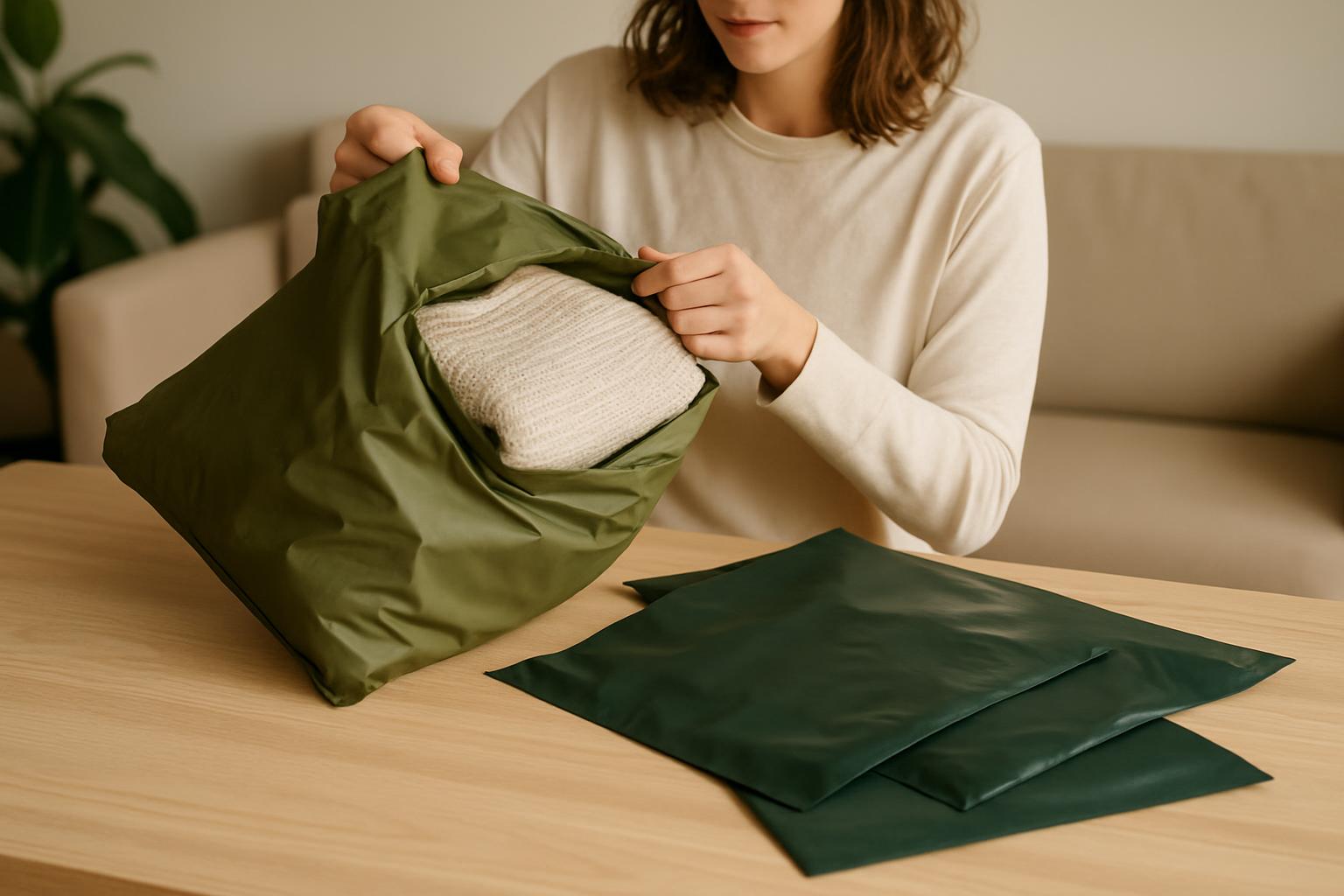
Finding the best compostable mailers for clothing comes down to four questions: what the film is made from, how well it resists a zip, hanger or rivet rubbing against it, whether its certificate matches how your customers can actually dispose of it, and how long it will sit in your warehouse before it is used. Compostable mailers are not ordinary poly mailers with a green label. They behave differently in heat, humidity and storage, and the rules around environmental claims vary by country. This guide compares materials, strength, shelf life and certifications specifically for apparel shipping, so you can write a clear specification before placing a bulk order.
In this article
- Key takeaways
- What 'compostable' really means for a clothing mailer
- Compostable mailer materials compared for apparel
- How strong does a clothing mailer need to be?
- Certifications that matter for compostable shipping bags
- Shelf life and storage of compostable mailers
- Choosing the best compostable mailers for clothing by garment type
- Buying compostable mailers in bulk without samples
- Making honest end-of-life claims to customers
- Conclusion
Key takeaways
- Most compostable poly mailers are blends of PBAT (a flexible compostable polymer) with PLA and starch; paper-based options trade flexibility for a more familiar recycling route.
- Clothing is light, so tear and puncture risk is usually modest, but seal strength and moisture protection matter more than raw film thickness.
- A certificate to EN 13432, ASTM D6400 or an equivalent standard proves industrial compostability; 'home compostable' needs a separate certificate such as TÜV OK compost HOME or AS 5810.
- Compostable films age. Plan stock rotation, keep cartons cool and dry, and do not over-buy.
- Terms like 'biodegradable' without a standard behind them are weak claims and increasingly restricted in several regions.
- Industrial composting is not available everywhere, so tell customers honestly how to dispose of the mailer in their area.
What 'compostable' really means for a clothing mailer
A compostable mailer is designed to break down into water, carbon dioxide and biomass under defined composting conditions, within a set time, leaving no toxic residue. The key words are 'defined conditions'. A mailer that passes a test in a 58 °C (136 °F) industrial composting facility may not break down in a backyard heap or in landfill.
The materials behind compostable poly mailers
Most film-style compostable mailers use a blend of three ingredients. PBAT is a fossil-derived but certified-compostable polymer that gives stretch and tear resistance. PLA is made from plant sugars and adds stiffness. Starch, often from corn or cassava, lowers cost and adds some softness. The ratio changes how the bag feels, how it seals and how long it lasts on a shelf. Some films also use bio-based PBAT or PBS, which changes the origin of the carbon but not the composting behaviour.
Compostable, biodegradable and oxo-degradable are not the same
'Biodegradable' simply means a material can be broken down by microorganisms eventually, with no time limit or conditions, so it is a weak claim on its own. 'Oxo-degradable' plastics fragment into microplastics and are restricted or banned in the EU and some other jurisdictions. If you are comparing biodegradable mailers for clothing, treat any product without a named compostability standard as unproven. Look for certification, not adjectives.
Compostable mailer materials compared for apparel
The table below summarises how the main options behave when shipping garments. Properties vary by supplier and film thickness, so use it as a guide for what to ask for rather than a guarantee.
| Material | Feel and look | Strength for clothing | Moisture protection | Typical end-of-life route |
|---|---|---|---|---|
| PBAT/PLA/starch film | Soft, slightly matte, plastic-like | Good tear and puncture resistance at 40-60 microns | Good barrier, though lower than polyethylene | Industrial composting; some certified for home composting |
| Paper-lined compostable film | Kraft exterior, film interior | Rigid, good for structured items | Good if the liner is intact; edges can wick | Depends on liner certification |
| Padded paper mailer | Kraft paper with paper cushioning | Good for rigid or fragile accessories | Weaker when wet | Paper recycling where accepted |
| Recycled-content polyethylene | Smooth, opaque, familiar | Very high tear strength | Excellent | Film recycling where collected; otherwise landfill |
Starch-PBAT-PLA blends
For most apparel brands, this is the practical answer when people search for compostable poly mailers. The film stays flexible in a courier network, accepts printing, and offers adequate water resistance for parcels that sit in vans and doorways. Expect slightly lower stretch recovery than polyethylene and a higher price per unit.
Paper-based and paper-lined options
Kraft paper mailers suit premium positioning and are easy for customers to understand. They are less forgiving in wet conditions, and a thin plastic liner can compromise recyclability unless it is certified compostable. If you are weighing this route, our guide on poly mailers versus compostable mailers covers the trade-offs in more depth.
Where recycled poly fits in
Recycled-content poly mailers are not compostable, but they are stronger and cheaper, and where store drop-off or kerbside film recycling exists they can be the lower-impact choice. Many brands run both: compostable for markets with composting infrastructure and recycled poly elsewhere.
How strong does a clothing mailer need to be?
Clothing is one of the easier categories to protect. Garments are soft, light and rarely fragile, so you do not need heavy-duty film. What fails in practice is usually the seal, a sharp accessory or water getting in.
Thickness and puncture resistance
Compostable mailers for apparel typically range from about 40 to 60 microns (roughly 1.6 to 2.4 mil). Thicker film is not automatically better, because some compostable blends become stiffer and more prone to cracking at the fold or in the cold. For t-shirts, knitwear and leggings, the middle of that range is generally adequate. For items with metal zips, studs, buckles or hard hangers, specify the upper end and fold the garment so hardware faces inward, away from the bag wall.
Seal strength and adhesive strips
The adhesive strip is the most common failure point. Compostable films have different surface energy to polyethylene, so a strip that works on poly may peel in cold stores or humid climates. Ask what adhesive is used and whether it was tested on the specific film. Check that seams are heat-sealed evenly with no thin spots, and that the strip has a clean release liner.
Moisture, rain and humidity
Are compostable mailers waterproof? Film-based ones are water-resistant for normal transit, but they are not designed for prolonged submersion, and paper-based ones take on water at the edges. If your customers are in rainy or tropical regions, or you ship light-coloured garments, consider whether an inner tissue wrap or a certified-compostable inner bag is worth the extra step. Seams and the closure are where moisture gets in.
Certifications that matter for compostable shipping bags
A certificate is the only reliable evidence that a mailer is compostable. It tests disintegration, biodegradation rate, ecotoxicity and heavy-metal content on the actual product formulation.
Industrial versus home composting
Industrial certification assumes controlled temperature, moisture and turning. Home composting runs cooler and less consistently, so the standard is stricter on timing and the film must be more readily degradable. Many mailers are industrial-only, and that is acceptable as long as you say so. A product marked home compostable should carry its own certificate, not just an industrial one.
Standards by region
| Standard or mark | Region | Covers |
|---|---|---|
| EN 13432 | Europe and widely referenced elsewhere | Industrial compostability of packaging |
| ASTM D6400 | United States and Canada reference | Industrial compostability of plastics |
| BPI certification | North America | Third-party certification against ASTM D6400 |
| ISO 17088 | International | Specification for compostable plastics |
| AS 4736 / AS 5810 | Australia | Industrial and home composting respectively |
| TÜV OK compost INDUSTRIAL / HOME | International mark | Industrial and home compostability |
How to check a certificate is real
Ask for the certificate number and the certified product name, then check it in the certifier's public database where one exists. Confirm that the certificate covers the film, ink and adhesive, not only the base resin. A resin certificate does not automatically make a finished printed mailer compliant. Also confirm the certificate is current, as they expire and need renewal.
Shelf life and storage of compostable mailers
Shelf life is the issue most guides skip, and it is where compostable films differ most from standard poly. Suppliers commonly quote a window of around six to twelve months, though this varies by formulation and should be confirmed for the product you are buying.
Why these films age
Compostable polymers are designed to be broken down by moisture, heat and microorganisms. In a hot, humid warehouse that process can start slowly during storage, leading to brittle film, weaker seals and adhesive strips that no longer grip. The result is split bags in transit and complaints that look like a shipping problem but began on the shelf.
Warehouse storage rules
- Store cartons off the floor, away from external walls, roof spaces and direct sunlight.
- Aim for cool, dry conditions; avoid shipping containers or sheds that swing to high temperatures.
- Use first-in, first-out and date-mark cartons when they arrive.
- Keep cartons sealed until needed and reseal part-used cartons.
- Buy a quantity you will use within the product's stated shelf life, not the biggest tier available. Our guide on how much packaging to buy helps you calculate it.
This is one reason a high-volume apparel brand with fast stock turnover is a better fit for compostable mailers than a seasonal seller who orders once a year.
Choosing the best compostable mailers for clothing by garment type
The right choice depends on what you ship, where you ship it and how your customers can dispose of the packaging.
Matching size to product
An oversized mailer wastes material and invites movement; a tight one stresses the seal. A rough guide for folded garments:
- T-shirts, vests and underwear: about 25 x 35 cm (10 x 14 in).
- Hoodies, jeans and knitwear: about 35 x 45 cm (14 x 18 in), sometimes larger for heavy fabric.
- Multi-item orders and coats: 40 x 55 cm (16 x 22 in) or above, or a box if the bundle is bulky.
- Accessories such as scarves and socks: 20 x 30 cm (8 x 12 in).
Measure your actual folded products, add 2 to 4 cm (about 1 in) for the seal, and choose sizes accordingly. For padded items like small accessories with hard parts, see our bubble mailer buying guide.
When a compostable mailer is the wrong choice
Compostable mailers are a poor fit for very heavy bundles, items with sharp hardware, long-haul shipments in extreme heat, or markets with no composting access, where a recycled poly or a cardboard option may be more honest. Returns are another consideration: reusable mailers with a second adhesive strip are better for exchange-heavy fashion, as covered in our guide to packaging for returns.
Buying compostable mailers in bulk without samples
Pack Merchants supplies poly mailers, recycled and compostable mailers, bubble mailers and kraft paper mailers in bulk only. We do not offer samples, so your decision rests on specification and certification rather than a trial pack. That makes a precise brief more important.
What to put in your specification
- Garment dimensions folded, and the largest item you ship in each size.
- Film thickness range and the blend, with the intended disposal route (industrial or home composting).
- The certification you require, such as EN 13432 or ASTM D6400, and confirmation of what documentation applies to the exact product being quoted.
- Adhesive strip type and any need for a second strip for returns.
- Printing requirements, and whether inks are covered by the certificate.
- Storage conditions at your warehouse and how many months of stock you will hold.
Confirm all of this before you order, because the minimum is 1,000 units per product and at least $500, which is a meaningful commitment. Our article on what a $500 minimum order actually means explains how that works in practice.
Costs, payment and freight
Volume pricing is published, and payment is by bank transfer, USDT or BTC. Freight is always quoted separately and depends on destination, weight and volume, so budget for it when comparing landed cost per mailer. Compostable mailers cost more per unit than standard poly, so compare against what drives poly mailer cost per unit to see the real premium for your sizes and volumes.
Making honest end-of-life claims to customers
Packaging claims are under growing scrutiny. The United States has its Green Guides, the European Union is tightening rules on generic environmental claims, and other countries have their own consumer protection laws. Check the rules in each market you sell to, and see our overview of packaging rules a small business needs to know.
Wording that holds up
- Name the standard: 'Certified industrially compostable to EN 13432' is verifiable; 'eco friendly mailer' alone is not.
- State the condition: 'Compost in an industrial facility where accepted' is clear and honest.
- Do not imply home compostability unless the product has a home certificate.
- Avoid 'biodegradable' and 'plastic-free' unless they are demonstrably true.
Disposal reality by country
Industrial composting that accepts packaging is common in parts of Europe, some US states and Australian councils, but absent or limited in many other regions. Where it is unavailable, a compostable mailer may end up in general waste, so say so on a care card and point customers to the best local option. Being straightforward builds more trust than a bold claim that cannot be verified.
Conclusion
The best compostable mailers for clothing are the ones whose material, strength, certification and shelf life match your products, your markets and your warehouse. Blends of PBAT, PLA and starch suit most apparel, paper options suit structured items, and recycled poly remains a valid alternative where composting is not available. Verify certificates, specify seal and adhesive performance, store stock carefully, buy only what you will use in time, and describe disposal honestly so customers know what to do.
Frequently asked questions
What are the best compostable mailers for clothing?
For most apparel brands, a certified blend of PBAT, PLA and starch film at about 40 to 60 microns offers the best balance of flexibility, tear resistance and water resistance. Paper-based mailers suit structured or premium items. The best choice depends on your garment hardware, climate and local composting access.
Are compostable mailers waterproof?
Film-based compostable mailers are water-resistant for normal transit but not designed for long exposure or submersion. Paper-based versions absorb water more readily at the edges and seams. For wet climates or light-coloured garments, consider an inner wrap.
How long do compostable mailers last in storage?
Suppliers commonly quote around six to twelve months, but this varies by formulation, so confirm it for the specific product. Heat and humidity shorten usable life by weakening film and adhesive. Store cartons cool, dry and away from sunlight, and use oldest stock first.
Can compostable mailers go in a home compost bin?
Only if the mailer has a home compostability certificate such as TÜV OK compost HOME or AS 5810. Many are certified for industrial composting only, which needs higher, controlled temperatures. Always check the exact certification before telling customers they can compost at home.
What certifications should I look for on compostable shipping bags?
Look for EN 13432, ASTM D6400 or ISO 17088 for industrial compostability, plus a third-party mark such as BPI or TÜV OK compost. In Australia, AS 4736 and AS 5810 apply. Ask for the certificate number and confirm it covers the finished product including ink and adhesive.
Are biodegradable mailers the same as compostable mailers?
No. Biodegradable has no required time frame or conditions, so it is a weak claim. Compostable means the product meets a standard for breakdown, time and safety under defined conditions. Oxo-degradable plastics are different again and are restricted in the EU and some other regions.
Are compostable mailers strong enough for jeans and hoodies?
Generally yes, if you choose a suitable size and a thickness in the upper part of the 40 to 60 micron range. The main risks are weak adhesive strips and hardware poking through the film. Fold garments with zips and studs facing inward and leave room for a clean seal.
Do compostable mailers cost more than poly mailers?
Usually yes, because the raw materials and certification cost more. The premium depends on size, thickness, print and order volume. Freight is a separate cost, so compare landed cost per unit rather than ex-works price alone.
Still not sure?
Tell us what you ship and roughly how much of it, and we will recommend a specification and price it.