Packaging guide
Buy Bubble Mailers in Bulk: Sizes, Quality Checks and Supplier Comparison for 2026
How to buy bubble mailers in bulk: pick the right size, check quality without samples, understand minimums and compare wholesale suppliers fairly.
Updated Oct 19, 2026
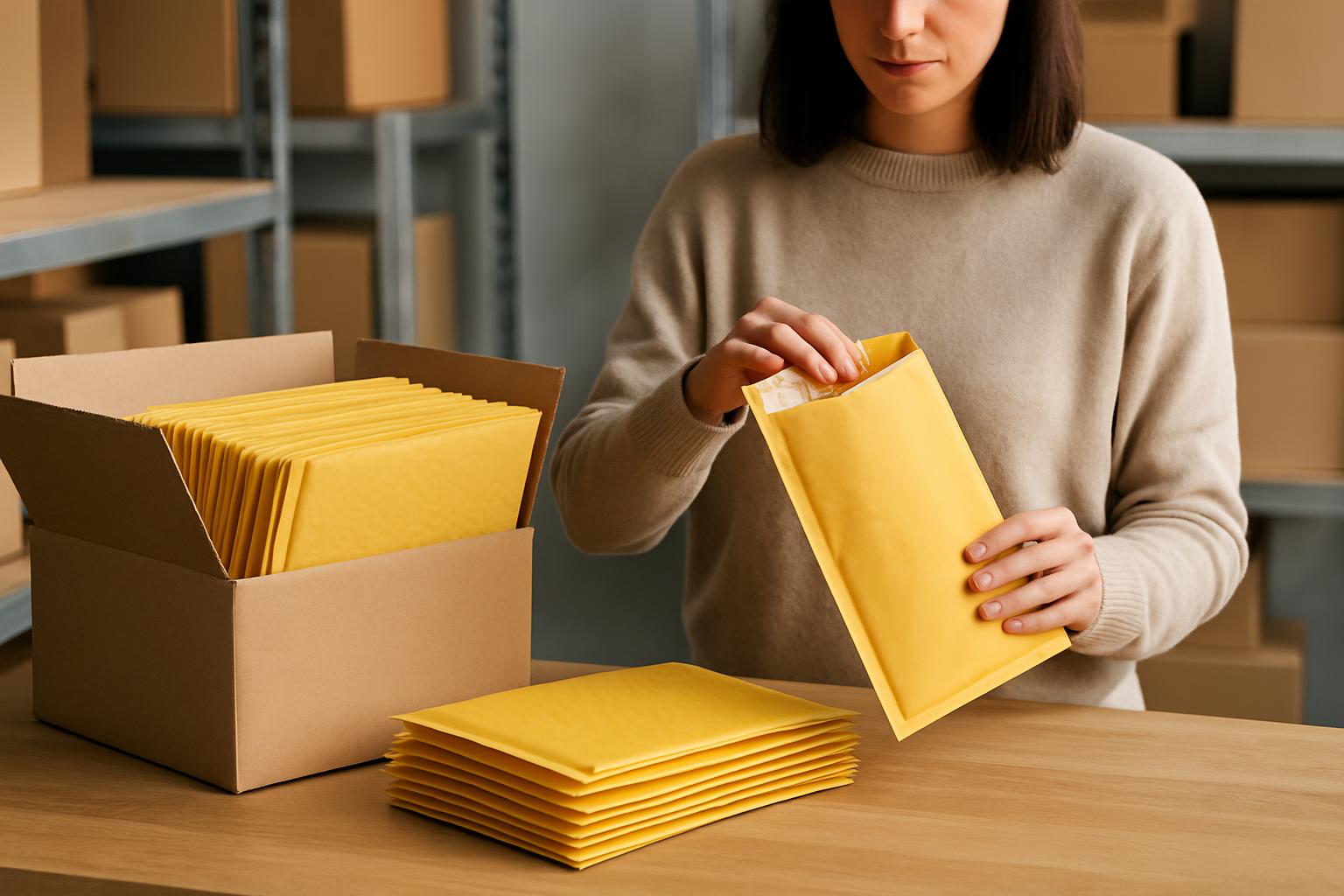
If you want to buy bubble mailers in bulk, the hard part is rarely finding a supplier. It is choosing the right size, film and cushioning before you commit to thousands of units that you cannot easily swap out. A wrong size can mean wasted stock, higher postage or damaged parcels. This guide answers the questions ecommerce sellers keep asking on forums: which sizes to pick, how to check quality when you cannot rely on a sample, what minimums to expect, and how to compare wholesale suppliers fairly. It is written for buyers in any country, so sizes are given in millimetres and inches, and we point out where numbering systems, duties and carrier rules differ by region.
In this article
- Key takeaways
- What it really means to buy bubble mailers in bulk
- Bubble mailer sizes: how to choose the right one
- Quality checks that matter before you place a large order
- Padded mailers in bulk: choosing the right style
- How to compare wholesale bubble mailer suppliers
- How many bubble mailers should you order?
- Rolling out a new bulk order without disrupting shipping
- Conclusion
Key takeaways
- Measure your packed product first, then add roughly 1 to 2 cm (about half an inch) of room for the seal and cushioning, and choose the smallest mailer that fits comfortably.
- Bubble mailer size numbers such as #0 to #7 are a convention, not a global standard, so always compare actual dimensions in mm or inches.
- Quality comes down to seal strength, bubble layer integrity, film thickness and consistency from the first unit to the last.
- Compare suppliers on landed cost per unit, including freight and any import taxes, not on the headline unit price alone.
- At Pack Merchants, orders carry a $500 minimum and 1,000 units per product, we do not offer samples, and freight is quoted separately, so get your sizing right on paper before ordering.
What it really means to buy bubble mailers in bulk
Buying wholesale is different from topping up a box of 25 at a retail shop. Prices are set by volume, the stock ships on pallets or in master cartons, and the decision is harder to reverse. Understanding the basic mechanics helps you plan the purchase before you start asking for quotes.
What counts as bulk
There is no universal threshold. Some suppliers sell by the carton of a few hundred, others only by the pallet. For bulk bubble mailers, think in thousands per size. A seller shipping 200 parcels a week will go through 1,000 mailers in about five weeks, which is why wholesale volume suits growing ecommerce brands, retailers and fulfilment teams better than casual sellers.
Minimums per product, not per order
Check whether a minimum applies to the whole order or to each product line. At Pack Merchants, the minimum is $500 and 1,000 units per product, so if you want three sizes of bubble mailer, each size must meet that minimum. Our guide on what a $500 minimum order actually means explains how this works in practice and how to plan around it.
Freight, duties and payment
Bubble mailers are light but bulky because they are mostly air, so freight can be a large share of the total cost. At Pack Merchants freight is always quoted separately, per order. If you import, also check local duties, VAT or sales tax and customs paperwork, which differ widely between countries. We take payment by bank transfer, USDT or BTC, so make sure your finance process can support one of those before you request a quote.
Bubble mailer sizes: how to choose the right one
Sizing is the single biggest source of regret in bulk packaging purchases. A mailer that is too tight splits seams and crushes contents. One that is too large wastes material, lets items slide around and may push you into a higher postage band.
Measure the packed product, not the product alone
Measure the item as it will actually be packed: folded, in its retail box or inner bag, with any insert card. Record length, width and thickness. Then work out the minimum mailer size using these steps:
- Take the length of the packed item and add 2 to 4 cm (about 1 to 1.5 in) to allow for the seal area and a little cushioning.
- Take the width and add 1 to 2 cm (about half an inch) of clearance, more if the item is rigid.
- Check the thickness. A thick item bulges the mailer and reduces the usable width, so size up if it is over about 2.5 cm (1 in).
- Choose the smallest mailer that meets those numbers and test the fit with several items, not one.
Outer size versus usable space
Listed dimensions are usually the outer size of the mailer, and the usable interior is smaller because of the side seams and the flap. Always ask whether a supplier's dimensions are outer or inner, and whether the flap is included in the length. Two suppliers can list the same size and deliver different usable space.
Numbering systems differ by region
Many sellers use a numbered scale from #000 to #7, which is common in North America. Elsewhere, suppliers may list only dimensions, or use letter codes. The table below shows commonly used nominal sizes. These are approximate, and manufacturers vary, so treat them as a starting point rather than a specification.
| Common size | Approx. outer size (inches) | Approx. outer size (mm) | Typical use |
|---|---|---|---|
| #000 | 4 x 8 | 100 x 200 | Jewellery, small accessories |
| #0 | 6 x 10 | 150 x 250 | Cosmetics, phone accessories, small items |
| #1 | 7.25 x 12 | 180 x 300 | Small paperbacks, boxed small goods |
| #2 | 8.5 x 12 | 215 x 300 | Larger paperbacks, slim boxed items |
| #4 | 9.5 x 14.5 | 240 x 365 | Folded lightweight clothing, flat goods |
| #6 | 12.5 x 19 | 320 x 480 | Bulkier garments, larger flat items |
Before ordering a full 1,000 units of any size, confirm exact dimensions in writing and compare them with your own measurements.
Quality checks that matter before you place a large order
Because we do not offer samples, and many wholesale suppliers do not either, you need other ways to judge quality. The checks below help you reduce risk, whichever supplier you use.
Seal strength and adhesive
The self-seal strip is the most common failure point. Ask what type of adhesive is used, whether it is covered by a release liner, and how it performs in cold, heat and humidity. If you ship to or from climates with extreme temperatures, raise this explicitly. Weak adhesive leads to opened parcels, lost goods and returns. When your first delivery arrives, seal ten mailers, leave them for a day, then try to peel them open. A good seal tears the film instead of releasing cleanly.
Film, bubble layer and puncture resistance
Ask for the outer film material and thickness, usually quoted in microns or mil, and the bubble layer description. Check that the bubbles are evenly formed and fully attached to the outer layer. Press a corner firmly and look for flat, popped or uneven areas. Corners and edges take the most knocks in transit, so inspect those. For sharp-cornered products, consider thicker film or a different format.
Consistency across the run
A single good unit proves little. Pull mailers from several cartons across the delivery and check for the same dimensions, seal quality and film feel. Measure at least ten units with a ruler and record the variation. Small deviations are normal, but large swings suggest weak quality control, which matters when packing is partly automated or sized tightly. Document any problems with photos immediately, and see our guide on what to do when a shipment arrives damaged for the steps to take.
Padded mailers in bulk: choosing the right style
When people search for padded mailers in bulk, they usually mean one of a few formats. Knowing the differences helps you buy the right type for your product mix and your sustainability goals.
Poly-outer bubble mailers
These have a smooth plastic outer layer, a bubble lining and a self-seal flap. They are lightweight, water resistant and suit printed labels well. They work well for ecommerce brands shipping apparel accessories, cosmetics, cables, small electronics accessories and similar items. The smooth surface also takes shipping labels cleanly. If you are unsure whether a plastic mailer suits your brand, our comparison of poly mailers vs compostable mailers covers the trade-offs.
Paper-based and kraft options
Kraft-style padded mailers use a paper outer. Some buyers prefer them for appearance or because paper is easier to recycle in their market. Recycling rules differ between countries and even between municipalities, so do not assume that any mailer is accepted by local collection. Ask the supplier for material composition and check your local guidance before making environmental claims to customers. Paper options can be less water resistant than poly, so consider your delivery climate.
When a mailer is the wrong choice
A bubble mailer protects against light impact, scuffs and moisture. It does not protect against crushing. Fragile, rigid or high-value items such as glassware, ceramics or boxed electronics usually need a corrugated box with proper void fill. For books, the decision is less obvious, and our guide to bubble mailers vs boxes for shipping books shows where each format makes sense.
How to compare wholesale bubble mailer suppliers
Comparing quotes is harder than it looks, because suppliers describe products differently. A fair comparison needs the same specification, the same quantity and the same delivery terms on every quote.
Compare landed cost per unit
Use this formula for each quote: (unit price multiplied by quantity, plus freight, plus duties and taxes, plus any handling or payment fees) divided by quantity. This gives landed cost per unit. A supplier with a low unit price and expensive freight can end up costing more than one with a slightly higher unit price and cheaper shipping. Freight is quoted separately at Pack Merchants, so ask for it at the same time as the product price. For a deeper look at how price is built, see what drives cost per unit in bulk poly mailers.
| What to compare | What to ask | Why it matters |
|---|---|---|
| Dimensions | Outer or inner size, flap included or not | Determines real fit and postage band |
| Material | Outer film type, thickness, bubble layer | Drives protection and durability |
| Seal | Adhesive type and release liner | Prevents opened parcels |
| Minimums | Per product or per order | Affects how many sizes you can buy |
| Pricing | Published volume tiers | Shows cost at different quantities |
| Freight | Included or quoted separately | Changes landed cost significantly |
| Payment | Accepted methods | Must fit your finance process |
Get specifications in writing
A verbal promise is not a specification. Ask for a written product description with dimensions, material, thickness and pack count per carton. Keep it on file so you can compare it against what arrives. If the delivered product differs from the written spec, you have something concrete to point to.
Check terms, payment and communication
Look at how clearly the supplier answers questions. Slow or vague replies before payment rarely improve afterwards. Confirm payment methods, quoted validity periods and what documents you will receive. Be cautious of any supplier that cannot tell you minimums or freight terms plainly.
How many bubble mailers should you order?
Ordering too few means frequent reorders and repeated freight costs. Ordering too many ties up cash and storage space. The right number comes from your own data.
Work from real shipping data
Count how many parcels of each size you shipped over the last three months, then multiply by your expected growth. Add a buffer for peak season and for waste, such as torn or misprinted units. Our guide on how much packaging you should actually buy walks through the calculation step by step.
Split volume across sizes carefully
With a minimum of 1,000 units per product, every extra size increases the total commitment. Try to consolidate. If two of your products fit comfortably in one size, choose the single size and use it for both. Fewer sizes means simpler packing, simpler stock counts and larger volume tiers on each line.
Storage and cash flow
Bubble mailers take up more space than flat poly mailers. A pallet of 1,000-unit lots can occupy more shelf or floor space than expected, so plan where it will sit and keep it dry and out of direct sunlight, which can weaken adhesive over time. Match order size to the cash you are comfortable tying up for the number of weeks of stock you want to hold.
Rolling out a new bulk order without disrupting shipping
Once your order arrives, avoid switching your whole operation overnight. A controlled rollout reduces risk.
Pilot on live orders
Pack the first 50 to 100 live orders in the new mailers and compare them with your previous packaging. Watch for fit problems, slow packing, label adhesion issues and seal failures. This is your practical substitute for a sample: it tests the product in your own workflow with your own items. If you are changing suppliers, our guide on how to switch packaging suppliers without disrupting shipping lays out the transition plan.
Track damage and returns
Record damage claims, complaints and returns linked to the new mailers over the first few weeks. Compare these with your previous rate. If damage rises for a specific product, consider a thicker format, a box or an extra internal wrap rather than abandoning the supplier immediately. Our Pack Merchants range also includes poly mailers, kraft paper mailers, corrugated shipping boxes and protective wraps, which may suit items that bubble mailers do not.
Conclusion
To buy bubble mailers in bulk with confidence, start with measurements, confirm dimensions and materials in writing, check seal and film quality on arrival and compare suppliers on landed cost rather than unit price. Plan your volumes around real shipping data, keep your size range tight to meet per-product minimums, and pilot the new mailers on live orders before a full rollout. With a clear process, wholesale bubble mailers can lower your cost per parcel and keep your shipments protected.
Frequently asked questions
What is the best way to buy bubble mailers in bulk?
Measure your packed products first, choose the smallest size that fits comfortably, and request written specifications for dimensions, material and seal type. Then compare quotes on landed cost per unit, including freight and any import taxes. Order quantities based on your real shipping data.
What size bubble mailer do I need?
Measure the packed item and add about 2 to 4 cm (1 to 1.5 in) to the length and 1 to 2 cm (about half an inch) to the width for the seal and cushioning. Allow for extra thickness if the item is bulky. Because size numbers vary between manufacturers, compare actual dimensions rather than the number alone.
Does Pack Merchants offer samples of bubble mailers?
No, Pack Merchants does not offer samples. Instead, confirm dimensions and specifications in writing before ordering, and test the first delivery on a small batch of live orders before rolling it out fully.
What is the minimum order for wholesale bubble mailers at Pack Merchants?
The minimum is $500 and 1,000 units per product. If you want several sizes, each size needs to meet that minimum. Volume pricing is published, and freight is always quoted separately per order.
How can I tell if a bubble mailer is good quality?
Check that the seal tears the film rather than peeling off cleanly, the bubbles are evenly formed and attached, and the corners are intact. Measure ten units from different cartons to confirm they are consistent. Compare what arrives with the written specification.
Are bubble mailers better than boxes for shipping?
Bubble mailers are lighter and often cheaper to ship, so they suit soft or low-risk items. Boxes protect better against crushing and are the safer choice for fragile or rigid products. The right choice depends on your product and your damage rates.
How do payments and freight work for bulk orders?
Pack Merchants accepts payment by bank transfer, USDT or BTC. Freight is always quoted separately, and import duties or taxes depend on your country, so factor them into your total cost before you order.
Still not sure?
Tell us what you ship and roughly how much of it, and we will recommend a specification and price it.