Packaging guide
Custom Printed Poly Mailers: The Order Process From Artwork to Freight (2026)
Custom printed poly mailers explained step by step: artwork specs, size and film choices, minimums, payment and freight for bulk orders.
Updated Nov 5, 2026
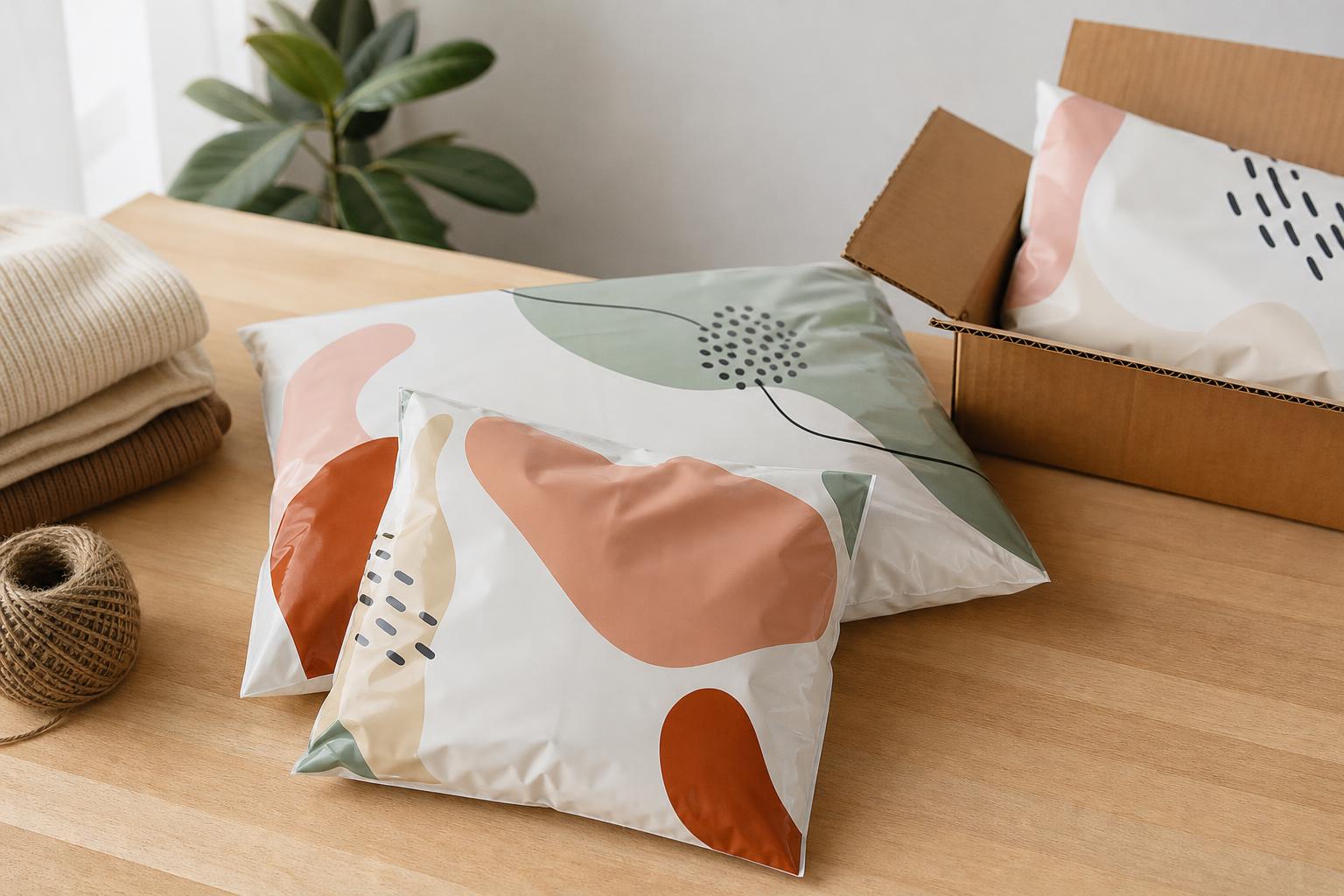
Ordering custom printed poly mailers is simple once you know the sequence: choose the mailer, prepare print-ready artwork, confirm the quote, pay in advance and plan the freight. Most delays and expensive mistakes happen before production even starts, in the artwork, the size or the delivery details. This guide walks through each step in order, for ecommerce businesses, retailers and growing brands that buy packaging in bulk. It explains what to prepare, what to ask for in a quote and how freight fits in. Customs, taxes and delivery rules differ from country to country, so we flag where your location matters.
In this article
- Key takeaways
- What custom printed poly mailers are and when they make sense
- Step 1: Lock the size, film and material first
- Step 2: Prepare artwork specs for custom poly mailers with logo
- Step 3: Understand the custom mailers minimum order and cost drivers
- Step 4: The order process, step by step
- Step 5: Freight, customs and receiving your custom shipping bags
- How to reduce risk when samples are not part of the process
- Custom order checklist
- Conclusion
Key takeaways
- Decide size, film thickness and material before you finalise artwork, because the mailer's dimensions set your print area.
- Send vector artwork with fonts outlined and colours specified, and keep key elements away from seals and edges.
- Every custom product has its own minimum order, worth at least $500, and the exact quantity and price come in a per-order quote in US dollars.
- Payment is made in advance by bank transfer or USDT, and freight is always quoted separately from the goods.
- Because samples are not offered, the written specification and your own fit tests are your main protection, so check every detail before paying.
What custom printed poly mailers are and when they make sense
Custom printed poly mailers are lightweight plastic shipping bags with a self-adhesive closure, printed with your logo, brand colours or a repeating pattern. They are used mainly for clothing, soft goods, accessories and other items that do not need rigid protection. Printing turns a throwaway shipping bag into the first physical contact a customer has with your brand.
Custom versus stock mailers
Stock mailers are plain, usually white, grey or black, and ready in standard sizes. Custom mailers let you set the print, and often the size and colour of the film. The trade-off is commitment: a custom run is made for you, so you are buying a whole production quantity and need to be sure of the design and the dimensions. If your volume is still unpredictable, stock mailers with a branded sticker or label may be a sensible bridge.
Who benefits most from branded poly mailers
Branded poly mailers pay off for brands that ship the same type of product repeatedly, so one or two sizes cover most orders. They also suit retailers sending to customers directly, and growing brands where unboxing content on social media matters. If your catalogue ships in many different sizes, you may only want to print the one or two sizes that carry the most volume. Our guide to poly mailers versus bubble mailers helps you decide whether a poly mailer is even the right format for a product.
Step 1: Lock the size, film and material first
Artwork is built around the finished mailer, so the physical specification comes first. Changing size after the design is drawn means redoing the layout, and with payment in advance you do not want to discover a size problem after the order is placed.
Measure the packed product, not the product alone
Fold or bag the item exactly as you ship it, then measure its width and length in both centimetres and inches. Add room for the closing flap and a small amount of slack so the seal can sit flat. Poly mailers are usually named by flat width by length, plus a lip, so compare your measurements against the size you plan to request. The detailed fit method is in our poly mailer size chart and fit guide.
Choose thickness and seal style
Thickness is quoted in mils (one mil is one thousandth of an inch) or microns (one mil is about 25 microns). A heavier film resists punctures and tears on long routes, but it also adds material cost and weight. Think about what the parcel will go through: sharp-cornered items, long international transit and automated sorting all argue for stronger film. Seals matter as much as film; our poly mailer thickness and seals guide explains how to judge both.
Decide on virgin, recycled or other film
Pack Merchants supplies poly mailers as well as recycled and compostable mailers, so material is a real choice. Ask in your quote request whether the material you want is available as a custom print product. Be careful with environmental wording on the bag itself: claims such as "recyclable" or "compostable" are regulated differently across regions, and printing them requires that the product genuinely qualifies where your customers live.
Step 2: Prepare artwork specs for custom poly mailers with logo
Printing on thin, flexible plastic has different limits from printing on paper or a screen. The exact technical requirements depend on the print method and the production line, so treat the points below as a preparation standard and confirm final specifications in your quote.
File formats and colour references
- Vector files: supply your logo and layout as vector artwork (commonly AI, EPS or a vector PDF) so lines stay sharp at any size.
- Outlined fonts: convert all text to outlines so a missing font cannot change your design.
- Spot colours: specify brand colours with a reference system such as Pantone, rather than relying on RGB values from a screen.
- Limited colour count: fewer flat colours usually print more cleanly on film and can keep cost down. Photographic gradients are harder to reproduce.
- Film colour matters: a light ink on a dark film, or the reverse, will look different from your screen mock-up, because the film colour affects how ink appears.
Print area, seams and safe zones
A poly mailer has a seam on the sides or bottom and an adhesive strip at the flap. Do not place a logo across those areas. Keep important elements a safe distance inside the edges, because film can shift slightly during printing and converting. Remember that the front and back face of a mailer are not equal: the flap side usually shows the closure strip, so decide whether you want one-sided or two-sided print and mark the layout clearly on a template.
Common artwork mistakes
- Very fine lines or small text that fill in or break up on flexible film.
- Logos placed too close to the seal so they wrinkle when the mailer is closed.
- Low-resolution images enlarged from a website or social media profile.
- A design drawn for a different size than the one ordered.
- Leaving out a shipping-label zone. Reserve a clear, flat area, so your label sticks well and scans reliably.
Step 3: Understand the custom mailers minimum order and cost drivers
Custom products are made to run in volume, so minimums apply. At Pack Merchants, every product has its own minimum order quantity, worth at least $500. There is no single unit count that applies to everything, so the quantity for your chosen mailer is the one shown on its product page or confirmed in your quote.
How minimums work for custom orders
The minimum is set per product, not per basket. Two different products do not add together to reach one minimum. If you want printed mailers in two sizes, each size needs to meet its own minimum. For a plain-language explanation, see what a $500 minimum order actually means.
What moves the price per unit
Prices are in US dollars and quoted per order for custom work. These are the factors that typically change the unit cost of branded poly mailers:
| Factor | Effect on cost | What to decide |
|---|---|---|
| Size | Larger bags use more film | Pick the smallest size that fits your packed product |
| Thickness | Heavier film costs more per bag | Match to product weight and route |
| Number of ink colours | More colours usually add set-up and ink cost | Simplify to flat brand colours |
| Print coverage | Full-surface patterns use more ink than a single logo | Choose logo only or all-over pattern |
| Material | Recycled or compostable film can be priced differently | Confirm material in your request |
| Quantity | Larger volume usually lowers cost per unit | Order what you will realistically use |
For a deeper view of how size, thickness and volume interact, read our bulk poly mailer price guide.
Step 4: The order process, step by step
A well-organised request saves rounds of back-and-forth. The order flow for custom printed poly mailers generally follows this path.
Request a quote with a complete brief
Send everything in one message so the quote can be accurate the first time:
- Mailer type and material (standard poly, recycled or other).
- Exact size in cm and inches, and the thickness you want.
- Film colour and ink colours, with colour references.
- Print placement: front, back or both, and logo only or pattern.
- Your artwork files, in the formats above.
- Estimated quantity and how many different designs or sizes.
- Full delivery address, including whether it is a business address with a loading dock.
Review, confirm and pay in advance
Read the quote line by line. Check dimensions, thickness, colours, print placement, quantity and the price in US dollars. Because payment is in advance, this is the moment to catch errors. Pack Merchants accepts payment by bank transfer or by USDT, a US-dollar stablecoin. Cryptocurrencies other than USDT are not accepted, and credit or Net payment terms are not offered. Check any bank transfer fees and currency conversion costs on your side, since they depend on your bank and country.
Production and hand-off to freight
After payment is confirmed, the order goes into production. Timings depend on the product and the order, so rely on what your quote states rather than on assumptions. Once the goods are ready, they move to the freight arrangement that was quoted separately. Keep your quote, artwork files and correspondence together in one folder for reference.
Step 5: Freight, customs and receiving your custom shipping bags
Custom shipping bags are light for their volume but still arrive in cartons on pallets, and shipping a large order can be a meaningful part of the total cost. Plan it as early as you plan the artwork.
Why freight is quoted separately
Freight is always quoted separately from the product price, because it depends on the destination, the carton count, the total weight and volume, and the delivery method. Ask for the freight quote at the same time as the product quote so you see the full landed cost before paying. Specify whether you need delivery to a warehouse with a dock, a forklift or a tail-lift, or to an address without these, since that changes how the shipment is handled.
International orders: duties, taxes and paperwork
Import rules differ widely. Depending on where you are, you may owe import duty, VAT or GST, brokerage fees or port handling charges on arrival. Some countries also have specific rules about plastic packaging or labelling. Check with your local customs authority or broker before you order, and read our overview of packaging rules for small businesses as a starting point. Those local costs are separate from the product price and freight quote.
Receiving and checking the delivery
When the shipment arrives, count cartons against the paperwork and note any visible damage on the delivery document before signing. Then open a carton and compare the mailers against your approved specification: size, print position, colour and seal. If something is wrong, document it with photos straight away. Our guide on what to do when a shipment arrives damaged covers the steps.
How to reduce risk when samples are not part of the process
Pack Merchants does not offer samples, so you will not hold a physical custom mailer before the order is made. That makes preparation more important, not less. You can close most of the gap yourself.
Test fit with what you already have
Pack your real products in a plain mailer of the same or similar size from your current supply and run a handful of test shipments. Check how the closure sits, how much slack remains and whether the product bulges at the corners. If you do not have a comparable bag, mark out the exact outer dimensions on a sheet of paper or thin card, then place the packed product on it to confirm fit.
Treat the written specification as your proof
Make sure the quote states the size, thickness, material, colours and print placement in writing. Print your artwork at actual size on paper and hold it against the packed product to judge logo scale and position. Ask a second person to proof-read every word and check every colour reference before you pay. Small errors, such as a misspelt web address, are cheap to fix on screen and costly to fix on thousands of printed bags.
Custom order checklist
Use this summary before you send a request and again before you pay.
| Stage | Check |
|---|---|
| Product fit | Packed item measured in cm and inches, with allowance for the flap and slack |
| Material | Thickness, film type and seal style chosen for the product and route |
| Artwork | Vector files, outlined fonts, colour references, clear of seams and label area |
| Quote | Size, quantity, colours, print placement and US dollar price all match your brief |
| Minimum | Quantity meets the product's own minimum order, worth at least $500 |
| Payment | Bank transfer or USDT arranged for payment in advance |
| Freight | Separate freight quote reviewed, delivery site details given, import costs checked |
| Receiving | Cartons counted, damage noted, contents compared to the specification |
If you are still comparing suppliers, our bulk packaging supplier checklist lists what to ask any wholesaler before committing.
Conclusion
Ordering custom printed poly mailers comes down to a clear order of work: fix the size, thickness and material, prepare clean vector artwork, confirm the quote against your brief, pay in advance by bank transfer or USDT and plan freight as its own line item. With no samples in the process, careful fit testing and a precise written specification are what protect your order. Take the time to check each stage and the delivery of your branded mailers should match what you planned.
Frequently asked questions
What is the minimum order for custom printed poly mailers?
Every product has its own minimum order quantity, worth at least $500. The exact quantity depends on the specific mailer and is confirmed on the product page or in your quote, so there is no single unit count for all products.
What file format should I send for custom poly mailers with a logo?
Vector files such as AI, EPS or a vector PDF are the safest choice, with all fonts converted to outlines and colours specified with a reference such as Pantone. Confirm the final accepted formats in your quote, because requirements can vary by print method.
Can I get a sample of a custom mailer before ordering?
No, samples are not offered. To reduce risk, test the fit using a similar plain mailer you already have, print your artwork at actual size to check scale, and make sure the quote states every specification in writing.
How do I pay for a custom order?
Payment is made in advance by bank transfer or USDT, a US-dollar stablecoin. Cryptocurrencies other than USDT are not accepted, and credit or Net payment terms are not available. Prices are in US dollars.
Is shipping included in the price of custom shipping bags?
No. Freight is always quoted separately from the product price and depends on destination, carton count, weight and delivery method. Ask for it alongside the product quote so you can see the total cost.
Will I pay import duties or taxes on an international order?
Possibly. Duties, VAT or GST, and brokerage fees vary by country and are separate from the product and freight prices. Check with your local customs authority or broker before you place the order.
Can I print on recycled or compostable mailers?
Ask when you request your quote, since availability depends on the specific product. Also check the rules for environmental claims in your market before printing words like recyclable or compostable on the bag.
How thick should custom poly mailers be?
It depends on what you ship and how far. Heavier film resists punctures better for sharp or heavy items and long routes, while lighter film saves material and weight for soft goods. Thickness is quoted in mils or microns, with one mil equal to about 25 microns.
Products in this guide
More guides on this topic
- Bulk Bubble Mailers: Wholesale Prices, Order Sizes and What to Check Before You Buy — What bulk bubble mailers really cost at 3,000, 10,000 and 25,000 pieces, how to work out your order size, and the five checks that stop a bad batch.
- Wholesale Poly Mailers and Courier Bags: Thickness, Prices and Bulk Orders — Everything a clothing or ecommerce brand needs to order courier bags in bulk: 2.5 mil thickness in micron, published prices, order sizes and delivery to Australia, NZ and South Africa.
- What a $500 Minimum Order Actually Means — Every product here has a minimum order worth at least $500, which is a very different number of units for a mailer and a roll of film. Here is how to work out whether you are ready, and what to do if you are not.
- Trash Bag Thickness: Mil, Micron, Gauge and What Matters — Mil, gauge, micron and "mil equivalent" all describe thickness, and not always honestly. How to read them, and why material matters as much as the number.
Still not sure?
Tell us what you ship and roughly how much of it, and we will recommend a specification and price it.