Packaging guide
How to Choose a Poly Mailer Size: Size Chart and Fit Guide (2026)
Learn how to choose a poly mailer size with a metric and imperial size chart, typical items per mailer and tips to avoid oversizing.
Updated Oct 26, 2026
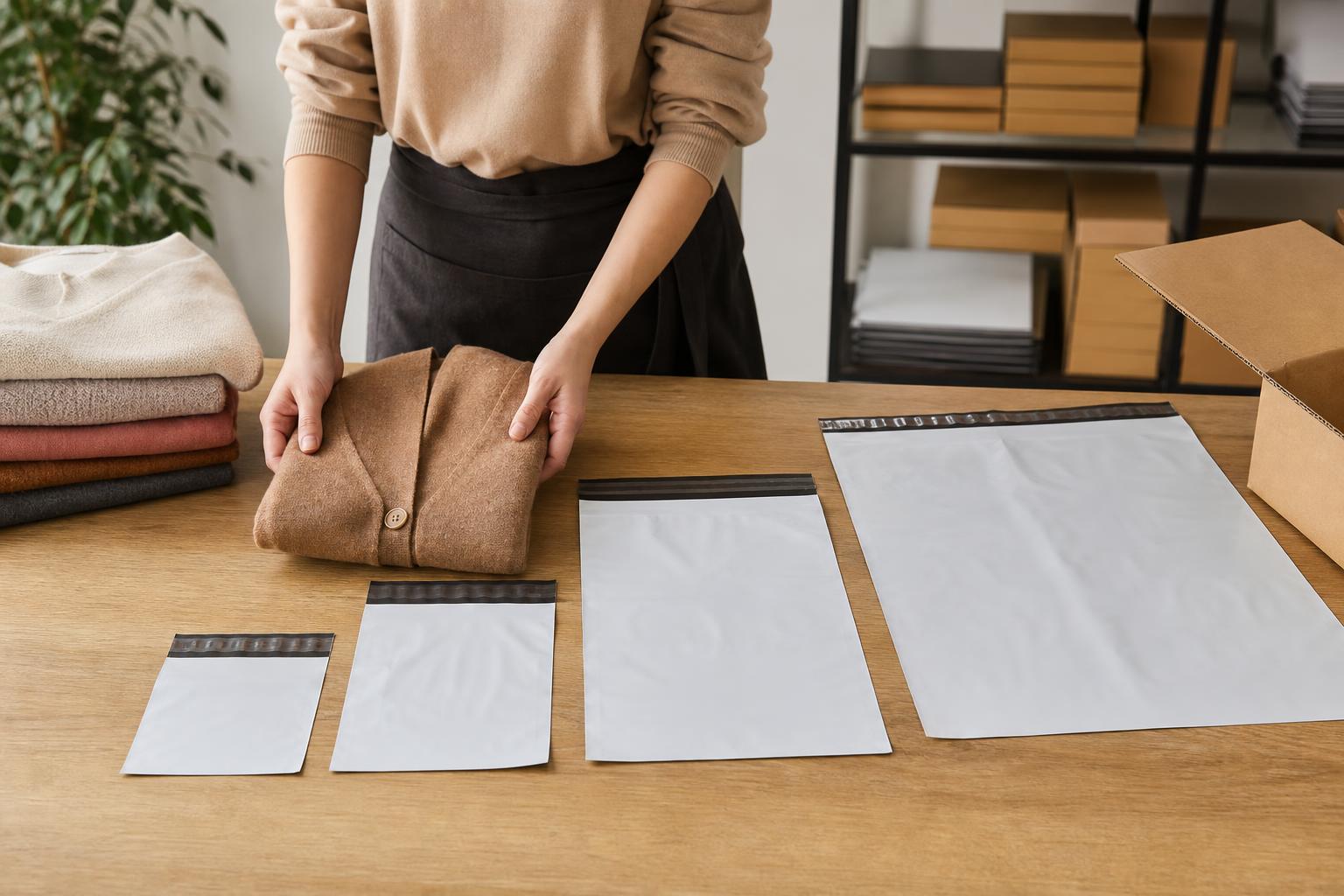
Knowing how to choose a poly mailer size saves money on every parcel you ship. A bag that is too small splits at the seams or refuses to seal. A bag that is too big wastes film, can raise shipping charges and lets products shift in transit. This guide gives you a simple method: measure the packed item, allow for the seal flap, then match the result to a size chart with typical items for each mailer. Sizes appear in inches and centimetres because suppliers around the world label them differently. We also cover clothing, the popular 10x13 poly mailer, and how to avoid oversizing when you buy in bulk, where one wrong choice is repeated across thousands of parcels.
In this article
- Key takeaways
- How to choose a poly mailer size: a four-step measuring method
- Poly mailer size chart with typical items
- What size poly mailer for clothing
- Is a 10x13 poly mailer the right size for your product?
- How to avoid oversizing poly mailers
- When a poly mailer is the wrong choice, whatever the size
- Planning poly mailer sizes for a bulk order
- Conclusion
Key takeaways
- Measure the item after it is folded and bagged, including its thickness, not the flat product.
- The listed mailer size is larger than the usable space, because the seal flap and side seams use up room.
- As a safe rule, the usable width should be at least the packed width plus the packed thickness, and the length should add roughly 5 cm (2 in) for the flap.
- Choose the smallest standard size that closes without strain. Going up more than one size usually means wasted film and a loose parcel.
- Fragile or rigid items with hard corners need a bubble mailer or a box, regardless of mailer size.
- For bulk buying, limit the number of sizes you order, because each size is a separate product with its own minimum quantity.
How to choose a poly mailer size: a four-step measuring method
Most sizing mistakes come from measuring the wrong thing. People measure a flat garment or a product box and then pick a bag with the same numbers. A mailer is a flat pouch that has to wrap around a three-dimensional parcel, so the method below works from the packed item instead.
Step 1: Pack the item the way you will ship it
Fold, bag and insert everything that goes in the parcel: the product, any inner tissue or paper, an invoice or a care card. Press it flat on a table. Then record three numbers: width, length and thickness at the thickest point. Measure in both centimetres and inches if your team or suppliers use different units.
Step 2: Calculate the minimum width and length
Use these working rules, which suit most soft goods:
- Minimum usable width: packed width + packed thickness. A thicker parcel needs extra width because the bag has to curve around it.
- Minimum usable length: packed length + about 5 cm (2 in) for the self-seal flap, plus a small margin of 1 cm (0.5 in).
Suppliers differ on whether the listed length includes the flap, so check how a size is defined before you order.
Worked example: a folded cotton t-shirt measures 22 cm wide, 28 cm long and 2.5 cm thick (8.7 x 11 x 1 in). The width needed is about 24.5 cm and the length about 34 cm. A 10x13 in mailer (25 x 33 cm) is a snug fit. A 9x12 in mailer (23 x 30.5 cm) is too small.
Step 3: Round up to the nearest standard size
Compare your numbers with the size chart in the next section. Pick the smallest mailer that clears both minimums. If two sizes are close, favour the smaller one when the product is soft and compressible, and the larger one when the item is bulky or stiff.
Step 4: Test with a template
Pack Merchants does not offer samples, so test before you commit. Cut a piece of paper or thin card to the listed mailer dimensions, fold a flap line at the top, and slide your packed item inside. If the paper template closes without bulging, the real mailer will work. Repeat this for your thickest typical order, not only the average one.
Poly mailer size chart with typical items
The chart below shows common poly mailer dimensions and the items that usually fit. Sizes are nominal and vary slightly between manufacturers, and the item guidance is approximate, because fabric weight, folding and product thickness change what fits. Confirm the exact dimensions of any size when you request a quote.
| Listed size (in) | Listed size (cm) | Typical items that fit | Notes |
|---|---|---|---|
| 6 x 9 | 15 x 23 | Phone cases, jewellery, socks, small accessories, cables | Keep items flat and under about 1.5 cm (0.6 in) thick |
| 7.5 x 10.5 | 19 x 27 | Cosmetics, small paperbacks, scarves, a child's t-shirt | A good size for compact, low-volume products |
| 9 x 12 | 23 x 30.5 | Thin t-shirt, leggings, swim top, A5 notebooks, a paperback | Folded garments need to be about 20 cm (8 in) wide or less |
| 10 x 13 | 25 x 33 | One or two t-shirts, a tank set, swimwear, light dresses folded small | The most widely used apparel size |
| 12 x 15.5 | 30 x 39 | Thin sweatshirt, a few tops, a folded blouse, A4 documents | Check thickness if the garment is knit or fleece |
| 14.5 x 19 | 37 x 48 | Hoodie, jeans, light jacket, multi-item orders | Roll or fold tightly to avoid a loose parcel |
| 19 x 24 | 48 x 61 | Bulky knitwear, small blankets, several garments, soft home textiles | Check carrier size and weight bands |
How to read the chart
Find your packed width and length in centimetres, add the allowances from the previous section, and look for the first row that meets both numbers. The "typical items" column is a starting point. If your product is stiffer or thicker than the examples, move up one row.
Why listed size and usable size differ
A mailer listed at 25 x 33 cm has side seams that take a few millimetres each side and a flap that takes several centimetres from the top. The inside space is therefore smaller than the label. Film thickness also matters: a heavier film is stiffer and can feel tighter around a full parcel. Our guide to poly mailer thickness, film and seals explains how gauge and seal quality affect how much you can safely put inside.
What size poly mailer for clothing
Clothing is the main use for poly mailers, and it is where sizing questions come up most. The answer to "what size poly mailer for clothing" depends on garment weight and how you fold it, not just the garment type.
T-shirts, tops and leggings
A single folded cotton t-shirt usually fits a 9x12 or 10x13 in mailer. Choose 9x12 for thin, lightweight tees and 10x13 for adult sizes, heavier cotton or when you add an insert. Leggings and swimwear fold small and often fit 9x12. Two tees in one order usually move you to 10x13 or 12x15.5.
Hoodies, jeans and jackets
Thicker garments need more width because of their thickness. A thin sweatshirt may fit 12x15.5 in when folded tightly, while a fleece hoodie, a pair of jeans or a light jacket typically needs 14.5x19 in. Bulky knitwear and multi-item orders often need 19x24 in. Always test the thickest size in your range, because XL garments are noticeably bigger than small ones.
Folding methods that change the size you need
- Standard fold: a flat rectangle that stacks neatly and suits most tops.
- Roll: reduces width but increases thickness, and it suits thick jeans or knitwear in a narrower bag.
- Tight fold with a card insert: keeps the shape presentable and gives a consistent size for every order.
Pick one method per product and write it into your packing instructions. Consistent folding makes packed size predictable, which is what lets you standardise on one mailer. If you want a material that suits apparel and an environmental brief, see our guide to compostable mailers for clothing.
Is a 10x13 poly mailer the right size for your product?
The 10x13 poly mailer is the standard choice for apparel because it fits a folded adult t-shirt and a typical insert with little room to spare. It is a good test case for the sizing method, because many products sit just on the edge of what it can take.
What fits comfortably
- One or two folded t-shirts of medium weight
- Leggings, shorts or a swimwear set
- A light dress folded small
- A paperback, a notebook set or cosmetics boxes up to about 3 cm (1.2 in) thick
What does not fit
A fleece hoodie, jeans, shoes, and anything with a hard box edge. Overfilling puts strain on the side seams, and the seal strip may not stay closed when the parcel is handled in a sorting hub.
When to go one size up or down
Go down to 9x12 in if your folded item is under about 20 cm (8 in) wide and the bag has more than 3 cm (1.2 in) of spare length. Go up to 12x15.5 in if you have to push the item in, if the flap will not sit flat, or if the parcel bulges. If you think you are between sizes, test your biggest typical order. A mailer that works for 90 percent of parcels but fails for the rest costs you in repacks and complaints.
How to avoid oversizing poly mailers
Oversizing is quieter than splitting, so it is easier to miss. The parcel arrives intact, but you pay for it in several small ways.
What an oversized mailer really costs
- More film per unit: larger bags use more material, and unit prices usually rise with size.
- Higher storage and freight volume: bigger bags take up more space on pallets and in your warehouse.
- Carrier charges: many carriers bill on dimensional weight or size bands, and the rules and divisors differ between carriers and countries. A loose, bulging parcel can fall into a more expensive band, so check your carrier's current rules.
- Product movement: loose garments crease and small items slide around, which affects presentation and sometimes damages packaging.
Practical tips to keep mailers snug
- Measure the packed item, not the flat product, and recheck whenever you change a fold, an insert or a product line.
- Choose the smallest size that closes without strain, and not the one that looks safest.
- Standardise folds so every order of a given item has the same packed size.
- Remove unnecessary inserts, such as thick flyers or extra tissue that add thickness.
- Split your range into size groups, such as light tops, heavier tops and outerwear, rather than shipping everything in one large bag.
- Do not fold excess bag length over to take up slack. It weakens the seal area and makes the parcel look untidy.
- Review your parcel mix quarterly. If most orders have 5 cm (2 in) or more of unused space, drop a size.
Avoid the opposite error too. A mailer packed so tightly that the seal is under strain is a false saving, because a single burst parcel costs more than the film you saved.
When a poly mailer is the wrong choice, whatever the size
Sometimes the problem is not the size at all. Poly mailers protect against moisture, dirt and light abrasion. They do not protect against crushing or impact.
Rigid or fragile items
Products with hard corners, glass, ceramics and electronics can puncture or distort a poly bag, even in the correct size. A padded option may suit lighter fragile items. Our comparison of poly mailers and bubble mailers sets out which one to use for which kind of product, and bubble mailers follow their own size logic, since the padding reduces the usable interior.
Choosing between mailers and boxes
If the item is heavy, rigid, stackable or valuable, or if you ship through long international routes with rough handling, a box is usually safer. Corrugated boxes protect against crushing, and a mailer box suits presentation-led brands. For board grades and ordering by the pallet, see our guide to wholesale corrugated shipping boxes.
Planning poly mailer sizes for a bulk order
Bulk buying changes how you should think about sizing. Choosing a size for ten parcels is a small decision. Choosing one for 10,000 parcels is a purchasing decision.
Limit the number of sizes
At Pack Merchants, every product has its own minimum order quantity, worth at least $500, and each size counts as its own product. A catalogue of six different mailer sizes therefore means six separate minimums. For most apparel brands, two or three sizes cover nearly everything: a small size for accessories and light tops, the 10x13 in size for standard garments, and a larger size for outerwear and multi-item orders. For more on how the minimum works, read what a $500 minimum order actually means.
Budget for freight and quantities
Poly mailers are light, but a large order is still bulky, so freight depends on the size, carton count and your destination. Freight is always quoted separately from the product price, and custom packaging, such as printed mailers, is quoted per order. Payment is by bank transfer or USDT. Before you request a quote, work out how many months of stock 1,000 units represents for each size, so that you do not over-order a size you rarely use. Include the packed dimensions and your monthly parcel volume by product when you ask for a quote.
Conclusion
To choose a poly mailer size, measure the packed item including its thickness, add allowances for the seal flap and curve of the bag, and then pick the smallest standard size that closes without strain. Use the size chart as a starting point, test with a paper template before ordering, and recheck sizes when your folds, inserts or products change. Keep your range to a few sizes, and move to a bubble mailer or a box when the product is fragile or rigid.
Frequently asked questions
How do I know what size poly mailer I need?
Pack your item the way you will ship it and measure the width, length and thickness. The mailer's usable width should be at least the packed width plus the thickness, and the length should be the packed length plus about 5 cm (2 in) for the flap. Then choose the smallest standard size that meets both numbers.
What fits in a 10x13 poly mailer?
A 10x13 inch (25 x 33 cm) mailer typically holds one or two folded medium-weight t-shirts, leggings, swimwear or a light folded dress. It also suits a paperback or small boxed cosmetics up to about 3 cm (1.2 in) thick. Hoodies, jeans and shoes usually need a larger size or a box.
What size poly mailer is best for a t-shirt?
A thin t-shirt often fits a 9x12 inch (23 x 30.5 cm) mailer. A standard adult t-shirt in medium-weight cotton usually fits 10x13 inches (25 x 33 cm), especially with an insert. Test your largest size, as bigger garments fold thicker and wider.
What size poly mailer do I need for a hoodie?
A fleece hoodie or a pair of jeans commonly needs about 14.5x19 inches (37 x 48 cm). A thin sweatshirt folded tightly may fit 12x15.5 inches (30 x 39 cm). Fabric thickness varies, so check your thickest typical item with a paper template first.
Is the listed poly mailer size the same as the usable space?
No. The side seams and the self-seal flap take up room, so the usable space is smaller than the listed size. Suppliers also differ on whether the listed length includes the flap, so confirm the definition before ordering.
Does a bigger poly mailer cost more to ship?
It can. Many carriers charge by dimensional weight or size bands, and the rules differ by carrier and country. A loose, bulging mailer can also push a parcel into a higher band, so check your carrier's current rules.
Can I order a sample poly mailer to test the size?
Pack Merchants does not offer samples. A practical alternative is to cut a paper or card template to the listed mailer dimensions and test your packed item inside it. This shows you whether the real mailer will close without strain.
When should I use a bubble mailer or box instead of a poly mailer?
Use a bubble mailer for light items that need some cushioning, and a box for rigid, fragile, heavy or high-value products. Poly mailers resist moisture and dirt but give little protection against crushing or impact.
Still not sure?
Tell us what you ship and roughly how much of it, and we will recommend a specification and price it.