Packaging guide
Wholesale Corrugated Shipping Boxes: Board Grades, ECT and Pallet Ordering (2026)
Wholesale corrugated shipping boxes explained: board grades, ECT vs burst, single vs double wall, sizing and pallet ordering.
Updated Oct 22, 2026
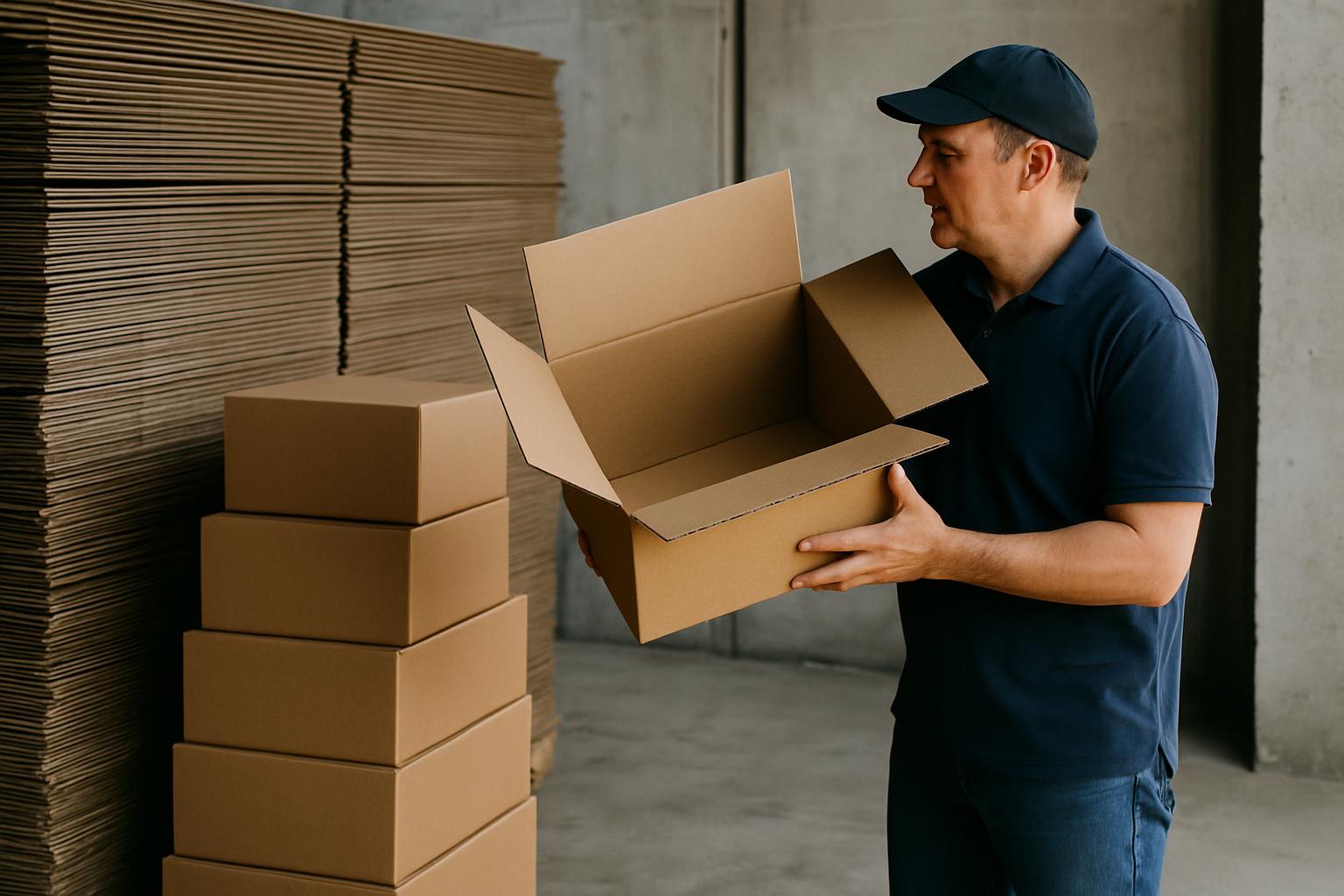
Buying wholesale corrugated shipping boxes is less about finding the lowest unit price and more about specifying the right board for the way your parcels actually travel. Two boxes with identical dimensions can differ widely in strength depending on flute, liner weight and ECT rating, and that gap shows up as crushed corners, returns and carrier claims. This guide goes past typical category pages. It explains board grades, ECT versus burst strength, single wall versus double wall, how to choose box sizes, and how to order by the pallet so freight works in your favour. It is written for ecommerce businesses, retailers and growing brands buying bulk shipping boxes anywhere in the world.
In this article
- Key takeaways
- How corrugated board is built: liners, flutes and why it matters
- Board grades, ECT and burst strength explained
- Single wall vs double wall boxes: which does your product need?
- Choosing shipping box sizes that cut damage and freight cost
- Box styles for bulk orders: slotted, mailer and custom formats
- Ordering corrugated boxes by the pallet
- Quality checks before and after a bulk delivery
- Buying wholesale from Pack Merchants: what to know before you request a quote
- Conclusion
Key takeaways
- ECT (edge crush test) is the most useful single number for stacking and shipping strength; burst strength mainly describes puncture and surface resistance.
- Single wall board suits most lightweight to medium parcels; double wall is for heavy, fragile or stacked-in-transit goods.
- Internal dimensions, not external, decide whether your product fits, so measure the product first and specify the box second.
- Ordering by the full pallet, with a known units-per-pallet count, makes freight quoting and warehouse planning simpler.
- Specify board grade in writing on every quote, because a box described only by size can be built from very different materials.
How corrugated board is built: liners, flutes and why it matters
Corrugated board is a sandwich. Flat paper liners sit on the outside, and a rippled paper layer, called the fluting or medium, sits between them. The arches of the fluting act like tiny beams, holding the liners apart and giving the board its stiffness and cushioning. Almost every specification you will see on a quote comes back to the three paper layers and the shape of that ripple.
Liners and the fluted medium
Liners are made from kraft paper, either virgin fibre or recycled, and are described by weight, usually in grams per square metre (gsm) or pounds per thousand square feet. Heavier liners generally raise puncture resistance and ECT. The medium is typically a lighter, recycled paper. Because recycled content varies between mills and regions, two boxes with the same nominal grade can behave slightly differently, which is another reason to ask for the full specification rather than a vague description.
Common flute profiles compared
Flute profiles are named by letter, and the letters indicate the height and pitch of the ripple. Taller flutes cushion and resist vertical stacking load; shorter flutes print better and fold more neatly. Naming conventions are broadly shared worldwide, though exact thicknesses differ slightly between manufacturers.
| Flute | Approx. thickness | Typical strengths | Typical use |
|---|---|---|---|
| B | about 3 mm (1/8 in) | Good flat crush, firm walls | Cans, jars, inner partitions |
| C | about 3.5-4 mm (5/32 in) | Good stacking and cushioning | General shipping boxes, the most common choice |
| E | about 1.5 mm (1/16 in) | Rigid, very good print surface | Retail and mailer boxes |
| BC (double wall) | about 6.5-7.5 mm (1/4 in) | High stacking strength and puncture resistance | Heavy or fragile items |
For most ecommerce shipping, C flute single wall is the workhorse, E flute is chosen for presentation-led mailer boxes, and BC double wall is the step up when weight or fragility demands it.
Board grades, ECT and burst strength explained
Board grade is the shorthand for how strong a particular construction is. Two systems dominate. One is the edge crush test rating, and the other is burst (or Mullen) strength. Understanding the difference stops you paying for the wrong kind of strength.
What an ECT rating tells you
ECT measures how much force a small strip of board can take on its edge before it crushes. Because a box stands on its edges when stacked, ECT correlates closely with how well a box resists top-to-bottom load in a warehouse or truck. It is expressed in pounds per inch width (lb/in) in North America and in kilonewtons per metre (kN/m) in most other regions. As a rough conversion, 32 lb/in is about 5.6 kN/m, and 44 lb/in is about 7.7 kN/m. Typical single wall boxes sit around 32 to 44 lb/in, while double wall grades commonly start in the high 40s and run well above that.
Burst strength and where it still applies
Burst strength measures the pressure needed to push through the board face, expressed in psi, kPa or as a grade such as 200 lb test. It is a fair indicator of resistance to puncture and rough handling on the surface, and some regions and carriers still reference it. It does not predict stacking performance as well as ECT. If your supplier quotes only burst, ask for the ECT as well, or confirm which standard the box will be certified against in your market.
Why box compression strength is not the whole story
Box compression strength, the load a finished box can bear, depends on ECT, but also on box dimensions, the proportion of length to width, the style, any cut-outs and how the box is stored. Humidity is a major factor: board that has absorbed moisture can lose a large share of its strength, so cartons stored in damp warehouses or shipped through humid climates need more margin. As a general rule, specify with a safety allowance rather than at the exact limit of your calculation.
Single wall vs double wall boxes: which does your product need?
Single wall vs double wall boxes is the decision that most affects both protection and cost per parcel. Single wall has one fluted layer between two liners. Double wall has two fluted layers and three liners, which roughly doubles the structural beams inside the wall.
| Factor | Single wall | Double wall |
|---|---|---|
| Typical product weight | Light to medium parcels | Heavy, dense or awkward items |
| Stacking load | Suitable for normal parcel networks | Better for long storage or palletised export |
| Puncture resistance | Moderate | High |
| Material weight and cost | Lower | Higher, and heavier to ship |
| Storage footprint when flat | Compact | Thicker stacks |
When single wall is enough
Apparel, soft goods, books, cosmetics, small accessories and most lightweight consumer products travel perfectly well in single wall, provided the box is correctly sized and the contents cannot rattle. Carrier networks generally handle these parcels with predictable loads. Using double wall for them mostly adds cost and shipping weight.
When double wall earns its cost
Consider double wall for products that are heavy for their size, such as tools, glassware or small appliances, items with sharp or rigid edges that could puncture a thinner wall, and goods that will be stacked on pallets for long journeys, including international freight. It is also a sound choice for reusable or multi-trip boxes.
Specifying by weight and route, not habit
A practical method is to group your products into weight bands, then match each band to a board grade, noting that carriers and countries may impose their own weight and size limits. Check your carrier's packaging guidance for the lanes you ship on, because requirements vary between countries and services. Reviewing your damage claims by product also shows where a stronger grade pays for itself and where you are overspending.
Choosing shipping box sizes that cut damage and freight cost
Shipping box sizes are always quoted as length by width by height, and the convention matters: length is the longest side of the opening, width is the shorter side of the opening, and height is measured from the opening to the base. Mix this up and a bulk order can arrive in the wrong shape.
Measure internal dimensions the right way
Dimensions quoted for boxes are normally internal measurements. Measure your product at its widest points in all three directions, then add room for protection on each side. A common starting allowance is a few millimetres (about 1/8 in) for snug-fit rigid items and more where cushioning is required. Remember that board thickness reduces the usable interior, and printing or inner packaging also takes space.
Dimensional weight and right-sizing
Many carriers bill by the greater of actual weight and dimensional weight, which is calculated from the box volume divided by a divisor. Divisors differ by carrier and region, for example 5,000 cm³ per kg in many international services or 139 cubic inches per pound in some domestic services, so check the current figures from your own carrier. The principle is constant: every extra centimetre of air in a box can raise the billable weight. Standardising on a small range of well-chosen sizes keeps ordering simple while limiting wasted space.
Void fill and product protection
A right-sized box still needs the product to stay put. Paper, air pillows, bubble and foam each behave differently, and our guide to void fill compared helps match the filler to the product. For items that need cushioning without bulky fill, honeycomb paper wrap is a recyclable option worth considering alongside the box.
Box styles for bulk orders: slotted, mailer and custom formats
Style determines how a box is assembled, how it closes, and how fast your team can pack it. Style also changes strength, because cut-outs, tuck flaps and self-locking folds all alter how load travels through the walls.
Regular slotted containers
The regular slotted container, known in European coding as FEFCO 0201, is the standard shipping carton. It is made from one piece with four flaps on top and bottom that meet at the centre. It is efficient to produce, ships flat, and offers excellent compression strength because the flaps double the board at the top and base. If you have no special presentation needs, it is usually the lowest-cost route to strong cardboard boxes in bulk.
Ecommerce mailer boxes
Mailer boxes are die-cut, self-locking boxes that fold up without tape and open cleanly for the customer. They are typically made in thinner, finer flute such as E flute, which prints sharply and presents well. They suit lightweight products and brands that care about the unboxing experience. For heavier or more fragile goods, a slotted carton in stronger board remains the safer option.
When to quote a custom size
If your best-selling product has an awkward shape that wastes space in standard sizes, a custom-sized box can reduce void fill, dimensional weight and damage. Custom sizes and printing are quoted per order, so they work best for products with steady, predictable volume. Standard sizes are better while a range is still changing.
Ordering corrugated boxes by the pallet
Boxes are bulky for their weight, so how you order matters as much as what you order. Thinking in pallets rather than loose cartons makes freight, storage and budgeting far more predictable.
Units per pallet and pallet footprints
Pallet sizes differ around the world. A common footprint in North America is 48 by 40 inches (about 1,219 by 1,016 mm), while the Euro pallet is 1,200 by 800 mm (about 47.2 by 31.5 in), and ISO pallets of 1,200 by 1,000 mm are widely used in global trade. The number of flat-packed boxes per pallet depends on box size, board thickness and how high the load is stacked. Ask for the units-per-pallet figure with every quote so that you can plan around full pallets and avoid half-empty ones.
Flat-packed vs pre-assembled
Corrugated boxes almost always ship flat, which allows far more units per pallet and keeps freight cost down. Pre-assembled boxes would occupy a vast amount of space and are rarely sensible for bulk shipping. Plan for the assembly time at your packing station, and consider simple tape or a tape-free self-locking style to speed this up.
Planning freight and storage
Freight is quoted separately from the goods on every Pack Merchants order, so treat it as its own line in your budget. Consolidating several box sizes and other supplies onto one pallet can lower the cost per unit moved, and our guide on how to cut pallet freight costs covers the practical levers. Store cartons flat, off the floor and away from damp walls, because moisture is the fastest way to weaken board before it ever reaches a customer.
Quality checks before and after a bulk delivery
Large orders carry large consequences, so a few disciplined checks are worth more than any discount. This is especially important when you cannot trial a different supplier's boxes in small quantities first.
What to confirm in writing
Before you place an order, get these items confirmed on the quote:
- Internal dimensions in length, width and height order, in both millimetres and inches.
- Flute type and wall construction (single wall or double wall).
- ECT rating or the board grade standard being used, with the unit stated.
- Box style or code, and the number of units per pallet.
- Any printing, plus the freight terms for your delivery location.
Pack Merchants does not offer samples, so the written specification is your reference point. Compare it with a box you already use and check that the numbers are equal or better for your product weight and route.
Inspecting the delivery
On arrival, inspect the pallet before signing: look for crushed corners, water marks and torn wrap, and photograph any damage. Open a few cartons from different layers and check dimensions with a tape measure, confirm the flute and wall construction, and assemble several boxes. Then pack real products into the first boxes, seal them with your normal tape, and run a simple drop and shake test before rolling the box out to your whole line. If something is wrong, the steps in our guide on what to do when a shipment arrives damaged help you document it properly.
Buying wholesale from Pack Merchants: what to know before you request a quote
Pack Merchants is a wholesale supplier of packaging and shipping supplies sold in bulk only. We supply corrugated shipping boxes and ecommerce mailer boxes alongside poly mailers, recycled and compostable mailers, bubble mailers, kraft paper mailers, honeycomb paper wrap, packing tape, labels, stretch film and trash bags.
Order rules and payment
The minimum order is $500 and 1,000 units per product, with published volume pricing. Payment is by bank transfer, USDT or BTC. Freight is always quoted separately, and custom packaging is quoted per order. Our guide on what a $500 minimum order actually means explains how this works in practice, including how it applies product by product. Because the minimum is 1,000 units per product, think carefully about how many sizes you really need.
Building a complete packaging setup
Boxes work best as part of a system: the right tape, labels, void fill and pallet wrap. If you are changing supplier, plan the changeover carefully so shipping never stops. Our guide on how to switch packaging suppliers without disrupting shipping sets out a sensible sequence. Prices, board availability and regulations differ between countries, so state your delivery location when you request a quote.
Conclusion
Choosing wholesale corrugated shipping boxes well comes down to specifying board by its ECT rating, wall construction and flute, sizing from the product outwards, and ordering by the pallet with freight planned separately. Confirm every detail in writing, inspect the first delivery carefully, and match the grade to the weight and route of each product. With that discipline, bulk shipping boxes protect your parcels and your margin.
Frequently asked questions
What is the difference between ECT and burst strength?
ECT measures how much edge-on force a strip of board can withstand and is a good predictor of stacking strength. Burst strength measures the pressure needed to puncture the board face. For shipping and storage, ECT is generally the more useful number, though some carriers and regions still reference burst.
Should I choose single wall or double wall boxes?
Single wall suits most lightweight and medium-weight parcels. Choose double wall for heavy, dense or fragile items, sharp-edged products, or goods that will be stacked for long periods or shipped internationally. Matching the grade to each product's weight and route avoids both damage and overspending.
What ECT rating do I need for shipping boxes?
It depends on the product weight, box size and how the parcels are handled and stacked. Many single wall shipping boxes sit around 32 to 44 lb/in (about 5.6 to 7.7 kN/m), with higher grades for heavier goods. Check your carrier's guidance and keep a safety margin, especially in humid conditions.
How do I measure shipping box sizes correctly?
Measure your product at its widest points, then add the protection space you need. Box dimensions are usually internal and listed as length by width by height, where length and width describe the opening and height runs from the opening to the base. Always confirm the measurement convention on the quote.
How many boxes fit on a pallet?
It varies with box size, board thickness, flat-pack format and the pallet footprint and stack height. Ask for the units-per-pallet figure on your quote rather than estimating, since it affects freight planning and storage space.
Does Pack Merchants offer samples of its corrugated boxes?
No, we do not offer samples. Instead, confirm dimensions, flute, wall construction and ECT rating in writing on the quote, compare them with boxes you already use, and test the first cartons from your delivery before using them across your whole operation.
What are the minimum order and payment terms?
The minimum order is $500 and 1,000 units per product. Payment is by bank transfer, USDT or BTC, and freight is always quoted separately. Custom packaging is quoted per order.
How should I store corrugated boxes before use?
Keep them flat, off the floor and away from damp walls, leaks and direct sunlight. Moisture can significantly reduce board strength, so a dry, stable environment protects the quality of the cartons you paid for.
Still not sure?
Tell us what you ship and roughly how much of it, and we will recommend a specification and price it.