Packaging guide
Kraft Paper Mailers Bulk: When Paper Works and When Poly Wins (2026)
Buying kraft paper mailers bulk? See when paper works, when poly mailers win, how to size them and what to check before a wholesale order.
Updated Oct 31, 2026
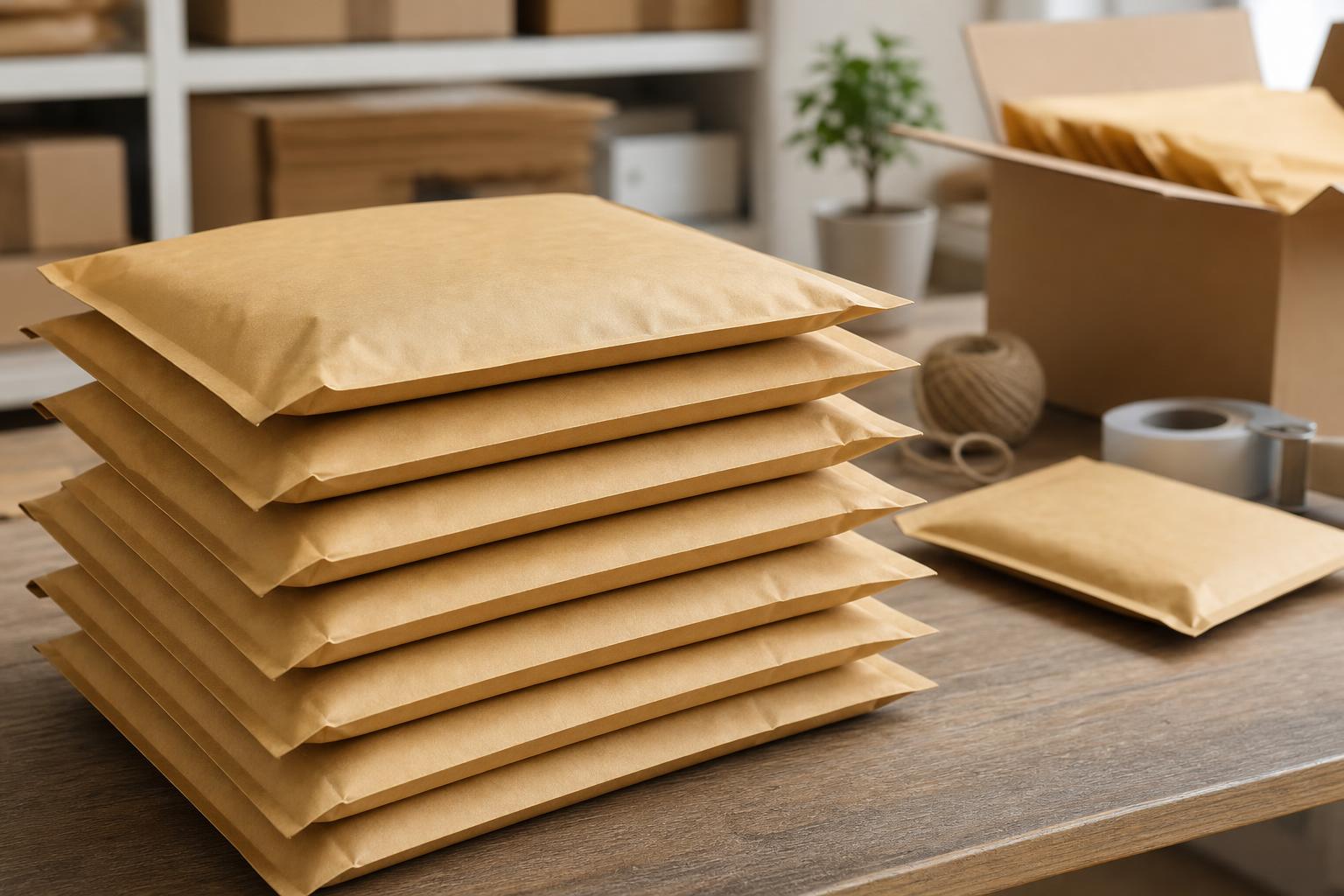
If you are weighing kraft paper mailers bulk orders against poly, the right answer depends on what you ship, how far it travels and what your customers expect when the parcel arrives. Paper mailers look natural, print well and suit plastic-free brands. Poly mailers resist water and tearing better and usually cost less to run on a busy pack line. Neither is better in every case. This guide explains where each one performs, where each one fails, how to pick sizes, and what to check before committing to a wholesale quantity. It is written for ecommerce businesses, retailers and growing brands that buy in volume and cannot afford to guess.
In this article
- Key takeaways
- Kraft paper mailers bulk: what they are and where they fit
- Paper mailers vs poly mailers: a direct comparison
- When kraft paper mailers work well
- When poly mailers are the better choice
- Kraft bubble mailers and padded paper options
- Plastic free and recyclable mailers: claims to check
- Choosing kraft mailer sizes
- Buying paper mailers wholesale: minimums, payment and freight
- Conclusion
Key takeaways
- Kraft paper mailers suit dry, soft, flat and lightweight products on routes with careful handling and low moisture exposure.
- Poly mailers are the safer choice for wet or humid routes, sharp or heavy items, and any product that would be ruined by water.
- Padded or bubble-lined paper options add cushioning, but mixed materials can complicate recycling claims in some countries.
- Always size from the packed product, not the bare product, and allow for the seal flap.
- Compare cost per delivered order, including damage and replacements, not just cost per mailer.
- At Pack Merchants every product has its own minimum order quantity worth at least $500, so test your choice carefully before you buy.
Kraft paper mailers bulk: what they are and where they fit
A kraft paper mailer is a flat envelope made from kraft paper, normally brown, with a peel-and-seal adhesive strip. Kraft paper is made from wood pulp and is valued for its strength relative to its weight and its natural appearance. Buyers use these mailers to replace plastic envelopes, to match a plastic-free brand position, or simply because the look suits the product.
Plain, padded and bubble-lined formats
Plain kraft mailers are a single paper layer, sometimes with extra body for stiffness. Padded versions add a cushioning layer inside. Kraft bubble mailers combine a paper outer with a bubble film lining, which protects better but mixes materials. Which constructions and sizes are available changes by product, so read the specification on the product page rather than assuming a format exists.
Why brands choose paper
Paper takes a shipping label cleanly and holds ink well, so a stamp or printed design can look sharp. Customers often read a paper mailer as more considered than a plain plastic bag. For retailers who sell eco-minded products, a paper outer can support the brand story without extra explanation.
That appeal is real, but it is not a substitute for performance. A mailer that arrives wet, torn or crushed damages the brand far more than any packaging material can help it. Start with the shipping conditions, then choose the material.
Paper mailers vs poly mailers: a direct comparison
The table below summarises how the two materials generally behave. Individual products vary with thickness, paper weight, seal quality and construction, so treat it as a starting point and check specifications.
| Factor | Kraft paper mailer | Poly mailer |
|---|---|---|
| Water resistance | Paper absorbs moisture and weakens when wet | Film does not absorb water, so contents stay protected from rain and splashes |
| Tear and puncture resistance | Can tear at edges and corners, especially with sharp items | Generally stretches before it tears; depends on film thickness |
| Appearance | Natural, matte, premium feel | Clean and modern; finishes range from plain to printed |
| Cushioning | Only with padded or bubble-lined versions | None unless it is a bubble mailer |
| Seal | Adhesive strip; check it holds in your climate | Self-seal strip, typically strong on a good film |
| End of life | Often accepted in paper recycling, depending on construction and local rules | Accepted in some film-recycling schemes; availability varies widely by country |
| Best for | Dry, soft, flat goods | Apparel and soft goods on mixed or wet routes |
Moisture and weather
This is the biggest practical difference. Parcels sit on loading docks, in vans and on doorsteps. A poly film shrugs off a rain shower. Paper may soften, stain or let water through at the seams. If your customers live in humid or rainy regions, or your parcels cross borders with long transit times, that gap matters.
Strength and tear resistance
Paper is rigid, which helps protect flat items from bending, but it can split along folds and corners. Poly is flexible and handles rough sorting better. For guidance on film gauge, see our poly mailer thickness guide.
Weight, storage and pack speed
Both formats ship flat and take little warehouse space compared with boxes. Per-parcel weight differences are usually small. Pack speed is more important: poly mailers open easily and fill quickly, while stiffer paper may need a bit more handling. Time a few packs with your own team before deciding.
When kraft paper mailers work well
Paper earns its place when the product, route and customer all line up. These situations tend to suit it.
Dry, soft and flat products
Folded apparel in a dry climate, textiles, printed matter, stationery, accessories and flat soft goods are common good fits. Items that cannot be harmed by a little humidity and have no hard edges are the safest candidates. If the product is already inside a sealed inner bag, paper becomes even more forgiving.
Brands where plastic-free matters
For some brands, avoiding plastic outer packaging is a core promise. Plastic-free mailers help keep that promise visible from the moment the customer picks up the parcel. If this is your reason for choosing paper, make sure any padding, tape and labels also fit the claim, otherwise the story weakens. Packing tape and labels are part of the pack-out, so check them too.
Short, well-handled routes
Local or regional deliveries with few handling points reduce the risk of crushing, tearing and weather exposure. A courier that scans and sorts by hand treats a paper mailer very differently from a high-speed automated hub. If most of your orders are domestic and short-haul, paper is lower risk than for long international routes.
When poly mailers are the better choice
Choose poly when failure is expensive or when conditions are unpredictable. A few clear cases stand out.
Wet, humid or long routes
Monsoon seasons, tropical ports, cold wet winters and multi-leg international journeys all raise moisture risk. Poly keeps the contents dry in conditions where paper may not. For goods such as clothing, soft furnishings or anything that stains or mildews, that protection often decides the case.
Sharp, heavy or awkward items
Zipper pulls, buckles, metal fittings, hard corners and heavier parcels put point loads on a mailer. Thin paper can be punctured or split. A suitably thick poly film copes better, and a bubble mailer adds cushioning. If an item is truly fragile, a mailer of any kind may be the wrong format; see our comparison of poly mailers and bubble mailers.
Returns and high-volume pack lines
Poly mailers are quick to fill, seal firmly and often work for return shipments if the customer is able to reseal them. Where packers handle hundreds of parcels per shift, small time savings per pack add up. If returns are a large part of your volume, consider the whole journey, not only the outbound trip.
Kraft bubble mailers and padded paper options
When a flat paper mailer offers too little protection, many buyers move to padded formats. Kraft bubble mailers are a popular middle path between a plain envelope and a box.
When padding is worth it
Padding suits small, light items that can be scratched or dented: cosmetics in sturdy packs, small accessories, electronics accessories, books and framed flat items. It does not turn a mailer into a crush-proof container. Padding absorbs minor knocks, not heavy compression in a sorting hub.
Mixed materials and recycling
A paper outer with a plastic bubble lining is a mixed-material product. Whether it can be recycled as paper depends on its construction and on local collection rules, which differ from country to country. Do not assume a mixed mailer is recyclable; confirm what is stated on the product page and describe it accurately to customers. Our guide to compostable and recycled mailers explains how these claims differ.
When to move up to a box
Fragile, high-value or rigid products usually need a box with proper void fill. Corrugated shipping boxes and ecommerce mailer boxes give structure that no envelope can. Honeycomb paper wrap is a paper-based protective option that works inside a box for items that need wrapping. Pack Merchants supplies each of these, so you can mix formats across your catalogue.
Plastic free and recyclable mailers: claims to check
Many buyers choose paper to reduce plastic. That is a fair goal, but the language around it is easy to get wrong.
Paper, recycled and compostable are different
- Paper: made from fibre, which may be virgin or recycled.
- Recycled: contains reclaimed material, but may still be a plastic film.
- Compostable: designed to break down under specific conditions, which often require industrial facilities that do not exist everywhere.
These terms are not interchangeable. Using the wrong one in marketing creates risk with customers and regulators.
Local recycling rules vary
Kerbside paper collection is common in many countries and absent or limited in others. Film recycling is even less consistent. A mailer that is easy to recycle in one city may have no recycling route in another. If you sell internationally, avoid promising recyclability everywhere, and state where a claim applies.
Keep marketing claims specific
Authorities in many regions, including the European Union, the United Kingdom and the United States, publish rules or guidance on environmental claims. Vague phrases such as eco-friendly without evidence can cause problems. Say what the mailer is made of, and only claim what you can support. See our overview of packaging rules for small businesses as a starting point, and check the rules in each market you sell to.
Choosing kraft mailer sizes
Wrong sizing causes more mailer problems than material choice. Mailers that are too tight strain seals and split. Mailers that are too large waste material, flap about and look careless.
Measure the packed product
Measure the product as it will ship, including any inner bag, tissue or insert. Record length, width and thickness in centimetres and inches. A typical folded T-shirt in an inner bag might measure about 30 x 25 cm (12 x 10 in), but products vary, so use your own measurements.
Allow for the seal flap
The labelled size of a mailer is often the outer size. The usable inside space is smaller because of the seams and the flap. Check whether the product page gives the usable dimensions, and allow room so the flap closes flat without strain. As a working rule, leave a few centimetres (about 1 inch) of margin beyond the packed item.
Standardise on a few sizes
Buying in bulk rewards a short size list. Group your products by packed dimensions and choose two or three sizes that cover most orders. This keeps your quantity per size high, reduces pack-line decisions and avoids stock of rarely used sizes. The same logic applies to poly; our poly mailer size guide shows a fit method you can adapt.
| Step | What to do |
|---|---|
| 1 | Measure packed length, width and thickness in cm and inches |
| 2 | Compare against usable internal size, not just the label |
| 3 | Allow margin for the flap and closure |
| 4 | Group SKUs into two or three standard sizes |
| 5 | Check bulky items for the extra thickness a padded mailer adds |
Buying paper mailers wholesale: minimums, payment and freight
Wholesale buying works differently from retail. Planning for it avoids surprises.
Minimum order per product
At Pack Merchants, we sell in bulk only, and every product has its own minimum order quantity worth at least $500. The quantity differs by product and is shown on the product page. Read it there rather than relying on a general number. Our article on what a $500 minimum order means explains how this works in practice.
Payment and freight
Payment is made in advance by bank transfer or USDT, a US-dollar stablecoin. We do not offer credit terms, and we do not accept other cryptocurrencies. All prices are in US dollars. Freight is always quoted separately, based on your order and destination, so include it when you calculate landed cost per mailer.
Checklist before you order
We do not offer samples, so your decision needs to rest on specifications and your own checks. Work through this list:
- Confirm the exact size, construction and listed specifications on the product page.
- Pack your heaviest and bulkiest SKU into a similar mailer from your current stock to test the fit.
- Review your damage and return rates by route and season.
- Decide which products stay on poly and which can move to paper.
- Add freight to the unit cost to see the true cost per shipped order.
- Check that your marketing wording matches what the product actually is.
Splitting your catalogue is often the most sensible outcome: paper for dry, flat, lightweight lines and poly for everything exposed to weather or rough handling. For wider supplier planning, see our checklist for buying packaging in bulk.
Conclusion
Kraft paper mailers suit dry, soft, flat and lightweight products on careful routes, and they support plastic-free branding. Poly mailers are the safer option for wet or humid conditions, sharp or heavy items and fast pack lines. Padded and bubble-lined paper sits between the two, with material and recycling trade-offs. Size from the packed product, keep marketing claims accurate, and compare cost per delivered order rather than per mailer. To go further, see the kraft paper mailers and poly mailers product pages for specifications and minimums, or use the quote request page to get freight and custom packaging quoted for your order.
Frequently asked questions
Are kraft paper mailers waterproof?
No. Kraft paper absorbs moisture and weakens when wet, so standard paper mailers are not waterproof. For wet or humid routes, a poly mailer is generally safer, or you can place the product in a sealed inner bag before it goes in the paper mailer.
Are paper mailers stronger than poly mailers?
Not usually. Paper is stiffer and can protect flat items from bending, but it tends to tear at corners and seams. Poly film stretches before it tears, although strength depends on film thickness and construction in both cases.
Can kraft paper mailers be recycled?
Plain paper mailers are often accepted in paper recycling, but this depends on local collection rules, adhesives and any added lining. Padded or bubble-lined versions mix materials and may not be accepted in every country. Check local rules and the product specification before making a claim.
What size kraft mailer do I need?
Measure the product as packed, including any inner bag, and choose a mailer whose usable inside space is larger by a few centimetres (about 1 inch). Remember that the labelled size can be the outer size, so allow for seams and the seal flap.
Do kraft bubble mailers protect fragile items?
They protect against minor knocks and scratches, which suits small, sturdy items. They do not protect against heavy crushing, so fragile or high-value products usually need a corrugated box with suitable void fill or wrap.
Is it cheaper to buy paper mailers in bulk?
Bulk buying generally lowers the unit cost compared with small quantities, but the right comparison is cost per delivered order. Include freight, which Pack Merchants quotes separately, and the cost of any damage or replacements.
Does Pack Merchants offer samples of its mailers?
No. Pack Merchants sells in bulk only and does not offer samples. Check the specifications on the product page, test fit with comparable packaging you already have, and request a quote if you need freight or custom packaging priced.
How do I pay for a bulk order from Pack Merchants?
Payment is made in advance by bank transfer or USDT, a US-dollar stablecoin. Prices are in US dollars and freight is quoted separately. Credit and Net payment terms are not offered.
Still not sure?
Tell us what you ship and roughly how much of it, and we will recommend a specification and price it.