Packaging guide
Compostable Mailers Wholesale vs Recycled Mailers: Cost, Shelf Life and Claims (2026)
Compostable mailers wholesale vs recycled: compare cost, shelf life and what certifications and green claims really mean before you buy in bulk.
Updated Oct 29, 2026
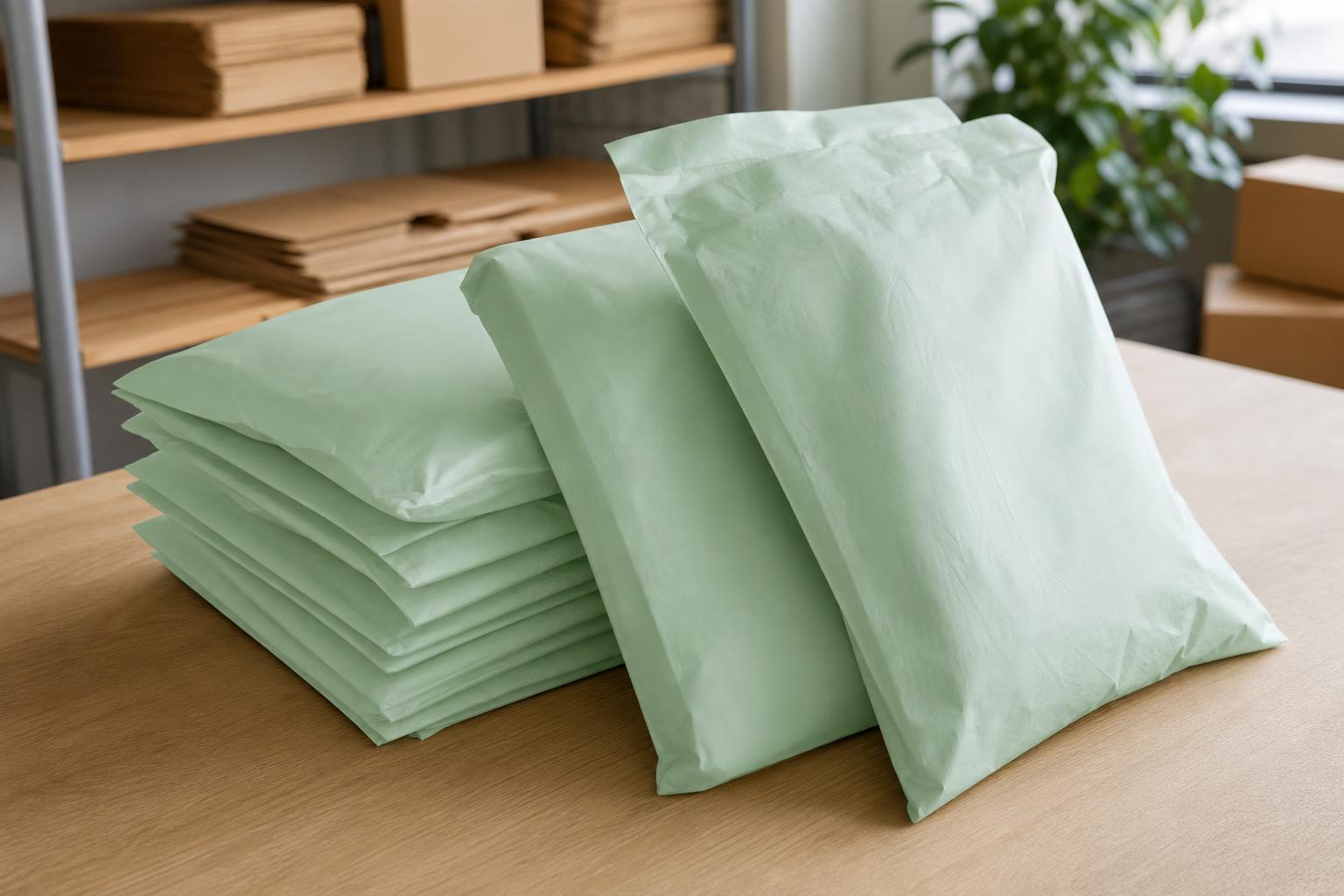
Sourcing compostable mailers wholesale sounds simple until you set it beside recycled poly mailers and realise the two products solve different problems. One is designed to break down under the right conditions. The other keeps plastic in use by being made from recovered material, and in many places it can be recycled again. They differ on unit cost, on how long unsold stock stays usable, and on what you can honestly print on the bag or put on your website. This guide compares both for ecommerce businesses, retailers and growing brands buying in volume. It covers cost drivers, shelf life, certifications and the wording of environmental claims, with notes on where rules differ between countries.
In this article
- Key takeaways
- Compostable and recycled mailers: what each one actually is
- Cost: compostable mailers wholesale versus recycled poly mailers
- Shelf life and storage: the hidden cost of bulk compostable mailers
- What the claims and certifications really mean
- Performance in the real world: strength, seals and weather
- How to buy in bulk with confidence
- Which mailer should you choose?
- Conclusion
Key takeaways
- Compostable mailers usually cost more per unit than recycled poly mailers, and they carry a shelf-life risk that recycled film largely avoids.
- "Compostable" is not one thing. Industrial and home compostable are different standards, and most local collection systems accept neither in a household food bin.
- "Recycled" describes what the bag is made from. "Recyclable" describes what can happen to it afterwards. Neither word covers the other.
- Ask for certificates and test reports tied to the exact product, not a general statement about the supplier's range.
- Work out how many months of stock you will actually use before you commit to a large order of compostable film.
Compostable and recycled mailers: what each one actually is
Both products look like a standard shipping bag, so it is easy to treat them as interchangeable. They are not, and the material behind each one decides how it behaves in storage, in transit and at the end of its life.
Compostable mailers
Most compostable mailers are made from blends of biodegradable polymers, often PBAT combined with plant-based materials such as PLA or starch. They are engineered to break down into water, carbon dioxide and biomass in a composting environment. That environment matters: the headline industrial standards test at around 58°C (136°F) with controlled moisture and aeration, which is very different from a backyard heap.
Recycled-content mailers
Recycled poly mailers are made from polyethylene that includes a share of recovered plastic. That might be post-industrial waste (offcuts from factories) or post-consumer waste (plastic that was used and collected). The share varies a lot between products, from a modest blend to nearly all recycled resin, so the percentage and its source are the facts that matter.
Why "biodegradable shipping bags" is the riskiest label
You will see biodegradable shipping bags offered at attractive prices. Be careful. "Biodegradable" has no time limit and no required end condition, so almost anything can be called biodegradable if you wait long enough. Some products sold under this label are ordinary plastic with an additive. Regulators in several regions have challenged generic uses of the word, and you should prefer a specific, certified term instead.
Cost: compostable mailers wholesale versus recycled poly mailers
Prices change with resin markets, freight and order size, so no honest article can give you a fixed number. What you can do is understand the structure of the cost and compare on the right basis.
Why compostable film costs more
Compostable resins are made in smaller volumes than polyethylene, and the film is harder to process. Certified formulations also carry testing costs. As a result, bulk compostable mailers typically sit at a premium to standard poly mailers of the same size, and the gap is usually wider than for recycled-content film. The premium shrinks as volume rises, but it rarely disappears.
Where recycled poly mailers sit
Recycled content can raise or lower cost depending on the resin market. When recycled resin is scarce, high-percentage recycled film can approach the price of virgin film or exceed it. In most cases it stays much closer to standard poly than compostable film does. Colour is also a factor, because recovered resin tends to produce grey or darker bags.
Compare total cost, not just unit price
The cheapest line on a quote is not always the cheapest bag to use. Include these items in your comparison:
- Unit price at the quantity you will really order.
- Freight, which is quoted separately and depends on weight, volume and destination.
- Write-off risk from stock that ages before you use it.
- Damage and reship costs if a thinner film fails in transit.
- Storage space, since a mailer that needs controlled conditions costs more to hold.
| Factor | Compostable mailers | Recycled poly mailers |
|---|---|---|
| Typical unit cost | Higher than standard poly | Close to standard poly, varies with resin market |
| Shelf-life risk | Meaningful; plan stock rotation | Low under normal storage |
| Storage needs | Cool, dry, out of sunlight | Normal dry warehouse conditions |
| End-of-life route | Composting, if a suitable facility exists | Film recycling where collected; otherwise waste |
| Main claim risk | Overstating compostability | Confusing recycled with recyclable |
Shelf life and storage: the hidden cost of bulk compostable mailers
Shelf life is the point most competitor guides skip, and it is the one that costs businesses real money. Polyethylene film can sit in a warehouse for a long time with little change. Compostable film is designed to degrade, so it is less forgiving.
How long compostable mailers last in storage
Manufacturers of compostable film often recommend using it within roughly six to twelve months of production, though the figure depends on the formulation, so treat that range as a rough guide and ask for the maker's stated figure for your product. Heat, humidity and sunlight speed up ageing. Signs of trouble include a bag that feels brittle, seals that peel or cannot hold, film that tears more easily than it did on arrival, and a faint odour change. Note that the clock may start at production, not at delivery, so ask about production dates when you order.
Recycled poly mailers and ageing
Recycled poly film is polyethylene, so it ages slowly in a dry, covered warehouse. It can still suffer from long exposure to UV light, which can weaken the film and fade colour, and the adhesive strip on a self-seal mailer can lose tack in extreme heat or cold. You should still rotate stock, but the penalty for overbuying is far lower.
A simple storage routine
- Keep cartons closed and off the floor, ideally on pallets.
- Store away from direct sun, heaters and loading-dock doors. Aim for a cool, dry space, roughly below 25°C (77°F) where you can.
- Label each carton with its receipt date and production date, and use the oldest first.
- Run a quick seal and tear check on a few bags from older cartons before they go to the packing line.
- Re-forecast every quarter so you never hold more compostable stock than you expect to ship.
What the claims and certifications really mean
This is where a good packaging choice can turn into a legal or reputational problem. Environmental claims are regulated in many countries, and the rules are tightening. Generic claims such as "eco-friendly" or "green" are increasingly treated as misleading when they are not backed by specific evidence. Check the current rules in each market where you sell, and see our overview of packaging rules a small business needs to know for a starting point.
Compostable, home compostable and industrially compostable
Industrial compostability is tested against standards such as EN 13432 in Europe, ASTM D6400 in the United States and AS 4736 in Australia. Home compostable mailers must meet a separate, tougher test at lower temperatures, for example the TÜV Austria OK compost HOME scheme or Australia's AS 5810. Not every product that passes industrial testing passes the home test. In practice, many customers do not have access to either an industrial facility or a hot home compost, so a compostable claim does not guarantee the bag will be composted.
Recycled content versus recyclable
A recycled poly mailer can truthfully say how much recycled material it contains, ideally with a figure and the type (post-consumer or post-industrial). That does not make it recyclable at the kerb. Soft plastic film is often not accepted in household recycling and is instead collected through store drop-off schemes in some countries. Say "check local soft plastic recycling" rather than "recyclable" unless you know your customers have access.
Certifications worth asking for
| Claim you want to make | What to ask the supplier for |
|---|---|
| Industrially compostable | Certificate to EN 13432, ASTM D6400 or the local equivalent, for this exact product |
| Home compostable | A home-compost certificate such as OK compost HOME or AS 5810 |
| Recycled content | Stated percentage, source of the material, and ideally third-party verification such as the Global Recycled Standard |
| Recyclable | Evidence of a collection route in the countries you ship to |
Certificates are issued for specific formulations and thicknesses. If the bag you receive differs, the certificate may not apply, so match the certificate to the product code.
Performance in the real world: strength, seals and weather
A greener bag that splits in the sorting centre is neither green nor cheap, because the wasted product, the second shipment and the unhappy customer outweigh any material saving.
Strength and film thickness
Compostable films can be strong, but they behave differently to polyethylene. Some are stiffer and more prone to tearing once nicked, while recycled poly can show small variations in strength between batches. Thickness matters in both. Read our guide to poly mailer thickness, mil, micron, film and seals to convert between units (1 mil equals 25.4 microns) and decide what suits your parcel weight. If you ship heavier or sharp-cornered goods, consider whether a mailer is the right format at all.
Seals, moisture and heat
Compostable film reacts to moisture and heat over time. A parcel stored in a hot delivery van or a humid warehouse is under more stress than one in a cool room. Recycled poly handles wet conditions well and is not affected by humidity in the same way. If you ship to tropical climates or through long, uncertain supply chains, that matters. For fashion and soft goods, our guide to the best compostable mailers for clothing covers materials, strength and certifications in more detail.
How to buy in bulk with confidence
Buying a large volume of any mailer carries risk. With compostable film, a mistake can also expire on your shelf.
Ask for documents, not adjectives
Before you order, request the product specification sheet, the film thickness, the certificate numbers and the production or manufacture date practice. Check that the certificate names the same product, and where it lists a certifying body, that the certificate is current. Pack Merchants supplies recycled and compostable mailers alongside poly, bubble and kraft paper mailers, and the product page for each item is the place to confirm what is specified for that item.
Match order size to shelf life
Every product has its own minimum order quantity, and each is worth at least $500, so the smallest possible order is set by the product and not by a flat number of units. Work out how many months that quantity will last at your current shipping rate. If it is more than the shelf life the maker states, the right answer may be a recycled mailer for your main volume and compostable for a smaller, faster-moving line. Our explainer on what a $500 minimum order actually means shows how that works in practice. Note that we do not offer samples, so rely on the specification sheet, certificates and your own incoming checks on the first delivery.
Budget for freight and payment up front
Freight is always quoted separately for each order, and prices are in US dollars. Payment is made in advance by bank transfer or USDT, a US-dollar stablecoin. We do not offer credit terms. Build all of these into your cash-flow plan, especially for bulky, lightweight products where freight can be a large part of landed cost.
Which mailer should you choose?
There is no universal winner. The right choice depends on your customers, your volume and the claims you are prepared to prove.
Choose compostable when
- Your customers have access to composting and you can explain the right disposal route.
- You ship at a steady rate, so stock turns over well within shelf life.
- You can hold certificates for the exact product and are willing to make a narrow, accurate claim.
Choose recycled when
- Cost per parcel and durability matter most.
- You ship in humid, hot or long-distance conditions.
- You want to reduce virgin plastic without adding shelf-life risk, and you can state the recycled percentage honestly.
Consider a split approach
Many brands use recycled poly mailers for core volume and a compostable range for a premium line or specific markets. If you are unsure whether a mailer is even the right format, our comparison of the poly mailer vs bubble mailer options is a useful next read.
Conclusion
Compostable and recycled mailers answer different questions. Compostable film is a higher-cost option with a limited shelf life and a claim that depends on disposal infrastructure. Recycled poly is generally cheaper, more stable in storage and easier to defend if you state the recycled percentage precisely. Whichever you choose, ask for product-specific certificates, plan your stock against shelf life, and keep your packaging claims narrow and provable.
Frequently asked questions
Are compostable mailers cheaper than recycled mailers?
Usually not. Compostable mailers typically cost more per unit than recycled poly mailers because the resins are produced in smaller volumes and certification adds cost. The gap varies by size, thickness and order volume, so compare quotes for the same specification.
How long do compostable mailers last in storage?
Many manufacturers suggest using compostable film within roughly six to twelve months, but this depends on the formulation and storage conditions. Keep stock cool, dry and out of sunlight, and ask the maker for the stated figure for your product.
What is the difference between compostable and home compostable mailers?
Industrially compostable mailers are tested to break down in controlled, hot conditions of around 58°C (136°F). Home compostable mailers must pass a separate test at lower temperatures. A product can pass the first without passing the second.
Are recycled poly mailers recyclable?
Not automatically. Recycled content describes how the bag was made, while recyclability depends on whether soft plastic film is collected where your customer lives. In many countries it is accepted only through store drop-off schemes, if at all.
Is biodegradable the same as compostable?
No. Biodegradable has no required timeframe or end condition, so it is vague and often challenged by regulators. Compostable, when backed by a recognised certification, is more specific and easier to verify.
Which certifications should compostable mailers have?
Look for certification to EN 13432, ASTM D6400 or AS 4736 for industrial composting, depending on your market. For home compostable claims, look for OK compost HOME or AS 5810. Make sure the certificate covers the exact product you are buying.
Can I put compostable mailers in my household food waste bin?
Only if your local collection scheme says so. Many municipal food-waste programmes do not accept compostable plastics, and rules differ by country and by city. Give customers clear instructions that match the real options where they live.
Can I order a sample of a mailer before buying in bulk?
Pack Merchants does not offer samples. Use the product page specifications, certificates and thickness details to decide, then check the first delivery against them when it arrives.
Still not sure?
Tell us what you ship and roughly how much of it, and we will recommend a specification and price it.