Packaging guide
How Much Do Poly Mailers Cost? Cost Drivers and Bulk Pricing (2026)
How much do poly mailers cost? See what drives poly mailer price (size, thickness, print, freight) and how bulk volume lowers the unit cost.
Updated Nov 8, 2026
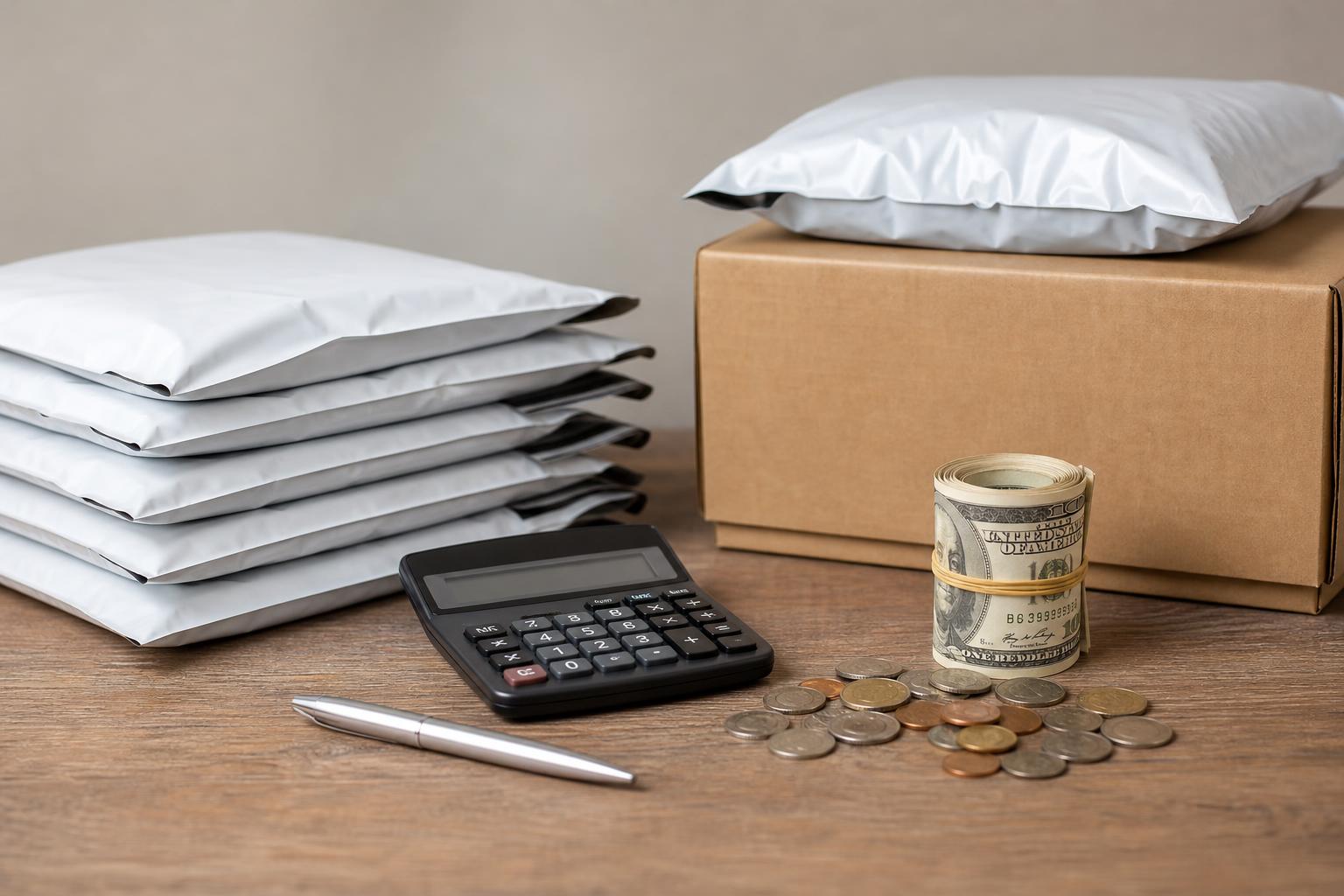
How much do poly mailers cost? The honest answer is that there is no single price, because the cost of each bag depends on film thickness, size, print, order quantity and freight. A plain mailer bought by the pallet costs a fraction of the same bag bought in a small pack, and a custom printed mailer adds setup and ink on top of the base price. This guide breaks down each cost driver in order of impact, shows the arithmetic for working out your real cost per shipment, and explains how larger quantities bring the unit price down. It is written for ecommerce businesses and retailers buying at wholesale, and it applies whichever country you ship from or to.
In this article
- Key takeaways
- What Drives the Price of a Poly Mailer
- How Much Do Poly Mailers Cost per Unit? A Simple Way to Calculate It
- How Buying in Bulk Lowers the Poly Mailer Price
- Thickness and Size: Where You Can Save and Where You Should Not
- Custom Poly Mailers Cost: What Printing Adds
- Hidden Costs Behind the Cost of Shipping Bags
- Cheapest Poly Mailers vs Lowest Total Cost
- How to Plan a Poly Mailer Order
- Conclusion
Key takeaways
- Poly mailer price is driven mainly by film thickness and bag size, because both determine how much plastic goes into each bag.
- Larger orders lower the unit price by spreading fixed costs, such as production setup and freight, across more bags.
- Custom printing adds setup and ink costs, so it pays off only at higher volumes and is quoted per order.
- The cheapest poly mailers per unit are not always the cheapest per shipment once failures, postage weight and freight are counted.
- Work out your cost per shipment, not just cost per bag, and size your order from your monthly shipment volume.
What Drives the Price of a Poly Mailer
A poly mailer is a simple product: plastic film, a seal, and an adhesive strip. Because the construction is simple, price differences come from a small number of factors. Understanding them lets you read any quote and see where the money is going.
Film thickness and material
Thickness is the biggest lever. It is measured in mils (thousandths of an inch) or microns (thousandths of a millimetre), where 1 mil equals 25.4 microns. Many standard mailers sit somewhere around 2 to 3 mil (roughly 50 to 75 microns), but the exact range varies by supplier. A thicker film uses more resin, so it costs more to make and weighs more to ship. Material also matters: virgin polyethylene, recycled-content film and compostable film are priced differently, and recycled or compostable options generally cost more than standard film. Our guide to poly mailer thickness, film and seals explains what each gauge is suited for.
Size and surface area
Bag price rises with surface area, and area grows faster than the dimensions suggest. A mailer of 10 x 13 in (25 x 33 cm) has about 130 sq in (825 sq cm) of face area. A mailer of 14.5 x 19 in (37 x 48 cm) has about 275 sq in (1,776 sq cm), which is more than double the film for a bag that looks only modestly larger. The bigger bag also costs more to freight and store. Choosing the smallest size that fits the product is one of the simplest ways to cut your cost of shipping bags.
Closure, finish and extras
Features add small amounts per bag: a double adhesive strip for returns, a tear strip, a matte or glossy finish, an opaque or co-extruded layer for privacy, or a perforation. Each one is a minor cost alone, but they stack. Decide which features your customers and your fulfilment process actually need, and drop the rest.
How Much Do Poly Mailers Cost per Unit? A Simple Way to Calculate It
Because prices are quoted in different currencies, pack sizes and units around the world, the most useful skill is converting any quote into a comparable cost per bag. Use the method below for every supplier, including us.
The basic formula
Divide the total landed cost by the number of usable bags. Landed cost means the product price plus freight, duties, taxes and any other charges to get the bags to your door. A quote of a price per 1,000 bags becomes a unit price by dividing by 1,000. A quote per case becomes a unit price by dividing by the bags per case. Always check how many bags are in a case and whether the quoted size is the internal usable size or the outside dimension including the flap.
What the $500 minimum buys at different unit prices
At Pack Merchants, wholesale packaging is sold in bulk only, with a $500 minimum per product. The table below shows the simple arithmetic of how many bags a $500 product order covers at different unit prices. The unit prices are round numbers chosen only to illustrate the maths. They are not a quote; check the published volume pricing on the product page for real figures.
| Example unit price (illustration only) | Bags covered by $500 |
|---|---|
| $0.05 | 10,000 |
| $0.08 | 6,250 |
| $0.10 | 5,000 |
| $0.15 | 3,333 |
For a deeper look at turning the minimum into a plan, see our guide on turning the $500 per product minimum into a quantity plan.
Price per bag versus price per shipment
Cost per shipment includes the bag, the label, the tape if any, and the effect of the bag on postage. A bag that is 2 g lighter might save little on one parcel but a meaningful amount across a year of shipments if it moves you under a carrier weight band. Always compare packaging at the shipment level.
How Buying in Bulk Lowers the Poly Mailer Price
Volume lowers the price per bag because many of the costs in a mailer order do not rise in step with the quantity. Manufacturers, shippers and suppliers all have fixed or semi-fixed costs that get shared across more units as the order grows.
Fixed costs spread over more bags
Setting up a production run, changing material, cutting and packing all take time regardless of whether the run makes 5,000 bags or 50,000. Larger runs spread that effort thinly. The result is a lower cost per bag, which suppliers pass on through volume pricing tiers.
Freight per bag falls as the order grows
Freight is the second big saver. Bags are light and bulky, so freight is often charged by space or by pallet. Using illustrative maths only: if freight for a shipment is $200 and it covers 5,000 bags, freight adds $0.04 per bag. If the same $200 freight charge were to cover 10,000 bags, it would add $0.02 per bag. Real freight is quoted per order and depends on destination, weight and volume, so this only shows the direction of the effect.
Volume pricing and how to read it
Our volume pricing is published, so you can see where each price break sits before you order. The table shows which costs shrink per bag and which do not.
| Cost component | Behaves like | Effect of a larger order |
|---|---|---|
| Film and resin | Variable | Small change; tier pricing may help |
| Production setup | Fixed per run | Cost per bag falls sharply |
| Freight | Semi-fixed | Cost per bag falls as space is filled |
| Printing plates or artwork | Fixed per design | Cost per bag falls sharply |
| Storage | Variable | Rises with quantity held |
The last row matters: volume is not free. Larger orders need space and tie up cash, so the best quantity is the one that gets you into a lower price tier without leaving you holding a year or two of stock.
Thickness and Size: Where You Can Save and Where You Should Not
Since thickness and size drive material cost, they are where careful specification pays off. The goal is the lightest, smallest bag that still protects the goods and survives your carrier network.
Matching thickness to the product
| Product type | Typical thickness need | Cost note |
|---|---|---|
| Soft garments, textiles | Standard film | Thicker film adds cost with little benefit |
| Items with corners or edges | Heavier film or a different pack type | Tears cost more than thicker film |
| Fragile goods | Not a plain poly mailer | Consider bubble mailers or a box |
Over-specifying thickness is a common waste for apparel sellers, while under-specifying leads to split seams and replacements. Test a handful of real parcels through your own carrier before committing to a pallet quantity.
Right-sizing to cut material and postage
An oversized bag wastes film and can push a parcel into a larger postage size band with some carriers. Rules vary by country and carrier, so check how yours measure parcels. Measure your folded product at its thickest point, then add allowance for the seal flap. Our poly mailer size chart and fit guide is a useful starting point. Keeping your range to two or three sizes also helps, because ordering fewer sizes in larger quantities gets you better volume pricing on each.
Custom Poly Mailers Cost: What Printing Adds
Custom poly mailers cost more than plain stock bags because printing adds work and materials. For a growing brand, the question is whether the branding value justifies the extra cost at your volume.
Setup and artwork costs
Printed bags often need plates or cylinders, plus artwork preparation and proofing. These are one-time costs per design. Spread over a small run they can add a lot per bag, and spread over a large run they become minor. That is why custom printing makes the clearest case for volume.
Ink coverage and colour count
A single-colour logo on one side is cheaper than full-colour all-over print. More colours and more coverage mean more ink and more setup. If budget is tight, a simple one-colour mark on a plain mailer gives a branded look at a lower cost.
Why custom orders are quoted per order
Custom packaging and freight are quoted per order, because the price depends on your size, material, print and quantity. Give your supplier exact dimensions, thickness, colours and the quantity you expect to use over a year. Clear specifications produce accurate quotes and avoid reprints. If you want branded packaging without the cost of a custom bag, a printed label or a branded sticker on a plain mailer can work, and we also supply labels and packing tape.
Hidden Costs Behind the Cost of Shipping Bags
The quoted bag price is only part of what you pay. Costs outside the quote can change which option is actually cheapest.
Freight, duties and taxes
Freight is quoted per order and varies by distance and delivery method. Import duties, VAT, GST or sales taxes depend on your country, and the rules differ widely, so check your local customs and tax treatment before comparing quotes from suppliers in different countries. Exchange rates can also move the real price of an order paid in a foreign currency.
Storage and tied-up cash
Bulk orders need dry, clean storage, and the money spent on stock is not available for other uses. We take payment by bank transfer or USDT (USDT is the only cryptocurrency we accept), and we do not offer credit or Net terms, so budget for the full order amount up front.
Failure and damage costs
A split bag, a failed seal or a lost item costs far more than the bag itself: the replacement product, postage again, and a possibly unhappy customer. If a thinner bag has even a small increase in failure rate, the savings can disappear quickly. Track your damage and loss rate by packaging type so the data guides your next purchase.
Cheapest Poly Mailers vs Lowest Total Cost
Searching for the cheapest poly mailers is understandable, but the lowest unit price can hide higher total cost. Look at what the bag has to do.
When a different mailer is the better value
Poly is cost-effective for soft, non-fragile goods. For items needing cushioning, a bubble mailer may cost more per bag but reduce breakage; see our wholesale poly mailers and courier bags guide for how poly compares on thickness and bulk orders. If your customers expect paper or you sell in markets with plastic restrictions, our kraft paper mailer comparison with poly shows when paper works and when poly wins. We also supply recycled and compostable mailers, bubble mailers and corrugated boxes.
How to compare quotes fairly
- Confirm the exact size, measured the same way in each quote.
- Confirm the film thickness in the same unit (mil or microns).
- Convert every price to a cost per bag.
- Add freight, duties and taxes to reach the landed cost.
- Check the seal and adhesive quality, because the cheapest option often compromises here.
- Check minimum order quantities and how many bags that really gives you.
How to Plan a Poly Mailer Order
A good order plan balances price tiers against storage and cash. A few simple steps keep it grounded in real data.
Work backwards from monthly shipments
Count how many parcels per month use each mailer size. Multiply by the months of stock you can comfortably store, and add a buffer for seasonal peaks and reorder time. If the result sits just below a price break, compare the cost of the extra bags against the saving per bag across your whole order. Sometimes stepping up a tier is clearly worth it, and sometimes it only adds stock. Our 2026 supplier checklist for buying packaging in bulk covers other questions worth asking.
Payment and budgeting
With bank transfer or USDT as the only payment options and no credit terms, plan your cash flow so the order is paid before dispatch. Request the freight quote early, since it is quoted per order and can change your best quantity. Order the bags together with the tape, labels and stretch film you need so freight is shared across one shipment.
Conclusion
How much poly mailers cost depends on thickness, size, print, quantity and freight, and the cost per bag is only the start of the calculation. Volume lowers the price by spreading fixed production and freight costs across more units, while storage and cash flow set the upper limit on what is sensible to buy. Specify the lightest, smallest bag that does the job, convert every quote to a landed cost per bag, and compare packaging at the cost per shipment level.
Frequently asked questions
How much do poly mailers cost?
There is no single price, because it depends on size, film thickness, print and order quantity. Bulk orders cost much less per bag than small packs. The best way to compare is to convert every quote into a landed cost per bag, including freight and any duties or taxes.
Why does the poly mailer price drop when I order more?
Fixed costs such as production setup, printing plates and freight are spread across more bags as the quantity grows. That lowers the cost of each bag. Suppliers usually reflect this in volume pricing tiers.
How much do custom poly mailers cost compared with plain ones?
Custom poly mailers cost more per bag because of artwork, setup, plates and ink. The extra cost per bag falls as the run gets larger. Custom packaging is quoted per order, so exact figures depend on your size, print and quantity.
What is the cheapest way to buy poly mailers?
Buy in bulk, choose the smallest size and thinnest film that still protects your product, and use a plain or one-colour design. Also compare landed cost, since freight, duties and taxes can change which supplier is truly cheapest.
Does a thicker poly mailer cost more?
Yes, a thicker film uses more plastic, so it usually costs more and weighs more. Thicker is not always better, because soft goods rarely need it. Choose the thickness that matches your product and carrier handling.
How many poly mailers do I get for the $500 minimum?
It depends on the unit price of the product you choose. Divide $500 by the unit price to see the quantity, so a bag at a unit price of $0.10 would give 5,000 bags. Check the published volume pricing for the real figures.
How can I pay for a wholesale poly mailer order?
We accept payment by bank transfer or USDT. USDT is the only cryptocurrency we accept, and we do not offer credit or Net terms. Plan to pay the full order amount before dispatch.
Are poly mailers always the cheapest shipping bags?
They are often the lowest cost for soft, non-fragile goods, but not for everything. Fragile items may need bubble mailers or boxes, and some markets or customers prefer paper or compostable options. Compare total cost per shipment, not just the bag price.
Still not sure?
Tell us what you ship and roughly how much of it, and we will recommend a specification and price it.