Packaging guide
Ecommerce Mailer Boxes Wholesale: Compared With Shipping Boxes and Mailers (2026)
Compare ecommerce mailer boxes wholesale with shipping boxes and mailers for presentation, protection, sizing and bulk ordering. A buyer's guide.
Updated Oct 30, 2026
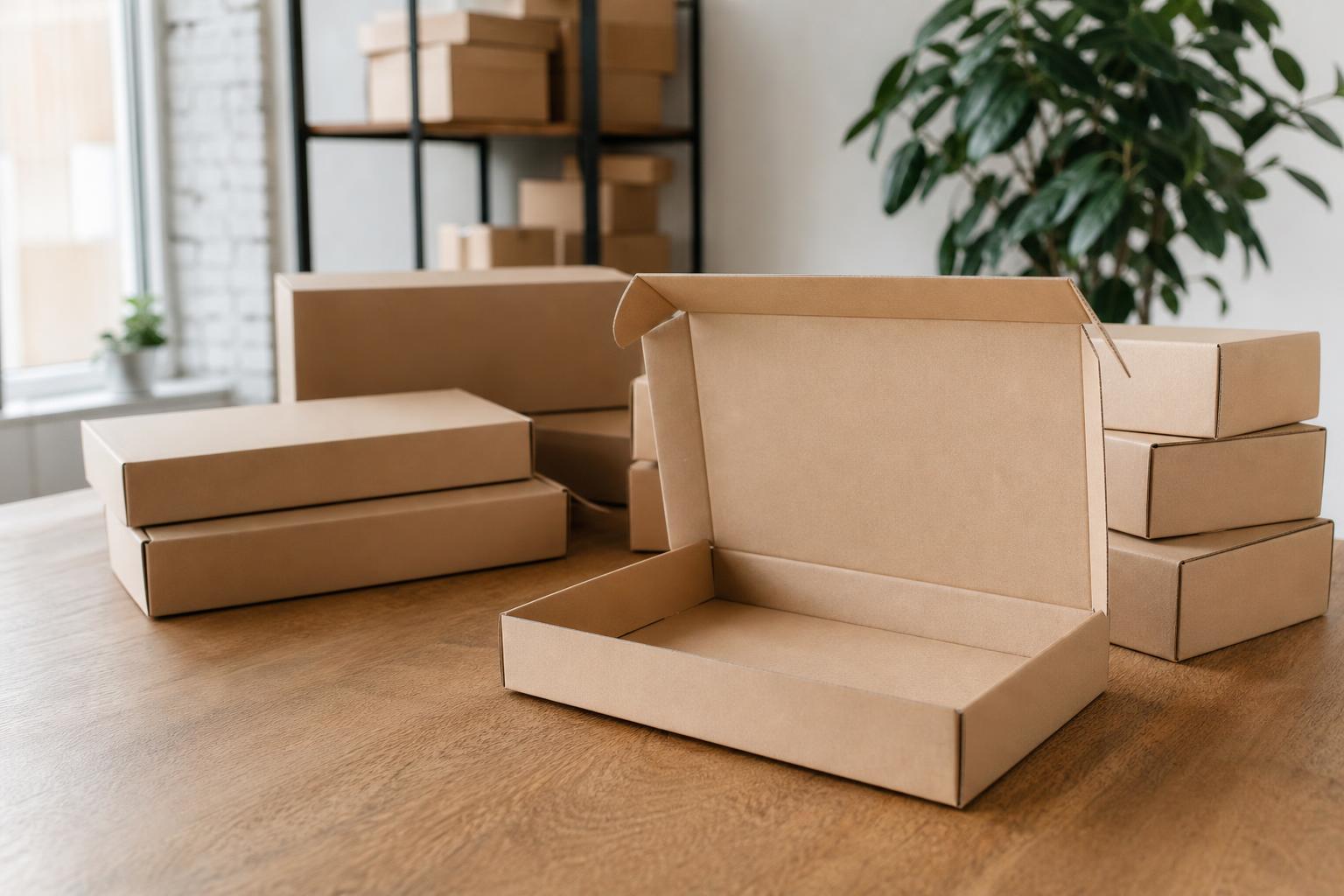
Ecommerce mailer boxes wholesale is the search most brands reach when they want parcels that look good on arrival and still survive a carrier network, but they are not sure whether a mailer box, a standard shipping box or a mailer bag is the right format. Each one solves a different problem. Mailers are light and cheap to ship, shipping boxes are built for stacking and rough handling, and mailer boxes sit between the two by adding presentation without always needing an outer carton. This guide compares the three on presentation, protection, cost drivers and ordering, so you can choose per product line and buy in bulk with fewer surprises. Carrier rules and pricing differ by country, so always check them locally.
In this article
- Key takeaways
- Ecommerce mailer boxes wholesale: what they are and how they differ
- Presentation: how each format looks when the customer opens it
- Protection: crush, puncture, moisture and movement
- Mailer box vs shipping box vs mailer: side-by-side comparison
- Mailer box sizes and board: how to specify a bulk order
- Which format fits your product?
- How to buy ecommerce mailer boxes wholesale without costly mistakes
- Conclusion
Key takeaways
- A mailer box is a self-locking, usually tape-free folding box that ships flat. It is the strongest option for presentation and a middle option for protection.
- Shipping boxes still win on stacking strength, heavy items and long or rough journeys. Mailers win on weight, storage space and cost for soft, durable goods.
- Judge packaging by cost per shipment, including damage, returns and carrier size or weight charges, not by unit price alone.
- Specify mailer box sizes from the internal dimensions of your packed product, in millimetres and inches, and allow clearance for inserts.
- Because bulk orders are large, confirm specs and minimum order quantities on the product page, and remember freight is quoted separately.
Ecommerce mailer boxes wholesale: what they are and how they differ
The three formats get mixed up in everyday talk, so it helps to define them before comparing. The differences in structure explain almost everything about how each one performs.
Mailer boxes
A mailer box is a folding box, normally corrugated board, with a hinged lid that tucks or locks into place. It arrives flat, folds up in seconds and usually needs no tape to close. The common roll-end tray style is catalogued as FEFCO 0427 in the European code system, a reference used by box makers in many countries. Corrugated mailer boxes are typically made from thinner flutes, which gives a smooth printable surface and a neat, compact look. Many brands use them as both the retail box and the shipping carton.
Shipping boxes
The standard shipping box is a regular slotted carton: four flaps fold in and meet in the middle, and you close it with tape. It comes in single-wall and double-wall board and is designed to be stacked, dropped and sorted by machines. If you want to understand board grades and edge crush test (ECT) ratings, our guide to wholesale corrugated shipping boxes, board grades and pallet ordering goes into detail.
Mailers (poly, bubble and kraft paper)
Mailers are flexible envelopes. Poly mailers are plastic film, bubble mailers add a cushioned lining, and kraft paper mailers use paper outside. They have no rigid structure, so they protect against scuffs, dirt and light moisture rather than crushing. They are very light and take almost no storage space. Our poly mailer vs bubble mailer decision table helps when you are choosing between the flexible options.
Presentation: how each format looks when the customer opens it
Presentation is where mailer boxes earn their place. A customer who pulls a tape strip, lifts a lid and finds the product sitting in a clean tray has a different first impression from one who tears open a plastic bag.
Unboxing and brand perception
A mailer box behaves like a gift box that happens to be a shipping container. The lid reveals the product in one motion, the structure holds its shape, and the customer is more likely to keep or reuse it. That matters for products where the packaging is part of the perceived value: cosmetics, accessories, premium apparel, gifts and subscription products. Shipping boxes can look good too, but their flaps and tape lines make the opening less deliberate, and brands often add tissue, inserts or a second inner box to compensate.
Print and finish options
Mailer boxes have large flat panels inside and outside, which suits brand colours, patterns or a message printed inside the lid. Custom printing and sizing for packaging are quoted per order, so the cost depends on your artwork, quantity and specification. Plain kraft or white boxes are a simple starting point, and you can add a label, sticker or stamp for branding. Mailers can be printed as well, but the surface is flexible and the result reads as practical rather than premium.
When presentation does not pay back
Not every parcel needs a showpiece. Replenishment orders, spare parts, B2B shipments and low-margin items rarely benefit from an unboxing moment. In those cases, the extra material cost of a mailer box can outweigh the gain, and a mailer or a plain shipping box is more sensible. A useful test is whether customers are likely to photograph, gift or reuse the pack. If the honest answer is no, spend the money on protection instead.
Protection: crush, puncture, moisture and movement
Protection depends on four things: how well the pack resists crushing, how well it resists puncture, how it handles moisture, and whether the product can move inside. Mailer boxes do well on some and only moderately on others.
Crush and stacking
Rigid corrugated gives a mailer box real crush resistance for its weight, far more than any flexible mailer. However, it generally cannot match a double-wall shipping box in a heavy stack, because mailer boxes use thinner board and a lid that relies on tuck or lock tabs. For single-parcel shipping of light to medium products, that is usually enough. For heavy goods, pallet loads or very long journeys, a shipping box is the safer base.
Puncture and impact
Poly mailers are tough against tearing but offer little against corners or sharp edges. Bubble mailers add cushioning against light knocks. A mailer box resists punctures from outside better than either, and the product sits in a defined cavity. For items with sharp corners or high value, cushioning inside the box still matters.
Moisture and sealing
Plastic mailers are naturally water-resistant and the adhesive strip seals the whole pack. Corrugated absorbs moisture, which weakens it, and a mailer box with a tuck lid is not sealed against rain or humid freight. If your parcels travel through wet or tropical climates, consider a poly bag around the product inside the box, or a tape or label closure on the lid.
Void fill and product movement
Empty space is what damages products. A well-sized mailer box needs little fill, but any gap should be filled with paper, inserts or protective wrap. Our void fill comparison of paper, air pillows, bubble and foam shows how each option behaves. Honeycomb paper wrap is a practical paper-based choice for wrapping items before they go in the box. For fragile or high-value goods, many brands place the mailer box inside a shipping box rather than relying on one layer. You can validate any pack with drop and vibration tests, such as the procedures published by ISTA (an international transit testing association), or simply with your own repeated drop tests from table height.
Mailer box vs shipping box vs mailer: side-by-side comparison
The table below summarises how the three formats usually compare. These are general patterns, and individual products vary with board grade, film thickness and design.
| Factor | Mailer box | Shipping box (slotted) | Mailer (poly, bubble, kraft) |
|---|---|---|---|
| Presentation | Strong; opens like a gift box | Basic unless an inner pack is added | Functional; limited premium feel |
| Crush resistance | Medium to good | Good to very good, especially double-wall | Very low |
| Puncture and tear resistance | Good | Good | Poly: good against tears; bubble adds cushion |
| Water resistance | Low unless lined or sealed | Low unless lined or sealed | Poly and bubble: good; kraft paper: moderate |
| Packing speed | Fast; folds without tape | Moderate; needs tape | Fastest; peel and seal |
| Storage space (before use) | Flat, moderate | Flat, moderate to large | Very small |
| Parcel weight and volume | Low to medium | Medium to high | Lowest |
| Best for | Branded, retail-style, subscription products | Heavy, fragile, mixed or stacked goods | Apparel, soft goods, light durable items |
How to read the table
No format wins every row. If most of your risk is crushed corners and customers who judge you by the unboxing, a mailer box is the efficient answer. If your risk is heavy loads, long transit or fragile items, begin with a shipping box. If you ship soft, bendable items at high volume and margins are tight, a mailer is hard to beat.
Compare cost per shipment, not cost per unit
A mailer is almost always cheapest per unit, yet a damaged order costs the product, the reshipment, the carrier fee and the customer's trust. Carriers in many countries also charge by volumetric (dimensional) weight, which uses package size rather than actual weight, and the formula differs by carrier and region. A box that is too large can cost more to ship than a snugger one. Add up unit cost, packing labour, shipping charges and expected damage for each format before you decide.
Mailer box sizes and board: how to specify a bulk order
Getting the size and board right matters more in bulk than in small runs, because a wrong choice is multiplied across thousands of units.
Measure internal dimensions, not outside size
Mailer box sizes are normally quoted as internal length x width x height. Measure your packed product, including any bag, tissue or insert, in millimetres and inches (1 inch is 25.4 mm). Then allow a small clearance, so the product fits without force and the lid closes without bulging. If you pack several items, measure the stacked or arranged set. Remember that a tray-style mailer box has a lid, so depth is measured to the top of the tray, not the lid.
Flute and board choices
Flute is the wavy layer inside corrugated board. Finer flutes such as E-flute (about 1.5 mm or 1/16 inch thick) give a smoother print surface and a slimmer box. B-flute (about 3 mm or 1/8 inch) is thicker and gives more cushioning and crush strength. Thicker flutes like C (about 4 mm) are common in standard shipping boxes. Thicker is not always better: it makes the box bulkier and can affect fold quality in small mailer box sizes. Check the board specification on the product page rather than assuming it.
Subscription box packaging
Subscription box packaging has an extra requirement: a consistent footprint across months. Choose one or two box sizes that handle every variation of contents, and use inserts or paper wrap to hold items still when the load is lighter. Plan how fast your team can fold and pack, since a tape-free mailer box can save a few seconds per parcel. Over thousands of orders per month, the difference adds up.
Which format fits your product?
Rather than picking one format for the whole catalogue, many brands use two or three. Use the guidance below as a starting point and adjust for your own damage rates and customer feedback.
Apparel and soft goods
T-shirts, hoodies and other textiles do not break, so a poly mailer is usually the efficient choice. If you need the right fit, our guides on choosing a poly mailer size and film thickness help. Use a mailer box for premium or gift apparel, folded sets, or items where the box is part of the experience. Shipping mailer boxes also work well for apparel that should not arrive creased.
Cosmetics, candles and gifts
These products rely on appearance, and they are often glass, wax or liquid. A mailer box with a fitted insert or wrap gives both presentation and protection. For liquids and glass, add paper wrap or void fill, and consider an outer shipping box when parcels travel long distances or through rough networks.
Electronics and fragile items
Electronics and breakables carry high replacement costs. A shipping box with proper cushioning is typically the safer primary pack, and a mailer box can serve as an inner presentation box inside it. See our guide on packaging for electronics for specific considerations such as static, corners and movement.
- Light, durable, low-margin: mailer (poly, bubble or kraft paper).
- Premium, giftable, subscription: mailer box.
- Heavy, fragile, or long journeys: shipping box, with a mailer box inside if presentation matters.
How to buy ecommerce mailer boxes wholesale without costly mistakes
Buying mailer boxes in bulk is different from ordering a few for a trial. The commitment is bigger, so a short checklist protects your budget. If you are comparing suppliers generally, our 2026 supplier checklist for buying packaging in bulk is a useful companion.
Minimums, payment and freight
At Pack Merchants, packaging is sold in bulk only. Every product has its own minimum order quantity, worth at least $500, and the exact quantity is on each product page. Our guide to what a $500 minimum order actually means explains how to read that. Volume pricing is published, all prices are in US dollars, and custom packaging is quoted per order. Payment is made in advance by bank transfer or USDT, a US-dollar stablecoin. We do not offer credit terms. Freight is always quoted separately, so include it when you compare landed cost per unit.
Check specs before you order
We do not offer samples, so do your homework on paper first. Compare the internal dimensions and board specification on the product page against the measurements of your packed product. Test your packing method with boxes you already have that are close in size, and run drop tests from table height to see where movement happens. If your product sits between sizes, ask for a quote before committing rather than guessing.
A pre-order checklist
- Measure the packed product in millimetres and inches, including inserts.
- Decide whether a mailer box is the only pack or an inner pack inside a shipping box.
- Match the flute and board to the weight and the journey.
- Calculate cost per shipment, including volumetric weight where your carrier applies it.
- Confirm minimum order quantity, volume pricing, and freight quote.
- Check storage space for the delivered quantity, since boxes arrive flat but still take room.
- Check local packaging and labelling rules in your destination markets, as they differ by country.
Conclusion
Mailer boxes, shipping boxes and mailers each have a job. Mailer boxes give the strongest presentation and moderate protection, shipping boxes give the strongest protection for heavy or fragile goods, and mailers are the lightest and cheapest for soft items. The right choice depends on your product, your customers and the full cost per shipment. To see specifications and minimum order quantities, visit the Ecommerce mailer boxes product page. If you need custom sizes, printing or freight to your location, use the quote request page.
Frequently asked questions
What is the difference between a mailer box and a shipping box?
A mailer box is a self-locking folding box with a hinged lid, usually closed without tape and designed to look good when opened. A shipping box is a standard slotted carton closed with tape and built mainly for protection and stacking. Mailer boxes favour presentation, while shipping boxes favour strength.
Are mailer boxes strong enough to ship without an outer box?
For many light to medium products, yes, especially if the box is the right size and the product is held still. For fragile, heavy or high-value items, or long journeys, many brands place the mailer box inside a shipping box. Drop-testing your own packed product is the best way to decide.
Are mailer boxes better than poly mailers?
It depends on the product. Mailer boxes protect against crushing and look more premium, while poly mailers are lighter, cheaper and water-resistant. Soft goods like T-shirts usually suit poly mailers, while giftable or fragile goods suit mailer boxes.
How do I choose the right mailer box size?
Measure your packed product, including any bag or insert, and choose a box whose internal length, width and height allow a small clearance. Measure in millimetres and inches, and measure stacked items together. Avoid oversized boxes, which add void fill cost and can raise carrier charges.
What is the best mailer box for subscription box packaging?
Choose a size that fits every month's contents with inserts or paper wrap to hold lighter loads in place. A consistent footprint simplifies packing and storage. A tape-free mailer box can also speed up packing.
Can I order samples before buying mailer boxes in bulk?
Pack Merchants does not offer samples. Check the internal dimensions and board specification on the product page against your product, test your packing method with similar boxes you already have, and request a quote if you are unsure about a size.
How do I pay for a bulk order of mailer boxes?
Payment is in advance by bank transfer or USDT, a US-dollar stablecoin. We do not accept other cryptocurrencies and do not offer credit terms. Prices are in US dollars and freight is quoted separately.
Still not sure?
Tell us what you ship and roughly how much of it, and we will recommend a specification and price it.