Packaging guide
Bulk Shipping Boxes for Ecommerce: Pallet Counts, Storage and Reorder Points (2026)
Plan bulk shipping boxes for ecommerce: how many to order, pallet counts, storage space and reorder points, with worked examples.
Updated Nov 2, 2026
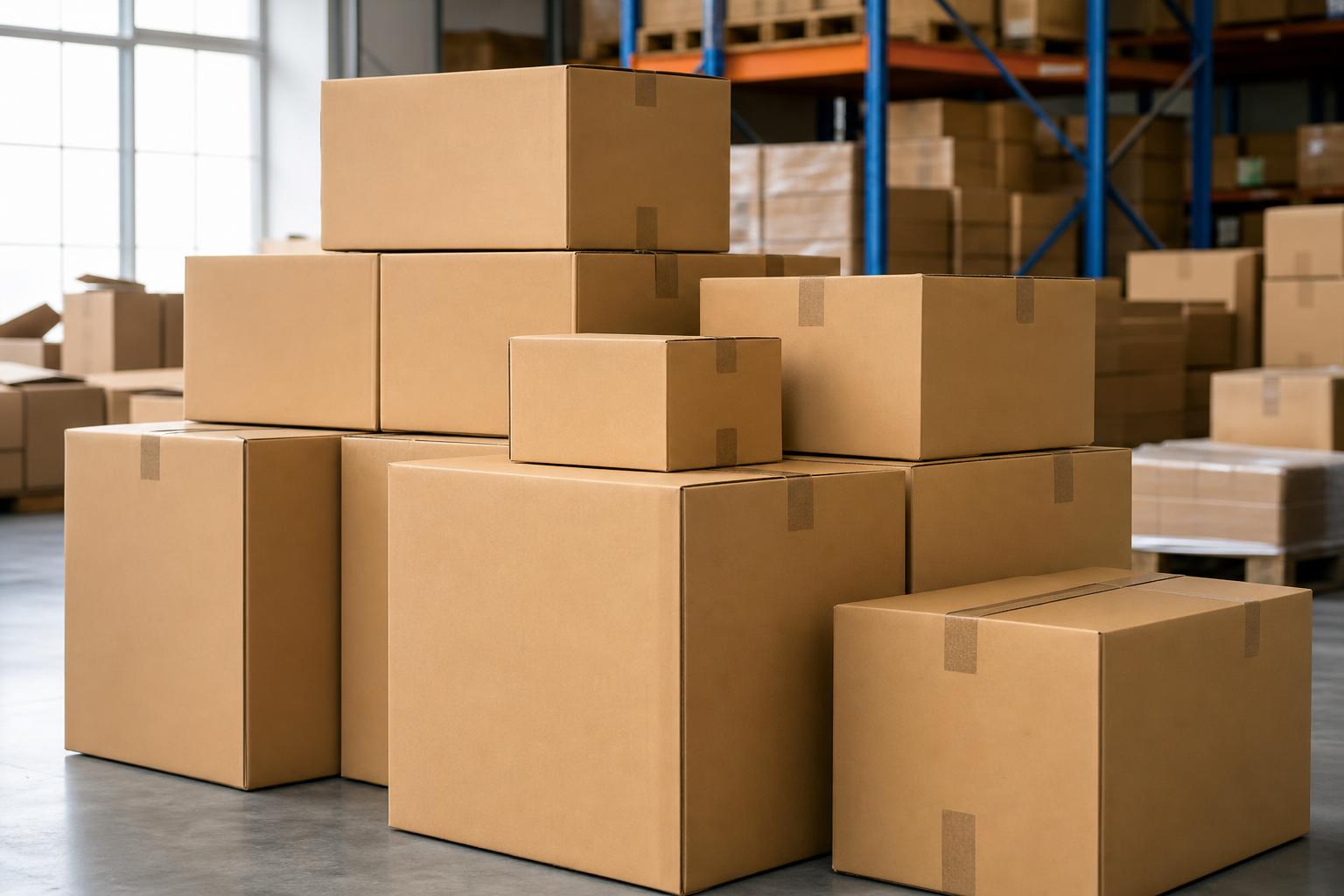
Buying bulk shipping boxes for ecommerce is less about finding the lowest price per box and more about getting three numbers right: how many boxes you will really use, how many pallets that becomes, and when to reorder. Get them wrong and you either run out in the middle of a peak week, or you tie cash up in pallets that block your aisles. This guide gives you a practical method for order-quantity planning, with worked examples in metric and imperial units, pallet maths, storage space rules and reorder-point formulas. The figures in the examples are illustrations only. Always confirm exact specifications, quantities and freight on the product page or in your quote.
In this article
- Key takeaways
- Why order-quantity planning matters for bulk shipping boxes for ecommerce
- How many shipping boxes to order: a demand-first method
- Box sizes for ecommerce: fewer sizes, bigger orders
- Pallet counts: turning boxes into pallets and floor space
- Shipping box storage: space, moisture and handling
- Reorder points for packaging: when to place the next order
- Buy shipping boxes in bulk without false savings
- A bulk box ordering checklist and how to request a quote
- Conclusion
Key takeaways
- Plan from demand: boxes needed per week, multiplied by the weeks of cover you want to hold.
- Convert every order into pallets, because pallets decide your storage space, handling and freight.
- Flat-packed boxes take a fraction of the space of assembled ones, so keep stock flat until it is needed.
- Reorder when stock falls to your reorder point: lead-time demand plus safety stock.
- Judge cheap shipping boxes in bulk by total landed cost, including freight, storage and damage, not unit price alone.
Why order-quantity planning matters for bulk shipping boxes for ecommerce
Packaging is a low-value item that causes high-value problems. A missing box size can stop a whole dispatch line, while an oversized order can occupy space that could hold fast-selling stock. Planning the quantity properly turns box buying from a reaction into a routine.
The two ways a box order goes wrong
The first failure is under-ordering. You run out of a size, staff switch to a larger box, and you pay more in void fill and carrier charges because larger parcels often cost more to ship. In many countries carriers price by dimensional (volumetric) weight, so an oversized box can cost more than the product's actual weight suggests. Rules differ by carrier and region, so check your own contracts.
The second failure is over-ordering. Boxes are bulky. A large order stored badly can be crushed, soaked or simply in the way, and a size you later retire becomes dead stock.
What changes when you buy by the pallet
Wholesale buying shifts the unit of thinking from single boxes to bundles and pallets. Freight is quoted by the load, so a part-filled pallet costs nearly as much to move as a full one. Storage is measured in pallet positions. Cash is committed in advance, so a larger order means more money sitting on your warehouse floor. For a deeper look at board grades and how pallet ordering works, see our guide to wholesale corrugated shipping boxes.
How many shipping boxes to order: a demand-first method
The question of how many shipping boxes to order has a simple answer: use your own order data, not a rule of thumb. Here is a method you can run in a spreadsheet in under an hour.
Step 1: map every product to a box
List your active products and assign each one to the smallest box that protects it with the right padding. Then add multi-item orders. Your order history shows which combinations are common, so look at the top 20 order patterns rather than every possible one. The output is a list of box sizes with the share of orders each one handles.
Step 2: forecast weekly usage
For each box size, take the average weekly orders over a recent period and multiply by that box's share. Then adjust for seasonality. If your sales run at 1.5 to 2 times normal for several weeks a year, build that into a separate peak forecast rather than averaging it away. Add a small allowance for damaged or mis-packed boxes, based on what you actually see in your warehouse.
Step 3: choose your weeks of cover
Weeks of cover is how long an order should last. Three limits decide it:
- Storage: how many pallet positions you can spare.
- Cash: payment is made in advance, so a bigger order commits more up front.
- Product minimum: each product has its own minimum order quantity, shown on its product page.
Pick the weeks of cover that fits inside the tightest of the three, then round to whole pallets where the product allows it. Our explainer on what a $500 minimum order actually means shows how minimums work in practice.
Box sizes for ecommerce: fewer sizes, bigger orders
Every extra size you stock splits your volume, adds a storage location and raises the chance of a stock-out. Choosing box sizes for ecommerce carefully is the quickest way to make each purchase larger, simpler and easier to plan.
Measure the product, not the old box
Measure the packed product in length, width and height, and always quote box sizes as inside dimensions. Add room for protection: typically a few millimetres to a couple of centimetres (roughly 0.25 to 1 in) each side, depending on how fragile the item is. Test the fit using boxes you already have, or fold a template from spare cardboard. Samples are not offered, so rely on the dimensions and specifications published on the product page and check them against your own measurements.
Cut the size range
Group your products into three to five box sizes that cover most orders. Moving a product into a slightly larger box that is already in stock is often cheaper than adding a seventh size, once you account for storage and ordering effort. Review the range once or twice a year, using data on how often each size is used.
When a mailer box or mailer is the better pick
Not every parcel needs a plain shipping box. Soft goods often ship better in poly mailers, and presentation-led products suit mailer boxes. Our guide to ecommerce mailer boxes compared with shipping boxes and mailers explains where each format fits. Moving suitable products to a lighter format frees pallet space for the boxes that really need it.
Pallet counts: turning boxes into pallets and floor space
Boxes are usually supplied flat in bundles, and the bundles are stacked on pallets. Knowing the count per bundle and per pallet lets you compare quotes and plan space before the truck arrives.
The pallet formula
The formula is simple: boxes per pallet equals boxes per bundle multiplied by bundles per pallet. Ask for both numbers on the product page or quote, because they vary with box size and board. Do not assume a figure from another supplier. Common pallet footprints include 1200 × 1000 mm (about 48 × 40 in), 1200 × 800 mm (the Euro pallet) and 48 × 40 in in North America. One 1200 × 1000 mm pallet occupies 1.2 m² (about 12.9 ft²) of floor.
A worked example
The numbers below are illustrative only and are not a product specification.
| Item | Illustrative figure | Where to find it |
|---|---|---|
| Boxes per bundle | 25 | Product page or quote |
| Bundles per pallet | 40 | Product page or quote |
| Boxes per pallet | 1,000 | 25 × 40 |
| Weekly use of this size | 600 | Your order data |
| Weeks per pallet | About 1.7 | 1,000 ÷ 600 |
| 10 weeks of cover | 6,000 boxes, 6 pallets | 600 × 10 ÷ 1,000 |
| Floor space, single-high | 7.2 m² (about 78 ft²) | 6 × 1.2 m² |
Part pallets and freight
Freight is always quoted separately from the product price, and it depends on the weight, the volume, the number of pallets and the destination. Ordering a full pallet count usually makes the load easier to handle than a part pallet, but confirm what the quote says. When you compare suppliers, put the product price and the freight on the same line so you see the true cost per box delivered.
Shipping box storage: space, moisture and handling
Good shipping box storage protects your investment and keeps the pack-out line moving. Corrugated board is strong when dry and flat, and weaker when it is damp, crushed or bent.
Flat versus assembled
Space is the biggest reason to keep boxes flat. Take a box measuring 40 × 30 × 20 cm (about 15.7 × 11.8 × 7.9 in). Assembled, it takes 24 litres of volume, so 1,000 of them occupy 24 m³, which is more than a dozen pallet loads of air. Flat, the same 1,000 fit on one pallet in the illustration above. Assemble boxes close to the packing station and only in the amount you need for the shift.
Floor, racking and stack height
Floor stacking uses the least equipment but the most area. Racking uses height and keeps pallets off the floor, but each position is paid for in rack capacity. Stacking pallets two high only works if the bottom load can take the weight, the pallets are stable and your safety rules allow it. Never exceed the stack limits for your racking or the load limits set by your site. Allow aisle width for your forklift or pallet truck, and remember that a working layout often needs about twice the pallet footprint once aisles are included.
Keeping corrugated dry
Humidity and water reduce the compression strength of corrugated board. Store pallets off the floor, away from doors, loading bays that leak and external walls, in a space with stable temperature and humidity. In humid climates, wrap the pallets or use a closed area. Use the oldest stock first, and keep part-used bundles covered so the top boxes do not curl or collect dust.
Reorder points for packaging: when to place the next order
A reorder point tells you the stock level at which you should place the next order. It protects you from stock-outs without forcing you to hold months of boxes.
The reorder point formula
Reorder point equals average daily use multiplied by lead time in days, plus safety stock. Safety stock is a buffer for variation, such as a sales spike, a late truck or a short delay in payment clearing. A common approach is to hold several days to a couple of weeks of usage as safety stock, depending on how disruptive a stock-out would be and how variable your demand is.
A worked reorder example
These figures are illustrative. Use your own data and the lead time given on your quote.
| Step | Illustrative figure |
|---|---|
| Average daily use | 86 boxes (600 per week ÷ 7) |
| Total lead time | 28 days |
| Demand during lead time | 2,408 boxes (86 × 28) |
| Safety stock (10 days) | 860 boxes |
| Reorder point | 3,268 boxes, about 3.3 pallets |
| Order quantity | 6,000 boxes (6 pallets) |
| Peak stock after delivery | About 6,860 boxes (order plus safety stock) |
The last line is the one people forget. Your peak storage need is the order quantity plus the safety stock still on hand when the delivery lands, so plan space for about seven pallets, not six.
What lead time really includes
Count the whole chain: time to request and confirm a quote, time for your bank transfer or USDT payment to be sent and received, production or preparation time, freight transit, customs and delivery to your dock, and the time to put stock away. Payment is made in advance, so your reorder date should also allow for your own internal payment approval. Do not rely on a lead time that is not stated on your quote. Before peak season, recalculate with a higher daily use, because the same formula gives a much larger reorder point at 1.8 times normal demand.
Buy shipping boxes in bulk without false savings
Many buyers search for cheap shipping boxes bulk and focus only on the unit price. A box that costs less but crushes in transit, or ships as a larger parcel, is the more expensive box.
Cheap shipping boxes bulk: look at landed cost
Add up the real cost per shipped order:
- Box price from the published volume pricing, in US dollars.
- Freight per box, from the separate freight quote.
- Storage cost for the space the pallets occupy.
- Carrier cost effects of box size, including dimensional weight where it applies.
- Damage and replacement costs linked to weak board.
A slightly stronger box that prevents claims often beats the thinnest option. Our board grade and ECT guide helps you match strength to the weight you ship.
Minimum order quantities and paying in advance
Every product has its own minimum order quantity, worth at least $500, and the quantity is shown on the product page. There is no single minimum that applies across the catalogue. Payment is in advance by bank transfer or USDT, a US-dollar stablecoin. No other cryptocurrency is accepted, and credit or Net payment terms are not offered. This means your cash plan should include the product price at order time, with freight quoted separately.
Checks before you commit
Confirm the inside dimensions, board type, strength rating, bundle and pallet counts, and whether the quote shows freight. For wider supplier questions, see this supplier checklist for buying packaging supplies in bulk. Check your own country's packaging, recycling-labelling and import rules too, because they differ between regions.
A bulk box ordering checklist and how to request a quote
When your numbers are ready, a clear request gets you a clear quote. Put the planning work into the request so there is less back-and-forth.
Information to have ready
- The box sizes you want, as inside dimensions in mm or cm and inches.
- Your estimated weekly or monthly usage for each size.
- The weight of the heaviest order each box must carry.
- The number of pallet positions you can store, and your pallet type.
- The delivery address and whether you have a loading dock or forklift.
- Your target delivery window, so that the reorder date can be calculated.
Order the supporting items together
A box rarely ships alone. Tape, labels and protective materials such as honeycomb paper wrap are used at the same rate as the boxes, so plan them with the same method and consider ordering them together to share freight. Each product has its own minimum order quantity, so check each one. If you sell fragile goods, our guide on honeycomb paper wrap can help you decide how much protective material to add to the plan.
Conclusion
Planning bulk shipping boxes for ecommerce comes down to a repeatable routine. Work out your weekly use by box size, convert it into bundles and pallets, store the boxes flat and dry, and calculate a reorder point that covers lead time plus a buffer. Judge cost on a landed basis, remembering that every product has its own minimum order quantity, payment is made in advance by bank transfer or USDT, and freight is quoted separately. To get started, open the Corrugated shipping boxes product page at Pack Merchants to check sizes and specifications, or send a request on the quote request page with your sizes, volumes and delivery details.
Still not sure?
Tell us what you ship and roughly how much of it, and we will recommend a specification and price it.