Packaging guide
Honeycomb Paper Wrap: How It Works, Its Limits and How to Wrap Fragile Goods (2026)
Honeycomb paper wrap explained: how it cushions, where it falls short, and step-by-step wrapping for fragile goods, plus bulk buying notes.
Updated Nov 1, 2026
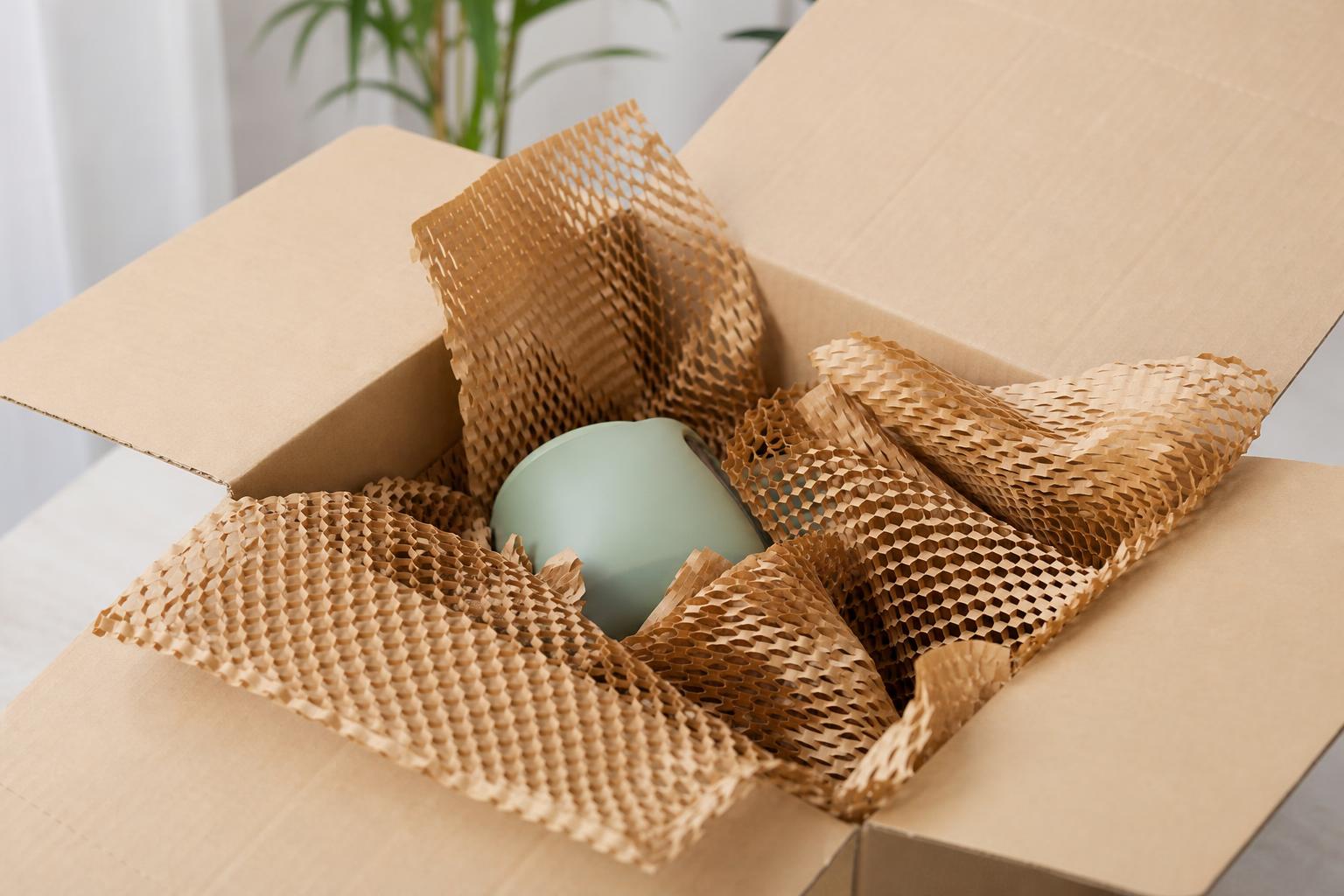
Honeycomb paper wrap is a die-cut kraft paper that pulls open into a honeycomb pattern, giving fragile goods a cushioned layer without plastic film. For ecommerce brands shipping glass, ceramics, cosmetics and small electronics, it is a practical paper bubble wrap alternative, but it only performs well when it is used the right way. This guide explains how the material works, where it falls short, and how to wrap fragile goods so they arrive intact. It also covers roll choice, honest sustainability claims and what to check before buying honeycomb wrap wholesale. Recycling rules and carrier standards differ between countries, so we flag where local checks matter.
In this article
- Key takeaways
- What honeycomb paper wrap is and how it works
- Honeycomb paper vs bubble wrap and other protective paper packaging
- The limits of honeycomb packaging paper
- How to wrap fragile items with honeycomb paper, step by step
- Wrapping specific fragile goods
- Choosing the right honeycomb paper roll
- Honeycomb paper as eco friendly void fill: what you can honestly claim
- Buying honeycomb wrap wholesale
- Conclusion
Key takeaways
- Honeycomb paper wrap cushions mainly by creating air gaps and resisting scuffs. It is best for light to medium fragile items, not heavy or sharp ones.
- Wrapping is only half the job. The item also needs a snug fit in a strong box, with no room to move and clearance from the walls.
- Use two or more layers on glass and ceramics, and add a second protective layer, such as a corrugated insert, for heavier pieces.
- Paper is a good fit for plastic-free packaging goals, but recycling acceptance varies by region, so word your claims carefully.
- Check roll width, paper weight and expanded thickness on the product page before ordering, and run your own drop tests on your actual products.
What honeycomb paper wrap is and how it works
Honeycomb packaging paper looks like a flat roll of kraft paper with rows of cuts in it. When you pull the sheet sideways, the cuts open into hexagonal cells, a bit like a honeycomb. The result is a light, springy, three-dimensional sheet you can wrap around products or use as a liner.
How the die-cut structure is made
The paper is passed through a die that cuts a repeating pattern of staggered slits. The paper is not removed, so the sheet stays in one piece. Because the slits are offset, stretching the sheet across its width opens the slits into cells. Wound back on a roll, the material is compact and cheap to store, and it only takes up volume once it is pulled out at the packing bench.
Why the honeycomb shape cushions
The cushioning comes from geometry, not from trapped air in sealed pockets like bubble wrap. The open cells make a bridge of paper fibres that bends and spreads a small impact over a wider area. They also keep the product’s surface slightly away from the box wall. That works well against the everyday knocks of parcel handling: vibration, light drops and surface rubbing. It is less effective against a hard, concentrated impact, because the paper has no sealed air to compress.
Wrap, liner or void fill: three roles
- Wrap: wound around an item to protect its surface and add a first layer of cushion.
- Liner: laid on the base of a box or around the sides to create a buffer.
- Void fill: scrunched or folded into gaps so the item cannot shift. Honeycomb paper is acceptable here, but it should not be the only thing holding a heavy product in place.
Honeycomb paper vs bubble wrap and other protective paper packaging
Buyers often compare honeycomb paper vs bubble wrap on price alone. A better question is what each material does well for your specific product and shipping route.
Side-by-side comparison
| Feature | Honeycomb paper wrap | Bubble wrap | Crumpled kraft paper |
|---|---|---|---|
| Cushioning type | Paper cells that flex and spread impact | Sealed air pockets that compress | Loose paper that fills gaps |
| Best use | Wrapping light to medium fragile goods; liners | Wrapping delicate or higher-value items; shock absorption | Void fill around already-protected items |
| Material | Paper only | Plastic film | Paper only |
| Moisture tolerance | Weak when wet | Good | Weak when wet |
| Storage before use | Compact on the roll | Rolls take more space | Compact on the roll |
| Impact performance | Moderate | Strong for its weight | Low on its own |
If you want to compare bubble options in more detail, our guide to bubble wrap sizes and types explains bubble diameter and film choices.
When honeycomb paper is the better choice
Honeycomb paper tends to win when you want a plastic-free pack-out, when the product’s surface needs protection from scratches, or when you ship to markets where customers react badly to plastic. It also suits brands that want a neat, consistent unboxing look. Bubble wrap tends to win for heavier fragile items, for products that may meet moisture in transit, and for items with high replacement cost where the extra shock absorption is worth it. Many brands use both: honeycomb for the lower-risk range and bubble for the most fragile SKUs.
The limits of honeycomb packaging paper
Honeycomb paper is a good material with real limits. Knowing them early prevents breakage and the cost of replacing and re-shipping goods.
Heavy items and point loads
Paper cells can flatten under a heavy product or a small, hard contact point such as the base of a bottle or the foot of a ceramic piece. Once flattened, the paper no longer offers much cushion. For heavy items, think of honeycomb paper as a surface layer, then add structural protection: a corrugated divider, a tight-fitting inner box, or a double-box method. Box strength matters as much as the wrap, which is why our guide to corrugated board grades and ECT is worth reading alongside this one.
Moisture and long storage
Paper absorbs water and loses stiffness when damp. Parcels that spend time in humid warehouses, on open pallets or in wet-weather delivery are at risk. If your items are moisture-sensitive, add a barrier: a poly bag around the item before wrapping, or a sealed inner pouch. Store rolls off the floor, away from external walls and in dry conditions.
Sharp edges, electronics and very delicate surfaces
Sharp corners can cut through the paper cells, so protect them with extra layers or corner guards. Honeycomb paper does not provide anti-static protection, so sensitive electronic components need purpose-made packaging. Very polished or soft-finish products may also pick up fibre marks or dust, so wrap them in a clean inner sleeve first.
How to wrap fragile items with honeycomb paper, step by step
Correct technique makes a big difference to how well honeycomb paper wrap performs. Follow the same routine every time so that every packer produces the same result.
Prepare the item and the box
- Choose a box that leaves roughly 5 cm (2 in) of space around the wrapped item for cushioning. Too tight means no buffer. Too loose means movement.
- Check the box is in good condition, with no crushed corners or weak seams, and is rated for the weight you are shipping.
- Put a layer of honeycomb paper in the base of the box as a cushion.
- If the item is moisture-sensitive or has a delicate finish, place it in a clean bag or sleeve first.
Wrap and secure
- Pull out enough paper to wrap the item at least twice. Keep the paper expanded; do not crush it flat.
- Place the item at one edge of the sheet and roll it so the paper covers every side, including the base and top.
- Fold the ends in like a parcel, so no part of the item is exposed.
- Secure the wrap with a few strips of paper-based or standard packing tape. Tape the paper to itself, not to the product.
- Wrap multiple items separately. Never let glass touch glass, even with a layer in between, if you can avoid it.
Pack the box and close it
- Place the wrapped item in the centre, away from the walls, on the base cushion.
- Fill the gaps at the sides and top with more honeycomb paper or crumpled kraft paper until the item cannot move when the box is gently shaken.
- Close the box and seal it with the H-taping method: one strip along the centre seam and one along each edge seam.
- Run a simple drop test from about 1 m (3 ft) on a few packed examples. Open the box and look for movement, flattening or breakage, then adjust your pack-out.
If damage still happens, our guide on what to do when a shipment arrives damaged covers evidence and next steps.
Wrapping specific fragile goods
Different products fail in different ways. Match the wrap to the failure mode.
Glassware and bottles
Glass usually breaks from impact on the rim, base or neck, or from two pieces hitting each other. Wrap each piece in two or three layers, paying extra attention to the rim and base. Stand stemmed or tall pieces upright with cushioning above and below, or lay them flat with firm support on both ends. For heavy bottles, add a corrugated divider or moulded insert so the paper is not the only barrier. Where bottles contain liquid, a sealed bag helps contain any leaks.
Ceramics and candles
Ceramics chip at the handles, spouts and lids. Wrap those parts first with a separate piece of paper, then wrap the whole item. Remove lids and wrap them separately. Candles in glass jars follow the glass rules, while wax candles mostly need protection from scuffing and heat, so a single honeycomb layer is often enough for the surface, with a firm box around it.
Cosmetics, jars and small electronics
Skincare jars and perfume boxes are light, so honeycomb paper is usually well suited. Wrap each jar once or twice and group them with dividers. Small electronics should go in their retail box or an anti-static bag first, then be wrapped in paper and boxed with a buffer on all sides. For accessories that ship in mailers rather than boxes, compare options in our guide to ecommerce mailer boxes versus shipping boxes and mailers.
Choosing the right honeycomb paper roll
Not all honeycomb packaging paper behaves the same. A few specifications decide whether a roll suits your operation.
Width, length and weight
- Roll width: pick a width that matches the items you wrap most. Wider rolls waste less time on large products but may be awkward for small ones.
- Roll length: longer rolls reduce changeovers at the packing bench, but they are heavier to lift and store.
- Paper weight: heavier paper has more stiffness and resists crushing better. Lighter paper is easier to wrap around small, delicate items.
- Expanded thickness: this tells you how much cushion you get once the sheet is pulled open.
Specifications such as these vary by product, so use the figures on the product page rather than assumptions. Sizing conventions also vary by country, so confirm whether the listing uses metric or imperial measurements.
Colour, recycled content and print
Natural brown kraft is the standard choice. It hides marks, looks consistent and is easy to handle. White or printed options may suit gift or premium products but can add cost and may complicate recycling claims if inks or coatings are involved. If recycled content matters to your brand, check what the product page states and do not claim more than it supports.
Honeycomb paper as eco friendly void fill: what you can honestly claim
Many buyers choose honeycomb paper because they want an eco friendly void fill. It can support that goal, but the claim needs care.
Recycling depends on where your customer lives
Plain kraft paper is accepted in kerbside paper recycling in many countries, but rules and collection systems vary widely, and some regions have little household recycling at all. Tape, labels and plastic bags attached to the paper can cause contamination. If your customers are spread across several markets, avoid saying the paper is recyclable everywhere. A safer line is that it is paper-based and can be recycled where local paper recycling accepts it.
Avoiding greenwashing
Be specific. Say “plastic-free cushioning” if the pack-out has no plastic, and then check that it really does. Mixing in bubble wrap, plastic tape or plastic bags changes that claim. Many countries have consumer-protection rules on environmental claims, and they differ, so check the requirements where you sell. Our overview of packaging rules a small business needs to know is a useful starting point. Also remember that the greenest packaging is the kind that prevents breakage, since a broken product and its replacement shipment carry a larger footprint than a few extra layers of paper.
Buying honeycomb wrap wholesale
Once you have confirmed the product suits your range, the next step is to plan the buy. Honeycomb wrap wholesale works best when you know your monthly use and storage space.
Minimums, payment and freight
At Pack Merchants, we sell in bulk only. Every product has its own minimum order quantity worth at least $500, which is set on the product page. Prices are in US dollars, and published volume pricing applies. Payment is made in advance by bank transfer or USDT, a US-dollar stablecoin. We do not offer credit terms. Freight is quoted separately for each order, so your delivered cost depends on destination and volume. Our explainer on what a $500 minimum order actually means shows how to plan around it.
What to ask before you order
- What are the roll width, length and paper weight, and how do they match your product sizes?
- How many rolls fit on a pallet, and what space do you have to store them dry?
- Do you need other items in the same shipment, such as corrugated boxes, tape, labels or mailers, so freight is shared?
- How many packers will use the paper, and how many parcels do you ship per month?
We do not offer samples, so decide using the product page specifications, your own product weights and your pack-out tests. If you have questions about a specification, ask through a quote request.
Conclusion
Honeycomb paper wrap is a light, plastic-free way to cushion and protect fragile goods, as long as it is matched to the right products. It works through a structure of flexible paper cells, performs best on light to medium items, and needs a strong, well-sized box and enough layers to do its job. Its limits are weight, moisture and sharp edges, and recycling claims depend on local systems. To see specifications and minimums for our protective packaging, visit the honeycomb paper wrap product page, or send a request on our quote request page for freight and volume pricing.
Frequently asked questions
What is honeycomb paper wrap used for?
It is used to wrap and cushion fragile products such as glassware, ceramics, cosmetics and small electronics during shipping. It can also line boxes or fill small gaps so items do not move. It is best suited to light to medium products.
Is honeycomb paper as protective as bubble wrap?
Not in every situation. Honeycomb paper protects well against scuffs, vibration and light knocks, but bubble wrap generally absorbs sharper impacts better and tolerates moisture. For heavy or high-value fragile items, bubble wrap or an added structural insert is often the safer choice.
How many layers of honeycomb paper should I use?
Two layers is a sensible minimum for glass and ceramics, with extra layers around rims, bases, handles and corners. Then check that the item cannot move in the box. Test a few packed parcels with a drop test to confirm your layer count.
Is honeycomb paper recyclable?
Plain kraft honeycomb paper is accepted by paper recycling in many places, but rules vary by country and local council. Tape, plastic bags and coatings can cause contamination. Check local guidance before making a recyclability claim to customers.
Can honeycomb paper be used as void fill?
Yes, it can be folded or scrunched into gaps to stop items shifting. It should not be the only support for heavy products, because the cells can flatten under load. Use a correctly sized box so you need less void fill.
Does honeycomb paper work in wet or humid conditions?
Not well. Paper loses stiffness when damp, so moisture-sensitive goods should go in a sealed bag or pouch before wrapping. Store rolls in a dry place off the floor.
What is the minimum order for honeycomb paper wrap at Pack Merchants?
Every product has its own minimum order quantity, worth at least $500, which is shown on the product page. We sell in bulk only, prices are in US dollars and freight is quoted separately. Payment is in advance by bank transfer or USDT.
Still not sure?
Tell us what you ship and roughly how much of it, and we will recommend a specification and price it.