Packaging guide
How to Wrap a Pallet with Stretch Film: Layers, Anchoring and Mistakes (2026)
Learn how to wrap a pallet with stretch film: anchoring, layer counts, tension and common mistakes, with a step-by-step method you can test.
Updated Nov 7, 2026
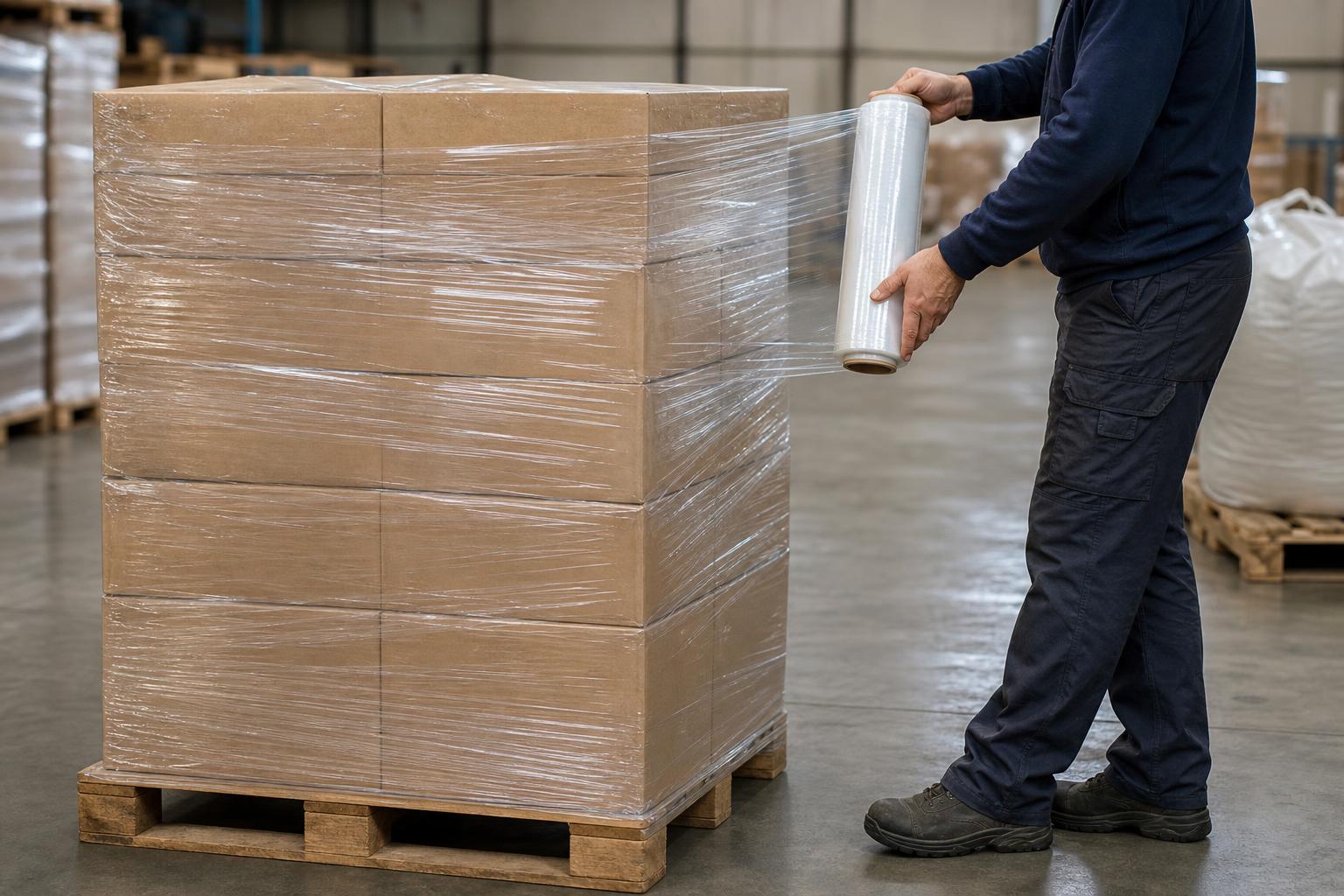
Knowing how to wrap a pallet with stretch film is often the difference between a load that arrives intact and one that shifts, tears or collapses at the first sharp turn. Much of the damage blamed on carriers starts in the warehouse: a weak anchor, too few turns at the base, or film applied so loosely that it does nothing. This guide gives you a repeatable method that any packer can learn in one shift. You will see how to prepare the load, anchor the film, choose layer counts by load weight, finish the top and test the result. The advice works for hand wrapping and machine wrapping, and we give metric and imperial units because shipping teams around the world use both.
In this article
- Key takeaways
- What you need before you wrap a pallet
- Prepare the load for better pallet load stability
- How to wrap a pallet with stretch film: the step-by-step method
- How many layers of stretch film does a pallet need?
- Anchoring and tension: what decides whether a wrap holds
- Common pallet wrapping mistakes and how to fix them
- How to test a wrapped pallet before it ships
- Hand wrapping vs machine wrapping and film usage
- Buying stretch film in bulk for consistent results
- Conclusion
Key takeaways
- Anchor the film before you wrap. A film tail that is not tied to the pallet or the load will slip and unwind.
- Put the most film at the base and the top. The bottom holds the load to the pallet, and the top stops the upper boxes sliding off.
- Use consistent tension and about 50% overlap. Even, snug film beats a thick but loose wrap.
- Layer counts are starting points. Heavier, taller or less stable loads need more, and you should always test the result.
- Prepare the load first. No film can fix an unstable stack, overhanging boxes or a damaged pallet.
What you need before you wrap a pallet
A good wrap starts with the right materials and a clear workspace. Skipping this stage is why two packers using the same roll get very different results.
Choose the right film
Hand stretch film is usually sold on 3 in (76 mm) cores in rolls about 20 in (500 mm) wide. Thickness is quoted in gauge or microns. As a rough guide, 80 gauge is 0.8 mil, or about 20 microns, and 100 gauge is 1 mil, or about 25 microns. Heavier loads and rougher cartons generally call for thicker or higher-performance film, while light, uniform cartons can often be held with thinner film. Our guide to bulk stretch film for pallets and gauge usage goes deeper on this choice.
Set up tools and workspace
You will need the film roll, a handle or dispenser if you wrap by hand, a cutter or a way to tear the film cleanly, and enough clear floor to walk fully around the pallet. If you use corner boards, edge protectors or a top sheet, place them within reach. Make sure the pallet sits on flat ground and, if possible, on a turntable or at a height that lets you wrap the base without bending too far.
Safety basics
Wear gloves if the film edge cuts your hands, and keep walkways clear of loose film tails. Do not climb on a loaded pallet to reach the top. Use a step platform or a stretch-wrap handle with a pole for tall loads. Lifting a heavy roll repeatedly also strains the back, so keep spare rolls near the wrapping station.
Prepare the load for better pallet load stability
Stretch film holds a stable load together. It does not make an unstable load stable. Spend a minute on the stack before the film comes out.
Build a stable stack
Where carton sizes allow, use an interlocking pattern so that each layer overlaps the one below, much like brickwork. Column stacking, where boxes sit directly on top of each other, is stronger for crush loads but less stable sideways, so it relies more heavily on the wrap. Keep the heaviest cartons at the bottom and the lightest on top, and avoid leaving gaps in the middle of a layer.
Keep the load inside the pallet footprint
Boxes that overhang the pallet edge lose much of their stacking strength and snag in racking and on trucks. Keep the load flush with the pallet edges, or slightly inside them. Check that the pallet itself is sound: broken boards, protruding nails and splinters can cut the film at the base. Standard pallets vary by region, for example 1,200 x 800 mm in much of Europe and 48 x 40 in in North America, so confirm your carrier or warehouse limits for size and height.
Add corner protection and a top sheet
Corner boards protect box edges from film pressure and spread the force of tight wrapping. A top sheet of cardboard or plastic gives the top layer a flat surface and helps keep the film from cutting into soft cartons. If you ship in wholesale corrugated shipping boxes, consistent box sizes make this stage quicker and the stack more predictable.
How to wrap a pallet with stretch film: the step-by-step method
This sequence works for hand wrapping and, with small changes, for turntable and rotary-arm machines. Treat it as a standard operating procedure and adjust the layer counts using the table in the next section.
Steps 1 to 3: anchor and wrap the base
- Anchor the film. Pull a short length of film from the roll, thread it through a gap between the pallet boards or around a bottom corner, then tie it off or pinch it under the first wrap. You can also tie a knot in the film itself. The anchor must be firm enough that a gentle tug does not pull it free.
- Wrap the base three to four times. Keep the film low, covering the top edge of the pallet and the bottom of the load together. This locks the cartons to the pallet. Walk steadily around the load and keep the film at the same height.
- Add a rope-wrap if needed. For heavier loads or slippery cartons, twist the film into a rope-like strand and run it once or twice around the base. A rope concentrates force in a narrow band and grips the pallet edge strongly.
Steps 4 and 5: spiral up and reinforce
- Spiral upward with about 50% overlap. Move the film up the load at a steady pace so each turn covers half of the one below. Keep the roll at a consistent angle, and keep the film tight against the load, not hanging away from it.
- Reinforce the middle and weak points. If the load is tall or has a mix of carton sizes, add an extra turn or two at the junction of layers or at the load's midpoint. Pay attention to corners, where film can slip or cut.
Steps 6 and 7: cover the top and finish
- Wrap the top edge two to three times. Bring the film just over the top layer so it overlaps the top carton edge. If you use a top sheet, make sure the film covers its edge. Then spiral back down, with fewer turns, so the film is anchored at both ends of the load.
- Finish cleanly. Cut or tear the film, then press the tail flat against the wrapped load or tuck it under a previous layer. Smooth it down with your hand so it cannot catch on a forklift, rack or another pallet.
How many layers of stretch film does a pallet need?
People often ask how many layers of stretch wrap per pallet is "correct". There is no single answer, because load weight, height, carton type and transport conditions all matter. What you can do is set a sensible starting point and then test it.
Wraps, overlap and layers explained
A "wrap" is one full turn around the pallet. A "layer" is the thickness of film at any single point on the load. With 50% overlap, every spiral pass puts roughly two thicknesses of film over most of the load. Going up and down the load again doubles that. So a pallet that looks lightly wrapped may already have four or more layers in the middle, while the base and top, where you add concentrated turns, may carry far more.
Starting points by load type
The figures below are typical starting points for hand wrapping with standard-quality film. They are not guarantees. Machine-applied pre-stretched film can often achieve the same hold with less material, and some loads need more. Confirm any figures with your own testing and your carrier's requirements.
| Load type | Base wraps | Spiral passes (50% overlap) | Top wraps | Notes |
|---|---|---|---|---|
| Light, uniform cartons, under 500 kg (1,100 lb) | 3 | 1 up, optional return | 2 | Interlocking pattern and a top sheet help |
| Medium load, 500 to 1,000 kg (1,100 to 2,200 lb) | 3 to 4 | 1 up and 1 down | 2 to 3 | Add a rope-wrap at the base if cartons slide |
| Heavy or tall load, over 1,000 kg (2,200 lb) | 4 to 5 | 2 up and down passes | 3 | Consider corner boards and a top sheet |
| Mixed or irregular load | 4 | 2 passes with extra turns at weak points | 3 | Wrap in smaller units first where possible |
| Export or long-distance load | 4 to 5 | 2 or more passes | 3 | Check the carrier and destination rules |
If you use a lot of film, our guide to wholesale stretch film and pallet wrap in 80 gauge rolls covers export pallet wrapping in more detail.
Anchoring and tension: what decides whether a wrap holds
If you remember only two things from this guide, make them anchoring and tension. They are the most common causes of failure, and they cost nothing to fix.
Anchoring options
The film should be fixed to something solid at the start. The three common options are tying a knot around the pallet, threading the film through a board gap, and pinching the tail under the first wrap on a corner. On a turntable, many operators clamp the film to the pallet or load before the platform turns. Whatever you use, the aim is the same: the film must pull against something, not slide along the load.
Getting tension right
Hand film should be stretched enough to grip the load without tearing or thinning to a narrow band. If the film "necks down" to a thin strip, you are pulling too hard. If it hangs in loose folds, it is too soft and will relax. A good test is to press a finger into the finished wrap: it should feel firm, with only slight give. Soft, cushion-like cartons, such as bags or pillows, need gentler tension so you do not crush them.
Overlap and film angle
Use roughly 50% overlap on spiral passes, which is about half the width of the film. Keep the film web flat against the load rather than twisted or rolled, except where you deliberately make a rope. Hold the roll so the film leaves it at a steady angle. This keeps the layer thickness even, and it stops gaps where cartons can slip out.
Common pallet wrapping mistakes and how to fix them
Most failed pallets show the same few faults. Teach these to every new packer, and check for them during spot audits.
Mistakes at the base
- No anchor. The film slips and unwinds. Always tie off or pinch the start.
- Wrapping only the load, not the pallet. The cartons can slide off the pallet. Include the pallet's top edge in the first turns.
- Too few base turns. Three to four is a sensible minimum for most loads.
Mistakes with tension and overlap
- Loose wrap. It looks full but gives no containment. Increase tension steadily.
- Over-stretching. The film thins, tears or snaps in transit. Slow down and let the film do the work.
- Uneven overlap. Gaps appear and layers pile up in other places. Keep a steady pace and angle.
- Using too thin a film for the load. More turns do not always compensate. Review gauge as well as layer count.
Mistakes at the top and finish
- Leaving the top uncovered. Top cartons can shift or fall. Wrap over the top edge two to three times.
- Loose tails. They catch on forklifts and unwind. Press and tuck them in.
- Wrapping too tightly over soft cartons. The load deforms and the film later loosens. Use corner boards or reduce tension.
- Hiding labels. Leave shipping labels visible or put them on the outside of the film, using suitable packing tape and labels if needed.
How to test a wrapped pallet before it ships
A wrap that looks tidy can still fail. Build a short check into your process so problems show up on the warehouse floor, not at the customer's dock.
Simple checks on the warehouse floor
- Push test. Push firmly against the side of the load at mid-height. It should not shift or the film should not visibly creep.
- Lift test. Lift the pallet a short distance with a forklift or pallet jack and check that nothing slides or leans.
- Brake test. Move the pallet and stop sharply at a safe speed. If the top layer moves, add top wraps or a top sheet.
- Visual check. Look for gaps, loose tails, torn film and cartons pushing through the wrap.
Standards and carrier requirements
Carriers and countries differ in what they require. Some road transport in Europe follows the EUMOS 40509 load stability method, and many parcel and freight networks follow ISTA test procedures. Others publish their own pallet rules for maximum height, overhang and wrapping. Because these requirements vary by region and carrier, check them for your route before you finalise your wrapping standard, and write down the standard you adopt so your whole team follows the same one.
Hand wrapping vs machine wrapping and film usage
The right method depends on how many pallets you ship each day and how consistent you need the result to be.
When hand wrapping makes sense
Hand wrapping suits low and moderate volumes, mixed loads and sites without space for a machine. It is flexible, as the packer can adapt to odd shapes. The drawback is variation: tension and overlap depend on the person, so training and a written procedure matter.
What machines and pre-stretch change
Turntable and rotary-arm machines apply film at a consistent speed and tension. Pre-stretch systems stretch the film before it touches the load, often by a large percentage, which can reduce the amount of film used per pallet. Machine film is a different product from hand film, so match the film to the machine and follow the manufacturer's guidance.
Tracking film use per pallet
To control cost, weigh a wrapped pallet's film or measure how much of a roll one pallet uses, then compare packers or shifts. If one operator uses far more film than another with the same result, there is something to learn. Consistent use also makes reordering easier. Our guide to turning a $500 per-product minimum into a quantity plan shows how to translate usage into order sizes.
Buying stretch film in bulk for consistent results
Once your method is set, consistency in your materials matters as much as consistency in your technique. Switching film mid-month changes stretch, cling and strength, so packers have to relearn tension. Buying in bulk lets you standardise on one gauge and roll size and keep enough stock to avoid running out mid-shift.
Pack Merchants is a wholesale supplier of packaging and shipping supplies sold in bulk only, with a $500 minimum per product and published volume pricing. Alongside stretch film, we supply packing tape, labels, trash bags and corrugated shipping boxes, so you can source the full pallet-building kit from one place. Custom packaging and freight are quoted per order, and availability and delivery depend on your destination.
Before ordering, work out your weekly pallet count, the film used per pallet and the storage space for rolls. That gives you a realistic order size, and it makes it easier to choose between gauges.
Conclusion
A secure pallet comes from a clear sequence: prepare the load, anchor the film, wrap the base, spiral up with steady tension and overlap, cover the top and finish the tail. Layer counts should rise with weight, height and journey length, and you should confirm them with simple tests and the rules of your carrier. Write down your standard, train everyone on it, and keep the same film in use so the result is repeatable on every pallet.
Frequently asked questions
How many times should you wrap a pallet with stretch film?
A common starting point is three to four turns at the base, a spiral pass up the load with about 50% overlap, and two to three turns at the top. Heavier, taller or mixed loads need more. Test the wrapped pallet and follow your carrier's rules.
How do you start stretch wrap on a pallet?
Anchor the film before you wrap. Tie it to a pallet board or corner, thread it through a gap between boards, or pinch the tail under the first wrap. A firm anchor stops the film slipping as you walk around the load.
How tight should stretch film be on a pallet?
It should be snug enough that the film grips the cartons and only gives slightly when you press it with a finger. If the film necks down to a thin strip or tears, you are pulling too hard. If it hangs in folds, it is too loose.
Should you wrap the pallet itself or just the load?
Wrap both at the base. The first turns should cover the top edge of the pallet and the bottom of the load together, which locks the cartons to the pallet and stops them sliding off during transport.
How much overlap should I use when wrapping a pallet?
Around 50% overlap, meaning each turn covers about half of the one below, is a common standard for spiral passes. It gives an even film thickness without wasting material.
Is hand wrapping or machine wrapping better?
Hand wrapping suits low volumes and mixed loads, while machines give more consistent tension and can use pre-stretched film to reduce film use. The better option depends on your daily pallet count, space and budget.
What thickness of stretch film should I use for pallets?
It depends on load weight, carton type and journey. As a reference, 80 gauge is about 20 microns and 100 gauge is about 25 microns. Heavier or rougher loads generally need thicker or higher-performance film, and testing will confirm the right choice.
Do pallet wrapping rules differ between countries?
Yes. Pallet sizes, maximum heights and load-securing requirements vary by country, carrier and transport mode. Check the rules for your route, and consider recognised test methods such as ISTA or, in some European road transport, EUMOS 40509.
Still not sure?
Tell us what you ship and roughly how much of it, and we will recommend a specification and price it.