Packaging guide
Bulk Stretch Film for Pallets: Gauge Guide and Usage per Pallet (2026)
Buy bulk stretch film for pallets with confidence: gauge chart, micron conversions and film usage per pallet to size your wholesale order.
Updated Nov 6, 2026
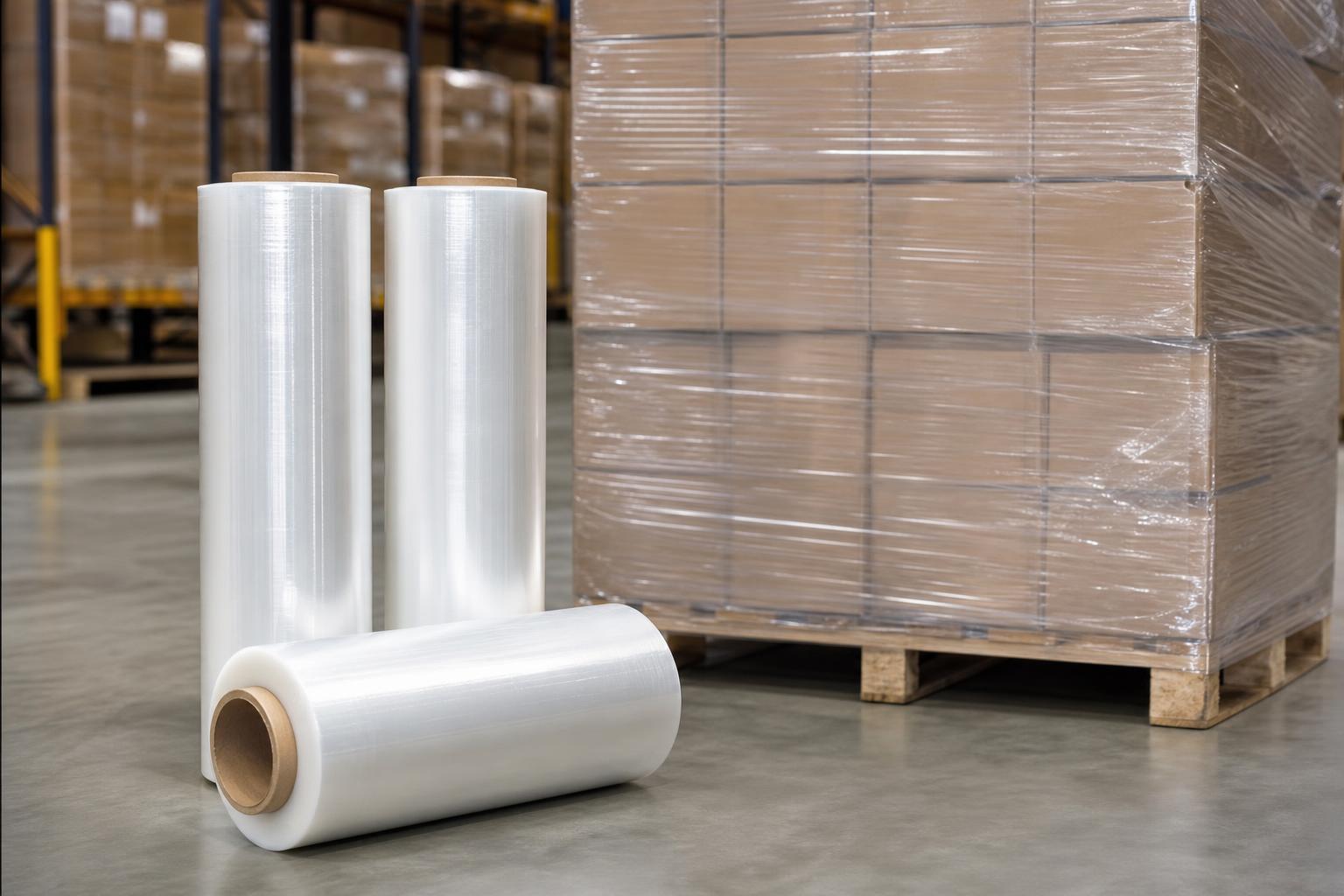
Buying bulk stretch film for pallets sounds simple until the first delivery arrives and the film is too thin for your heavy loads, too wide for your machine, or enough for three weeks instead of three months. Gauge, roll width, hand or machine format and wrapping technique all change how much film you use per pallet and what you end up spending. This guide explains stretch film gauge in mil and micron, shows which gauge suits which load, and gives usage estimates per pallet so you can turn your weekly pallet count into a realistic order. It is written for ecommerce businesses, retailers and growing brands that buy in volume, in any country.
In this article
- Key takeaways
- What to know before you buy bulk stretch film for pallets
- Stretch film gauge explained: gauge, mil and micron
- Which stretch film gauge suits your pallet loads
- How much stretch film per pallet: usage estimates
- How to wrap a pallet so the load stays stable
- Hand vs machine stretch film: which should you buy?
- Planning a wholesale stretch wrap order
- Storing and checking pallet wrap rolls
- Conclusion
Key takeaways
- Gauge is thickness: 80 gauge equals 0.8 mil, or about 20 microns. It is the usual starting point for hand-wrapped pallets of cartons.
- Film weight, not roll count, is the fairest way to compare rolls and to forecast usage. A simple formula is given below.
- Hand wrapping commonly uses roughly 150-300 g (0.33-0.66 lb) of film per pallet; well-set machines with pre-stretch often use much less. Treat these as planning ranges and weigh your own.
- Technique matters as much as gauge. Anchoring the film, overlapping layers and locking the load to the pallet base cut both film use and load damage.
- Choose one or two gauges and widths you can standardise on, then size the order against the $500-per-product minimum and your storage space.
What to know before you buy bulk stretch film for pallets
Stretch film is a polyethylene film, usually LLDPE, that is stretched as it is applied and then pulls back to grip the load. Before you compare prices, settle three questions: how the film is made, how it will be applied and what size roll fits your process.
Cast film vs blown film
Cast film is quiet, clear and unrolls smoothly, which makes it popular for machines and for scanning barcodes through the wrap. Blown film is generally tougher, grips itself harder and resists punctures better, which is useful for sharp corners and irregular loads. Many warehouses use cast film for standard cartons and keep a small amount of heavier blown film for awkward pallets. Suppliers describe these types differently from country to country, so ask what the film is and what its gauge is rather than relying on a brand name.
Hand rolls vs machine rolls
Hand rolls are lighter, usually come in a case of several rolls and often have a handle or a small core. Machine rolls are longer and heavier, sit on a turntable or rotary-arm wrapper and need a core size that fits the machine. Decide this first because it limits every other choice. The comparison is covered in more detail in the hand vs machine section below.
Width, core and roll length
Common hand widths are 15 in or 18 in (about 380 mm or 450 mm) in North America and 450 mm or 500 mm in many other regions. Machine film is often 20 in (500 mm) wide, with 30 in (750 mm) used on some equipment. Always check the exact width, core diameter and length before ordering, because a roll that is 30 mm too wide for your machine can be unusable. Our guide to wholesale stretch film and pallet wrap in 80 gauge covers rolls and export wrapping in more depth.
Stretch film gauge explained: gauge, mil and micron
Gauge is the most-quoted number on a stretch film spec sheet, and it is also the most misunderstood. Different regions use different units, so a converted comparison avoids buying the wrong film.
How the units convert
One mil is one thousandth of an inch (0.001 in), or 25.4 microns. One gauge is one hundredth of a mil. So 80 gauge is 0.8 mil, which is about 20 microns (20.3 µm exactly). Europe, Australia and many other markets quote microns; the United States and Canada often quote gauge or mil. The table below gives common values.
| Gauge | Mil | Micron (approx.) | Typical role |
|---|---|---|---|
| 60 | 0.60 | 15 | Light loads, often machine or pre-stretched film |
| 70 | 0.70 | 18 | Light to medium hand wrapping |
| 80 | 0.80 | 20 | General-purpose hand film for cartons |
| 90 | 0.90 | 23 | Heavier or less stable loads |
| 100 | 1.00 | 25 | Heavy, sharp-cornered or irregular loads |
| 120 | 1.20 | 30 | Very demanding hand wrapping |
Why thicker is not always stronger
Two films of the same gauge can perform very differently. Resin quality, the number of layers, cling additives and how much the film can be stretched all change load holding force and puncture resistance. A well-made 70 gauge film may outperform a poor 80 gauge one. Gauge is a useful starting point, but it is not a performance guarantee, so ask for the stated stretch capacity and the film type as well. Also remember that stretching thins the film while it is applied; a film stretched by 100% is roughly half as thick on the load as it was on the roll.
Which stretch film gauge suits your pallet loads
There is no single correct gauge, because load weight, shape, handling and the journey all matter. The table gives sensible starting points for hand-applied film. Adjust after you test on real pallets, and check any carrier, port or customer requirements for export loads.
| Load type | Starting gauge (hand) | Notes |
|---|---|---|
| Light, stable cartons, short internal moves | 60-70 (15-18 µm) | Low cost, but needs careful technique |
| Mixed ecommerce cartons, standard distribution | 80 (20 µm) | The most common general-purpose choice |
| Heavy cartons, long-haul or multi-handling | 90-100 (23-25 µm) | More holding force and tear resistance |
| Sharp corners, bagged goods, uneven shapes | 100+ (25 µm+) | Consider corner boards or blown film |
Light and stable loads
Pallets with uniform, interlocked cartons and a short journey, such as moving stock between two rooms in the same building, rarely need heavy film. A thinner gauge can work well here, as long as the wrapper applies enough overlap and the pallet is built squarely.
Standard cartons and boxed goods
For typical ecommerce stock, 80 gauge is the sensible default. It is thick enough to tolerate normal handling and thin enough to stay economical. If you are building pallets of your own shipping cartons, the planning ideas in our bulk shipping boxes guide on pallet counts, storage and reorder points pair well with a film plan.
Heavy, sharp or irregular loads
Items such as bagged product, cased drinks, tools or anything with hard corners put stress on the film. Move up a gauge, add corner protection, and use more wraps at the base rather than relying on thickness alone. If a pallet is regularly tearing the film at the same point, fix the corner or edge before spending more on film.
How much stretch film per pallet: usage estimates
Usage depends on pallet height, wrapper technique, whether film is pre-stretched and how many layers are applied. Published figures vary widely, so the most reliable method is to calculate by weight and then check against your own wrapped pallets.
Working out the weight of a roll
Use this formula for the net weight of film in a roll: width in metres × length in metres × thickness in microns × 0.92 = grams, where 0.92 is the approximate density of polyethylene. For a popular hand roll of 18 in (457 mm) by 1,500 ft (457 m) in 80 gauge (20.3 µm), that gives roughly 3.9 kg (8.6 lb) of film, before the weight of the core. Weight stays the same when film is stretched, which is why it is the fair way to compare rolls and quotes.
Pallets per roll at different usage rates
The figures below assume the 3.9 kg roll above. They are planning estimates, not guarantees.
| Film used per pallet | Typical scenario | Pallets per roll (approx.) | Rolls for 500 pallets |
|---|---|---|---|
| 300 g (0.66 lb) | Generous hand wrapping, heavy or tall load | 13 | About 38 |
| 200 g (0.44 lb) | Typical careful hand wrapping | 19 | About 26 |
| 150 g (0.33 lb) | Disciplined hand wrapping or basic machine | 26 | About 19 |
| 100 g (0.22 lb) | Machine with high pre-stretch | 39 | About 13 |
Measuring your own usage
- Weigh a new roll and note the gauge, width and length.
- Wrap 10 typical pallets using your normal method.
- Weigh the roll again and divide the difference by 10 to get grams per pallet.
- Repeat for your tallest or heaviest pallet type, because it often uses double the average.
Add a buffer of around 10-15% for waste, damaged rolls and busy periods. Repeat the test whenever you change gauge, supplier or wrapper, since a small change in technique can move usage far more than a small change in price.
How to wrap a pallet so the load stays stable
The best film in the world will fail on a badly built pallet. Stable stacking comes first: keep cartons within the pallet edges, interlock layers where possible, and keep the top flat. Then wrap with a repeatable pattern.
Step-by-step pallet wrapping
- Anchor the film by tying it to a pallet corner or board, or pinching it through the first layer.
- Make three or four turns at the base, covering the lower edge of the load and the pallet itself so the load cannot slide off.
- Spiral upward with roughly a 50% overlap, keeping steady tension so the film stays tight but not so tight that it crushes cartons.
- Add extra turns around the top layer, partly covering the top edge to hold it down.
- Spiral back down to the base for a final turn and tuck or press the tail flat so it does not catch.
Mistakes that waste film
Common errors include wrapping with no tension, using too many turns in the middle where the load is already stable, ropes of film (twisting it into a band) that leave gaps, and skipping the pallet base. Another costly habit is cutting a new section when a roll is almost empty, which leaves film on the core. Training one person to wrap well and showing the others usually saves more than switching brands.
Wrapping pallets for export
Export loads face more handling, vibration and moisture. Many shippers use a heavier gauge, extra base wraps, corner boards and a top sheet. Requirements differ between carriers, ports and destination countries, so confirm them with your freight forwarder before you finalise the film spec. For metal products that also need corrosion protection, see our overview of VCI film for export and industrial packaging.
Hand vs machine stretch film: which should you buy?
The right format depends on volume, labour cost and consistency. There is no benefit in buying machine film if you do not own a machine, and no benefit in hand-wrapping hundreds of pallets a day if a machine would pay for itself.
When hand film makes sense
Hand wrapping suits low to moderate volume, mixed pallet sizes and sites without space for equipment. It is flexible and needs no capital outlay. The downside is variability: usage per pallet can differ widely between operators, and fatigue leads to loose wraps. Choose 80 gauge as a baseline and move up if loads are heavy.
When machine film pays back
If you wrap many pallets a day, a turntable or rotary-arm wrapper gives consistent tension and overlap, and can apply pre-stretch to use less film per pallet. Machine film is typically cast, wider and wound on larger rolls, so it needs fewer roll changes. Check the core size and maximum roll weight of your machine before ordering.
What pre-stretched film changes
Pre-stretched film has been stretched at the factory, so it is thinner and lighter and can be applied by hand with less effort. It can reduce film weight per pallet, but it has less stretch left, so the load-holding result depends on correct technique. Compare it by film weight per pallet rather than by gauge alone.
| Factor | Hand film | Machine film |
|---|---|---|
| Best for | Low to moderate volume | High, steady volume |
| Upfront cost | None beyond film | Wrapper purchase and space |
| Consistency | Depends on operator | High |
| Film per pallet | Usually higher | Usually lower with pre-stretch |
Planning a wholesale stretch wrap order
Once you know the gauge, width and grams per pallet, the order itself is arithmetic. The aim is to buy enough to avoid running out without tying up cash and floor space in film you will not use for months.
Turn pallets per month into rolls
Multiply pallets wrapped per month by grams per pallet, divide by the net weight of one roll, and add a 10-15% buffer. For example, 800 pallets at 200 g is 160 kg; with 3.9 kg rolls that is about 41 rolls, or about 47 with the buffer. Then decide how many months of supply you want on the shelf, based on storage space and how steady your volume is. Our guide to turning the $500 per-product minimum into a quantity plan shows how to check that your film order clears the minimum sensibly.
Minimum order and payment
Pack Merchants sells packaging and shipping supplies, including stretch film, in bulk only, with a $500 minimum per product and published volume pricing. Freight is quoted per order, so share your delivery location and quantity when you ask. Payment is by bank transfer or USDT. USDT is the only cryptocurrency we accept, and we do not offer credit or Net terms, so build the payment into your purchasing cycle.
Order the rest of the pallet kit together
Film is only one part of dispatch. Cartons, tape and labels run out on the same schedule, and combining them cuts the number of orders and freight quotes you manage. Review your tape usage with the wholesale packing tape buying guide so the whole outbound line is planned at once.
Storing and checking pallet wrap rolls
Stretch film is durable, but poor storage and rough handling can cost you usable film. A few simple habits protect what you buy in bulk.
Storage conditions
Keep rolls in their cases or wrapped, off the floor, in a clean, dry area away from direct sunlight, heaters and sharp objects. Extreme heat or cold can change how film unwinds and clings, and dust on the surface reduces cling. Stack according to the case strength, and use older stock first so no roll sits for years. Cores stored on their side can flatten, so keep rolls upright unless they are packed otherwise.
Checks when a delivery arrives
- Match the label to your order: gauge or micron, width, length, film type and core size.
- Look for crushed cores, dented edges or telescoped rolls where the film has slid sideways.
- Weigh one roll and compare it with the expected net weight to confirm you received the specification you ordered.
- Wrap a pallet and compare grams per pallet with your earlier test, so the first real figures are on record.
Report any discrepancy promptly and keep photos of the labels and packaging. Recording the results also makes your next quantity plan far more accurate than relying on estimates.
Conclusion
Choosing bulk stretch film for pallets comes down to a few decisions: the gauge that suits your loads, the width and core that fit your process, and an honest figure for how many grams you use per pallet. Convert gauge to mil and micron to compare quotes fairly, calculate roll weight, and test on your own pallets before forecasting. Good wrapping technique and a stable pallet build then keep both film use and damage low. With those numbers in hand, a bulk order becomes a simple calculation rather than a guess.
Still not sure?
Tell us what you ship and roughly how much of it, and we will recommend a specification and price it.